
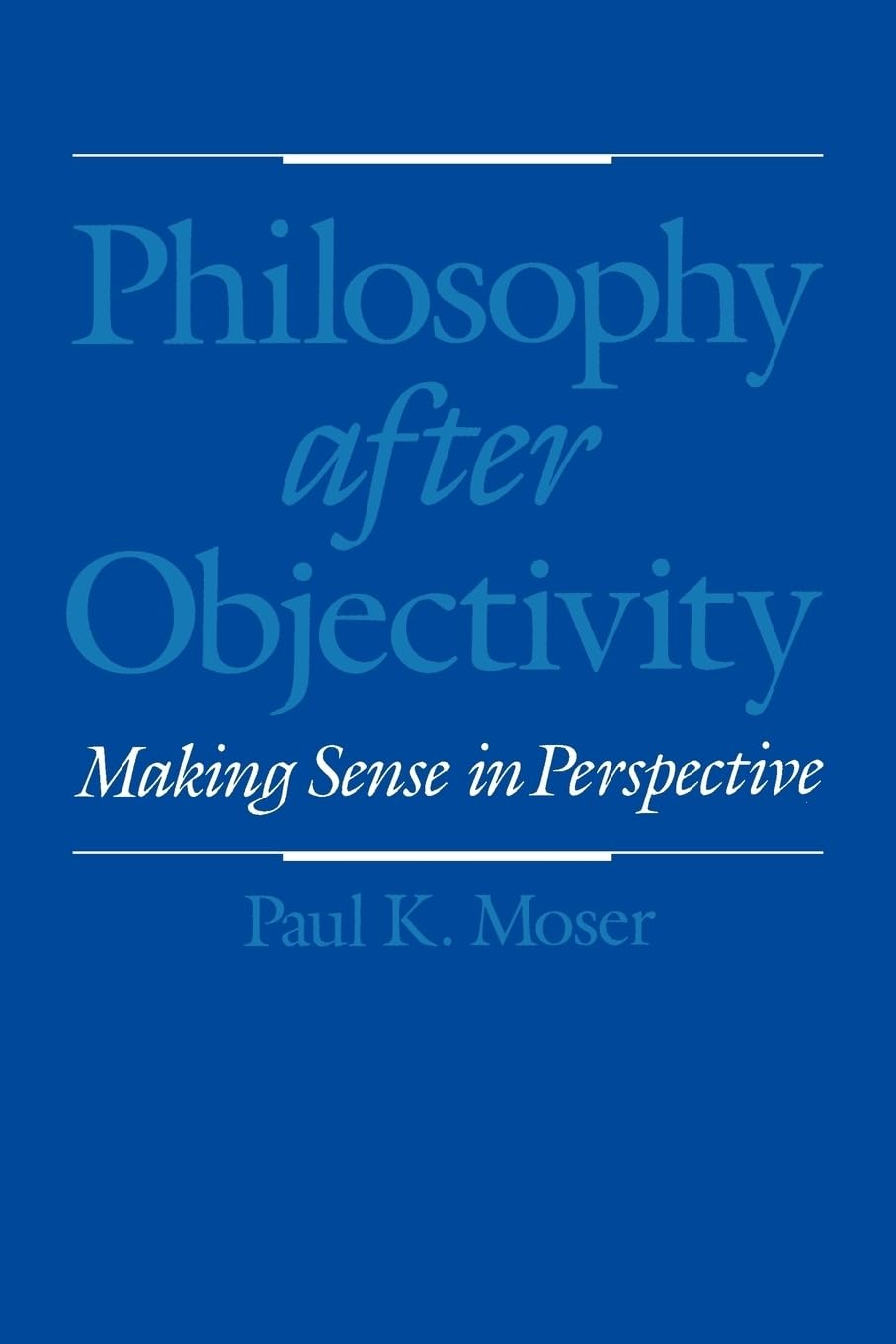
Philosophy after Objectivity: Making Sense in Perspective by Paul K. Moser – A Groundwork for Understanding Skepticism a
Inclusive of all applicable taxes. FREE shipping on all orders.
Available Offers
- 🚚Free Delivery — Free shipping on all orders
- 💵Cash on Delivery — Pay when your order arrives
- ↩️15-Day Easy Returns — Hassle-free return policy
- 🔒Cash on Delivery — Pay safely when your order arrives
Check Delivery
Product Description
Introduction
In the landscape of contemporary philosophy, few works challenge the very foundations of objective knowledge as incisively as Paul K. Moser's Philosophy after Objectivity: Making Sense in Perspective. Published by the prestigious Oxford University Press, this hardcover volume invites Indian readers and students to rethink the traditional quest for certainty. Moser draws on decades of epistemological debate to argue that the demand for objective truth, free from all perspective, may be an unattainable ideal. Instead, he offers a compelling case for understanding philosophical reasoning as inherently perspectival—yet still rigorous and meaningful. For anyone grappling with questions about truth, skepticism, and the limits of human understanding, this book is an indispensable companion.
Book Overview
Philosophy after Objectivity is a carefully argued work that reexamines the nature of philosophical inquiry. Moser begins by acknowledging the classical philosophical goal: to attain knowledge that stands independent of any particular viewpoint. He then systematically unpacks the challenges posed by skeptics who demand non-question-begging justifications for claims to objective truth. Through a series of lucid arguments, Moser shows that such demands cannot be fully met, and that philosophers must therefore shift their focus. Rather than seeking unassailable foundations, he advocates for a perspective-based approach to reasoning—one that acknowledges our situatedness while still aiming for coherence, explanatory power, and practical relevance. This book is not a rejection of objectivity, but a sophisticated reimagining of what it means to make sense of the world from within our limited perspectives.
Key Highlights
- Original Argument: Moser provides a fresh critique of the traditional quest for objective knowledge, offering an alternative rooted in perspectival reasoning.
- Engagement with Skepticism: The book directly addresses skeptical challenges, showing why they cannot be dismissed but can be navigated through pragmatic and coherentist strategies.
- Interdisciplinary Relevance: While firmly philosophical, the arguments have implications for the social sciences, cognitive science, and any field concerned with the nature of justification.
- Clear and Accessible Prose: Despite its depth, Moser writes with clarity, making complex ideas accessible to advanced undergraduates and graduate students alike.
- Oxford Quality: As a hardcover from Oxford University Press, this edition is built to last—perfect for Indian libraries, academic collections, and serious readers.
Inside the Book
The book is structured to guide the reader from the problem of objectivity to a constructive perspectival alternative. Early chapters dissect the classic demands for objective truth and expose their logical vulnerabilities. Moser then introduces the concept of 'perspectival reasons'—reasons that are context-sensitive yet not arbitrary. He explores how such reasons can support philosophical views without pretending to be immune to all doubt. Later chapters apply this framework to key areas such as metaphysics, epistemology, and philosophy of mind. Throughout, Moser engages with major thinkers like Descartes, Hume, Kant, and contemporary figures such as Richard Rorty and Hilary Putnam. The result is a rich, dialogical text that does not shy away from complexity but rewards careful reading.
Key Topics
- The nature and limits of objective knowledge
- Skepticism and the demand for non-question-begging justification
- Perspectival reasoning and epistemic humility
- Coherence, pragmatism, and truth
- Metaphysical and epistemological implications of perspectivalism
- Comparative analysis of foundationalism, coherentism, and contextualism
Reader Benefits
- Deepens Critical Thinking: Readers learn to evaluate arguments about truth and justification with greater nuance.
- Expands Philosophical Toolkit: The perspectival approach offers a new framework for tackling age-old problems.
- Connects Theory to Practice: Moser shows how abstract epistemological issues bear on real-world reasoning in science, law, and daily life.
- Enhances Academic Performance: Ideal for students writing papers or preparing for exams in epistemology, metaphysics, and philosophy of science.
- Builds Intellectual Confidence: By understanding the limits of objectivity, readers become more comfortable with uncertainty and more skilled at navigating disagreements.
Learning Outcomes
By the end of this book, readers will be able to: articulate the core challenges to objective knowledge; explain why skeptical demands for non-question-begging support are problematic; describe the concept of perspectival reasons and how they function in philosophical argument; critically evaluate foundationalist and coherentist theories of justification; apply perspectival thinking to contemporary debates in philosophy and social sciences; and develop their own reasoned positions on the possibility of objective truth. These outcomes make the book particularly valuable for Indian university courses in epistemology, philosophy of knowledge, and critical thinking.
Who Should Read
- Philosophy Students at undergraduate and postgraduate levels, especially those specializing in epistemology, metaphysics, or the history of philosophy.
- Academics and Researchers in philosophy, sociology, political theory, and cognitive science who are interested in foundational questions about knowledge and justification.
- Curious General Readers who enjoy rigorous intellectual challenges and want to understand why some philosophical debates remain unresolved.
- Indian Civil Services Aspirants preparing for papers on philosophy or ethics, as the book offers a sophisticated perspective on reasoning and truth.
- Library Collections in Indian universities, colleges, and research institutions seeking authoritative works in contemporary epistemology.
About the Author
Paul K. Moser is a distinguished American philosopher known for his work in epistemology, philosophy of religion, and metaphysics. He is Professor of Philosophy at Loyola University Chicago and has authored numerous influential books, including Knowledge and Evidence and The Evidence for God. Moser is widely respected for his rigorous analytical style and his ability to engage with both classical and contemporary philosophical traditions. His work consistently challenges readers to rethink taken-for-granted assumptions about knowledge, truth, and rationality.
About the Publisher
Oxford University Press (OUP) is one of the oldest and most prestigious academic publishers in the world, with a history dating back to 1586. Known for its rigorous editorial standards and commitment to scholarly excellence, OUP publishes works that shape intellectual discourse across disciplines. For Indian readers, an OUP hardcover signifies a reliable, authoritative, and beautifully produced volume—ideal for serious study and long-term reference.
Conclusion
Philosophy after Objectivity: Making Sense in Perspective is not just a book for specialists; it is a thoughtful and accessible guide for anyone who has ever wondered whether we can truly know anything for certain. Paul K. Moser's perspectival turn offers a way forward that honors the rigor of philosophical inquiry while acknowledging the human condition of limited vantage points. For Indian students and scholars navigating a world of diverse perspectives and competing truth claims, this book provides both intellectual solace and a robust toolkit for reasoned debate. Order your hardcover copy from Bookshops.in today and add a landmark work to your library.
Quick Summary
Philosophy after Objectivity: Making Sense in Perspective by Paul K. Moser is a seminal work in epistemology that challenges the traditional pursuit of objective knowledge. The book argues that skeptical demands for non-question-begging justification are impossible to satisfy, leading Moser to propose a perspectival approach where reasons are understood within specific frameworks. This makes the book essential for philosophy students and scholars who want to grapple with the limits of knowledge and the nature of justification. Readers will learn to critically evaluate claims of objective truth and understand why philosophical views cannot be grounded in absolute certainty. Published by Oxford University Press, this hardcover edition is a durable addition to any academic library. By purchasing from Bookshops.in, Indian readers gain access to a trusted source for premium academic texts, with reliable delivery and competitive pricing.
Book Highlights
Book Specifications
| ISBN-13 | 9780195130942 |
| ISBN-10 | 0195130944 |
| Publisher | OUP USA |
| Language | English |
| Dimensions | 15.49 x 2.29 x 23.34 cm |
| Weight | 431 g |
| Country | India |
| Category | Philosophy › Epistemology |
| Genre | Non-fiction |
| Original Language | English |
Frequently Asked Questions
What is Philosophy after Objectivity about?
Who is the author of this book?
Is this book suitable for Indian philosophy students?
What is the main argument of the book?
Which publisher released this book?
What is the ISBN-13 of this book?
Is this a hardcover edition?
What is the price in Indian rupees?
Does the book address Indian philosophical traditions?
Is this book suitable for beginners?
What are the key concepts covered?
Can I use this book for my PhD research?
Where can I buy this book in India?
Readers Also Search For
Customers Also Bought
Islam
Spiritual Economies (English, Daromir Rudnyckyj)

Islam
Who Is Allah? (English, Bruce B. Lawrence)

Islam
Islam and Liberal Citizenship: The Search for an Overlapping Consensus by Andrew F. March

Islam
Fiqh Us-Sunnah: Funerals and Diggers by Al-Sayyid Sabiq – Islamic Funeral Guide

Christianity
Genetics (English, Thomas a. Shannon | Mark P. Aulisio | Françoise Baylis)

Hinduism
Karma and Creativity by Christopher Key Chapple – Indian Philosophy
Related Products
View All
Philosophy
Latin American Philosophy: Currents, Issues, Debates by Eduardo Mendieta

Philosophy
Al-Farabi's Short Commentary on Aristotle's Prior Analytics by Nicholas Rescher – Philosophy
Philosophy
Poetics of Imagining: Modern to Post-modern by Richard Kearney

Philosophy
The Metaphysics of Extrinsic Properties: 11 (Metaphysical Research, 11)
Philosophy
Dialogues on Metaphysics and on Religion by Nicolas Malebranche – Philosophy
Philosophy