
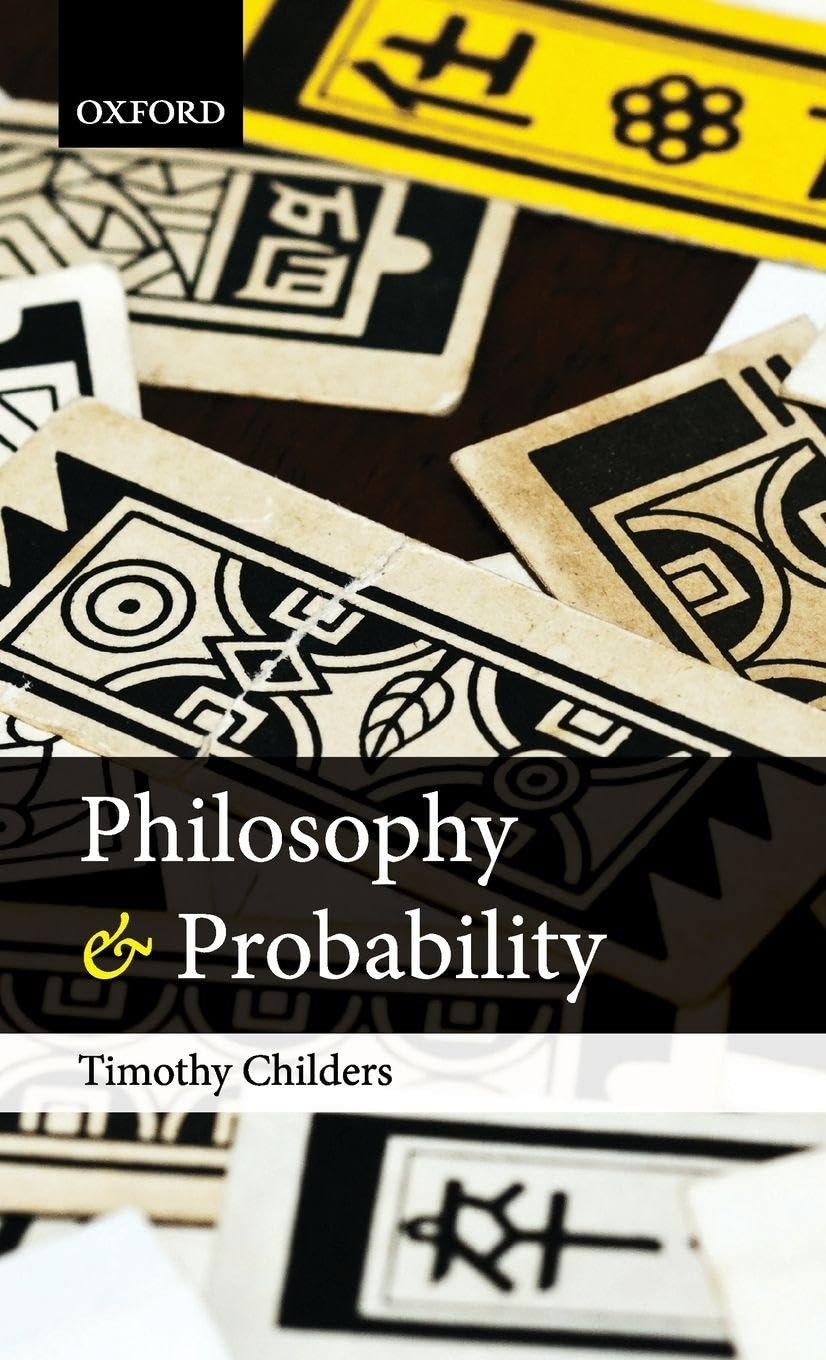
Philosophy and Probability by Timothy Childers – A Comprehensive Introduction to Probability Theory and Its Philosophica
Inclusive of all applicable taxes. FREE shipping on all orders.
Available Offers
- 🚚Free Delivery — Free shipping on all orders
- 💵Cash on Delivery — Pay when your order arrives
- ↩️15-Day Easy Returns — Hassle-free return policy
- 🔒Cash on Delivery — Pay safely when your order arrives
Check Delivery
Product Description
Introduction
Probability is no longer just a branch of mathematics; it has become a fundamental lens through which we interpret uncertainty, make decisions, and understand the world around us. For students of philosophy, grappling with the concept of probability is essential to engage with modern debates in epistemology, philosophy of science, and logic. Philosophy and Probability by Timothy Childers offers a rigorous yet accessible entry point into this fascinating intersection. Published by Academic Press, this hardcover edition is an ideal resource for Indian university students and self-learners who wish to explore how probability shapes philosophical reasoning without getting lost in complex equations.
Book Overview
This book provides a clear, step-by-step introduction to the philosophical foundations of probability. Childers assumes no prior knowledge of the subject, making it perfect for undergraduates and curious readers alike. The narrative is built around the major interpretations of probability—frequentist, propensity, classical, Bayesian, and objective Bayesian—and examines how each interpretation answers the central question: What does it mean to say something is probable? Through carefully chosen examples and thought experiments, the author bridges abstract theory with real-world applications, ensuring that readers not only learn the mechanics but also appreciate the deeper philosophical implications.
Key Highlights
- Accessible approach: Technical details are kept to a minimum, with a focus on conceptual clarity.
- Comprehensive coverage: Explores all major interpretations of probability in one volume.
- Engaging examples: Uses stimulating, relatable scenarios to illustrate abstract ideas.
- Philosophical depth: Connects probability theory to core issues in epistemology, philosophy of science, and decision theory.
- Indian context: Examples and discussions are designed to resonate with students from diverse academic backgrounds.
Inside the Book
Readers will find a well-structured journey that begins with the basic question of what probability means. Early chapters introduce the classical interpretation and its limitations, followed by the frequentist view that ties probability to long-run frequencies. The propensity interpretation is examined as a way to understand single-case probabilities, while Bayesian and objective Bayesian approaches are presented as frameworks for updating beliefs in light of evidence. Each chapter includes summaries, key terms, and thought-provoking exercises that reinforce understanding. The book also touches on applications in scientific reasoning, gambling, and everyday decision-making, making the content lively and relevant.
Key Topics
- The classical interpretation of probability and its paradoxes
- Frequentist probability and the problem of the single case
- Propensity theory and causal probability
- Subjective Bayesianism and coherence
- Objective Bayesianism and the principle of indifference
- Probability and evidence in scientific inference
- The role of probability in philosophical logic
Reader Benefits
- Builds critical thinking: Develops the ability to evaluate probabilistic claims in philosophy and daily life.
- No prerequisites needed: Designed for readers with little or no background in mathematics or statistics.
- Enhances academic performance: Ideal for philosophy majors and students of logic, epistemology, and philosophy of science in Indian universities.
- Practical insights: Learn how probability underpins reasoning in law, medicine, economics, and artificial intelligence.
Learning Outcomes
By the end of this book, readers will be able to distinguish between the major philosophical interpretations of probability, critically evaluate arguments that rely on probabilistic reasoning, and apply these concepts to real-world problems. They will gain a solid foundation for advanced study in formal epistemology, decision theory, and the philosophy of statistics. The book also equips students to engage with contemporary debates about uncertainty, risk, and rationality—skills that are increasingly valuable in both academic and professional contexts.
Who Should Read
This book is primarily aimed at undergraduate and postgraduate students of philosophy, especially those enrolled in Indian universities where courses on logic and scientific method are part of the curriculum. It is also highly suitable for students of mathematics, statistics, and computer science who wish to understand the philosophical underpinnings of their discipline. Researchers and professionals in fields such as economics, law, and data science will find the conceptual clarity valuable. Finally, any curious reader with an interest in how we make sense of chance and uncertainty will enjoy this accessible yet profound exploration.
About the Author
Timothy Childers is a philosopher and educator with extensive experience in teaching logic and philosophy of science. His research interests include formal epistemology, probability theory, and the history of philosophy. Childers is known for his ability to make complex ideas understandable without sacrificing depth, and this book reflects his commitment to clear, engaging exposition. He has taught at several universities and brings a global perspective to the subject, ensuring that students from all backgrounds feel included.
About the Publisher
Academic Press is a renowned publisher of scholarly books and textbooks, with a strong focus on philosophy, science, and mathematics. Their titles are known for rigorous editorial standards and a commitment to educational excellence. This hardcover edition of Philosophy and Probability is built to last, making it a valuable addition to any personal or institutional library. Bookshops.in is proud to offer this title to Indian readers, ensuring that students and scholars have access to world-class academic resources delivered right to their doorstep.
Conclusion
In a world increasingly driven by data and uncertainty, understanding probability is not just an academic exercise—it is a life skill. Philosophy and Probability by Timothy Childers provides the philosophical foundation needed to navigate this landscape with confidence and clarity. Whether you are a philosophy student in Delhi, a researcher in Bengaluru, or a curious reader in Mumbai, this book will change the way you think about chance, evidence, and belief. Order your copy today from Bookshops.in and take the first step toward mastering the philosophy of probability.
Quick Summary
Philosophy and Probability by Timothy Childers is an engaging and accessible introduction to the philosophical foundations of probability, published by Academic Press. The book is designed for readers with no prior background in probability, making it ideal for Indian students of philosophy, science, and mathematics. Childers systematically explains the major interpretations of probability—frequentist, propensity, classical, Bayesian, and objective Bayesian—using vivid examples that connect abstract ideas to everyday reasoning and scientific practice. Readers will learn how probability shapes our understanding of uncertainty, induction, evidence, and decision making. The book avoids heavy technical jargon, focusing instead on conceptual clarity and philosophical debate. It is perfect for undergraduate and postgraduate courses, as well as for self-study by curious readers. By purchasing from Bookshops.in, you get a genuine hardcover edition with fast delivery across India, supporting a trusted local bookstore. Whether you are a philosophy student, a data science enthusiast, or simply someone who wants to think more clearly about chance and uncertainty, this book offers a rewarding intellectual journey.
Book Highlights
Book Specifications
| ISBN-13 | 9780199661824 |
| ISBN-10 | 0199661820 |
| Publisher | OUP Oxford |
| Language | English |
| Dimensions | 21.59 x 2.03 x 14.22 cm |
| Weight | 386 g |
| Country | India |
| Category | Philosophy › Epistemology |
| Genre | Nonfiction |
| Original Language | English |
Frequently Asked Questions
What is Philosophy and Probability about?
Who is the author of Philosophy and Probability?
Do I need a background in mathematics to read this book?
Is this book suitable for Indian students?
What topics does the book cover?
Is this a textbook or a general read?
What is the ISBN of this book?
What is the price of Philosophy and Probability at Bookshops.in?
Does the book include examples?
Can this book help with competitive exams?
Is the book available in hardcover?
How is this book different from standard probability textbooks?
Does the book discuss Bayesian reasoning?
Why should I buy from Bookshops.in?
Readers Also Search For
Customers Also Bought
Islam
Spiritual Economies (English, Daromir Rudnyckyj)

Islam
Who Is Allah? (English, Bruce B. Lawrence)
Islam
Islam and Liberal Citizenship: The Search for an Overlapping Consensus by Andrew F. March

Islam
Fiqh Us-Sunnah: Funerals and Diggers by Al-Sayyid Sabiq – Islamic Funeral Guide

Christianity
Genetics (English, Thomas a. Shannon | Mark P. Aulisio | Françoise Baylis)

Hinduism
Karma and Creativity by Christopher Key Chapple – Indian Philosophy
Related Products
View All
Philosophy
Latin American Philosophy: Currents, Issues, Debates by Eduardo Mendieta

Philosophy
Al-Farabi's Short Commentary on Aristotle's Prior Analytics by Nicholas Rescher – Philosophy
Philosophy
Poetics of Imagining: Modern to Post-modern by Richard Kearney

Philosophy
The Metaphysics of Extrinsic Properties: 11 (Metaphysical Research, 11)
Philosophy
Dialogues on Metaphysics and on Religion by Nicolas Malebranche – Philosophy
Philosophy