
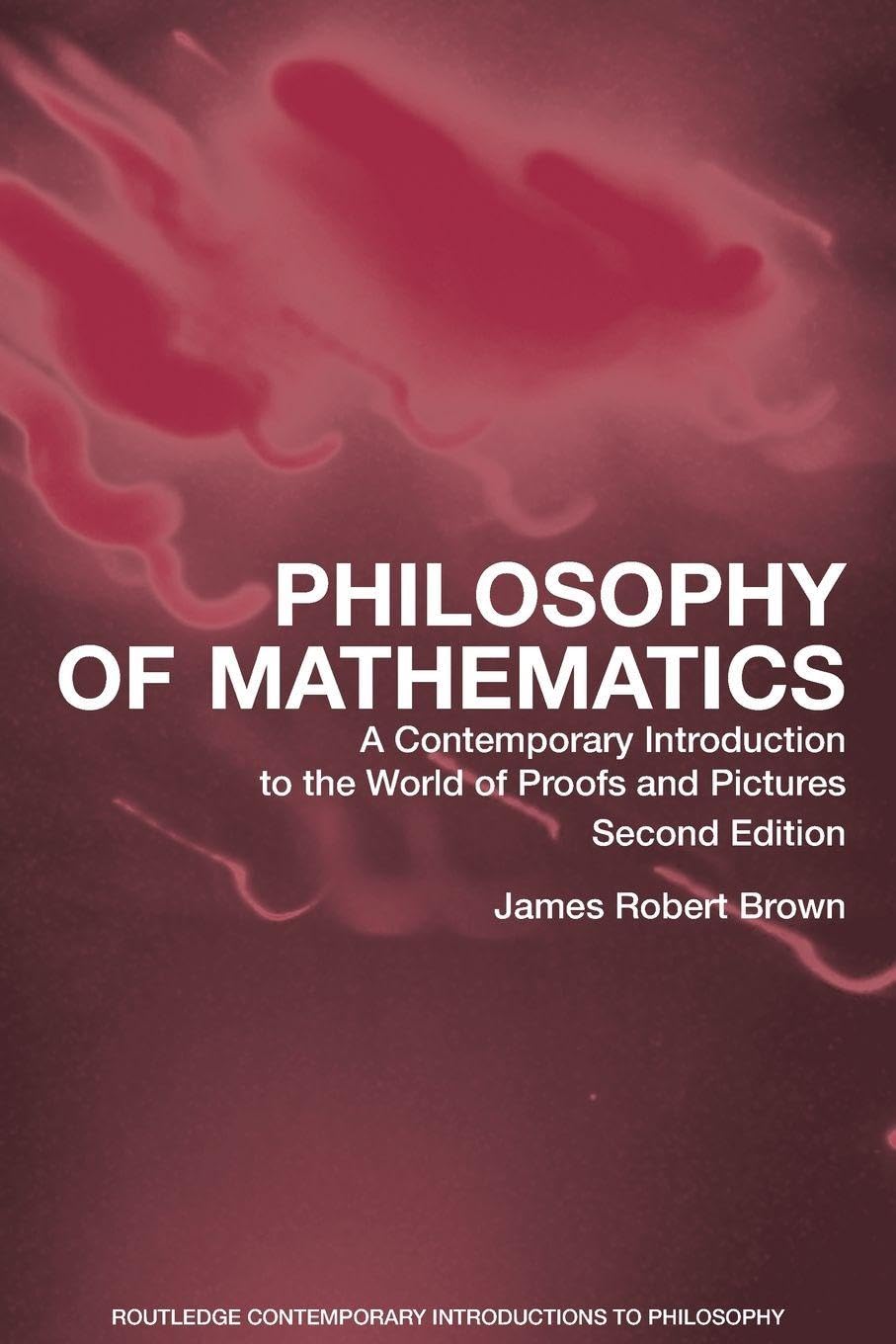
Philosophy of Mathematics: A Contemporary Introduction to the World of Proofs and Pictures by James Robert Brown
Inclusive of all applicable taxes. FREE shipping on all orders.
Available Offers
- 🚚Free Delivery — Free shipping on all orders
- 💵Cash on Delivery — Pay when your order arrives
- ↩️15-Day Easy Returns — Hassle-free return policy
- 🔒Cash on Delivery — Pay safely when your order arrives
Check Delivery
Product Description
Introduction
What is the nature of mathematical truth? Can a simple diagram ever serve as a rigorous proof? Do computers change the very fabric of mathematical reasoning? In Philosophy of Mathematics: A Contemporary Introduction to the World of Proofs and Pictures, James Robert Brown invites readers on a captivating journey through the most profound questions that have shaped the mathematical sciences. This second edition, published by Routledge, is an essential companion for Indian students, researchers, and anyone curious about the philosophical foundations of the discipline. With a unique focus on visual reasoning, notation, and computer-assisted methods, this hardbound volume bridges the gap between abstract theory and tangible practice, making it a must-have for every serious library.
Book Overview
This is not your typical dry textbook on mathematical philosophy. Brown masterfully weaves together traditional topics—such as formalism, Platonism, and constructivism—with non-standard yet equally vital themes like the role of pictures in proofs, the importance of symbolic notation, and the revolutionary impact of computers on mathematical discovery. The book is structured to guide both beginners and advanced readers through a landscape where logic meets imagination. The revised and updated second edition includes fresh examples, expanded discussions on the continuum hypothesis, and a novel approach to one of mathematics' most enduring puzzles. Brown’s clear, engaging prose ensures that complex ideas become accessible without sacrificing depth.
Key Highlights
- Visual Proofs and Reasoning: Explores how diagrams and pictures can function as legitimate mathematical arguments, challenging the traditional dominance of symbolic logic.
- Revised and Expanded Content: The second edition features more examples, updated references, and a groundbreaking perspective on the continuum hypothesis.
- Computers in Mathematics: Investigates how computational tools and experiments are reshaping what it means to prove a theorem.
- Notation as a Tool: Examines how the choice of symbols influences mathematical thought and discovery.
- Balanced Approach: Covers both classical philosophical schools (Platonism, formalism, constructivism) and contemporary debates.
- Reader-Friendly Structure: Each chapter includes suggestions for further reading, making it ideal for self-study or classroom use.
Inside the Book
From the opening chapter, Brown sets the stage by asking: Can a picture prove anything? He then guides readers through a series of compelling case studies where visual reasoning has led to genuine mathematical breakthroughs. The book delves into the nature of mathematical objects—are they discovered or invented?—and examines the implications of experimental mathematics, where computers generate hypotheses and even proofs. Brown does not shy away from technical details, but he presents them in a way that feels like a conversation rather than a lecture. The chapters on the continuum hypothesis and the philosophy of set theory are particularly rewarding, offering fresh insights that will stimulate both newcomers and seasoned philosophers.
Key Topics
- Platonism vs. Formalism: The age-old debate about whether mathematical entities exist independently of human minds.
- Constructivism and Intuitionism: The view that mathematics is a human construction, not a discovery of pre-existing truths.
- Visual Reasoning in Proofs: How diagrams, graphs, and geometric pictures can serve as rigorous evidence.
- Notation and Symbolism: The hidden power of mathematical language and its influence on problem-solving.
- Experimental Mathematics: The role of computers in generating conjectures and verifying proofs.
- The Continuum Hypothesis: A deep dive into one of the most famous unsolved problems in set theory, with Brown’s novel approach.
- Realism and Anti-Realism: Philosophical positions on the objectivity of mathematical truth.
Reader Benefits
- Broaden Your Perspective: Gain a holistic understanding of mathematics that goes beyond calculations and formulas.
- Enhance Critical Thinking: Learn to question assumptions about proof, truth, and certainty in mathematical practice.
- Bridge Philosophy and Practice: See how philosophical ideas directly impact the way mathematics is done and taught.
- Stay Updated: The revised edition incorporates the latest developments in the field, including computational approaches.
- Perfect for Indian Curricula: Aligns with advanced undergraduate and postgraduate courses in philosophy, mathematics, and logic offered across Indian universities.
Learning Outcomes
By working through this book, readers will be able to: evaluate the strengths and weaknesses of major philosophical positions in mathematics; analyze the role of visual and computational methods in contemporary mathematical practice; articulate informed views on the nature of mathematical truth and existence; engage critically with classical and modern arguments about proof and certainty; and apply philosophical insights to their own mathematical or scientific work. Brown’s approach ensures that these outcomes are achieved through rich examples and accessible reasoning, not abstract jargon.
Who Should Read
This book is ideal for undergraduate and postgraduate students in philosophy, mathematics, computer science, and physics. It is equally valuable for educators seeking to enrich their teaching with philosophical depth, and for self-learners who are fascinated by the big questions behind the numbers. Indian students preparing for competitive exams like the UGC-NET in philosophy or mathematics will find it a goldmine of conceptual clarity. Professionals in STEM fields who wish to reflect on the foundations of their discipline will also benefit immensely from Brown’s lucid exposition.
About the Author
James Robert Brown is a distinguished philosopher of science and mathematics, known for his pioneering work on visual reasoning and the philosophy of mathematics. He has taught at leading universities and published extensively on topics ranging from thought experiments to the nature of proof. Brown’s ability to blend rigorous analysis with engaging storytelling has made him a favourite among students and scholars alike. His research continues to influence contemporary debates on the role of pictures and computers in mathematics.
About the Publisher
Routledge is one of the world’s most respected academic publishers, with a proud history of producing seminal works in philosophy, science, and the humanities. Known for their commitment to scholarly excellence, Routledge titles are widely adopted in Indian universities and research institutions. This hardcover edition reflects the publisher’s dedication to quality, ensuring durability and a premium reading experience for years to come.
Conclusion
Philosophy of Mathematics: A Contemporary Introduction to the World of Proofs and Pictures is more than a textbook—it is an invitation to rethink what mathematics truly is. James Robert Brown’s revised and updated second edition offers a fresh, inclusive perspective that honours tradition while embracing innovation. Whether you are a student grappling with foundational questions or a seasoned mathematician curious about the philosophy behind your craft, this book will challenge, inspire, and illuminate. Add this hardcover gem to your collection and discover the beautiful interplay between proof and picture, logic and imagination.
Quick Summary
Philosophy of Mathematics: A Contemporary Introduction to the World of Proofs and Pictures by James Robert Brown is a thought-provoking exploration of fundamental questions in mathematics. This book goes beyond traditional topics like Platonism, formalism, and constructivism to include non-standard areas such as visual reasoning, the importance of notation, and the role of computers in mathematical practice. Written in a clear and engaging style, it is suitable for both beginners and advanced readers. Readers will learn about the nature of mathematical truth, the validity of visual proofs, and the impact of technology on mathematical discovery. The updated second edition contains more examples and suggestions for further reading, making it an ideal resource for Indian students and scholars. By purchasing from Bookshops.in, you get a high-quality physical copy delivered to your doorstep, supporting a trusted Indian bookstore dedicated to academic excellence.
Book Highlights
Book Specifications
| ISBN-13 | 9780415960472 |
| ISBN-10 | 0415960479 |
| Publisher | Routledge |
| Language | English |
| Dimensions | 15.6 x 1.52 x 23.39 cm |
| Weight | 386 g |
| Country | India |
| Category | Philosophy › Epistemology |
| Genre | Non-fiction |
| Original Language | English |
Frequently Asked Questions
What is the main focus of Philosophy of Mathematics by James Robert Brown?
Is this book suitable for beginners?
Does the book discuss visual reasoning in mathematics?
What philosophical positions are covered?
Is this book relevant for Indian students?
Does the book include modern topics like computers?
Who is the author James Robert Brown?
Can I use this book for a university course?
Does the book cover mathematical certainty?
Are there experiments discussed in the book?
What is the ISBN for this book?
Is this a hardcover or paperback edition?
Where can I buy this book in India?
Readers Also Search For
Customers Also Bought

Islam
Spiritual Economies (English, Daromir Rudnyckyj)

Islam
Who Is Allah? (English, Bruce B. Lawrence)

Islam
Islam and Liberal Citizenship: The Search for an Overlapping Consensus by Andrew F. March

Islam
Fiqh Us-Sunnah: Funerals and Diggers by Al-Sayyid Sabiq – Islamic Funeral Guide

Christianity
Genetics (English, Thomas a. Shannon | Mark P. Aulisio | Françoise Baylis)

Hinduism
Karma and Creativity by Christopher Key Chapple – Indian Philosophy
Related Products
View All
Philosophy
Latin American Philosophy: Currents, Issues, Debates by Eduardo Mendieta

Philosophy
Al-Farabi's Short Commentary on Aristotle's Prior Analytics by Nicholas Rescher – Philosophy

Philosophy
Poetics of Imagining: Modern to Post-modern by Richard Kearney

Philosophy
The Metaphysics of Extrinsic Properties: 11 (Metaphysical Research, 11)

Philosophy
Dialogues on Metaphysics and on Religion by Nicolas Malebranche – Philosophy
Philosophy