
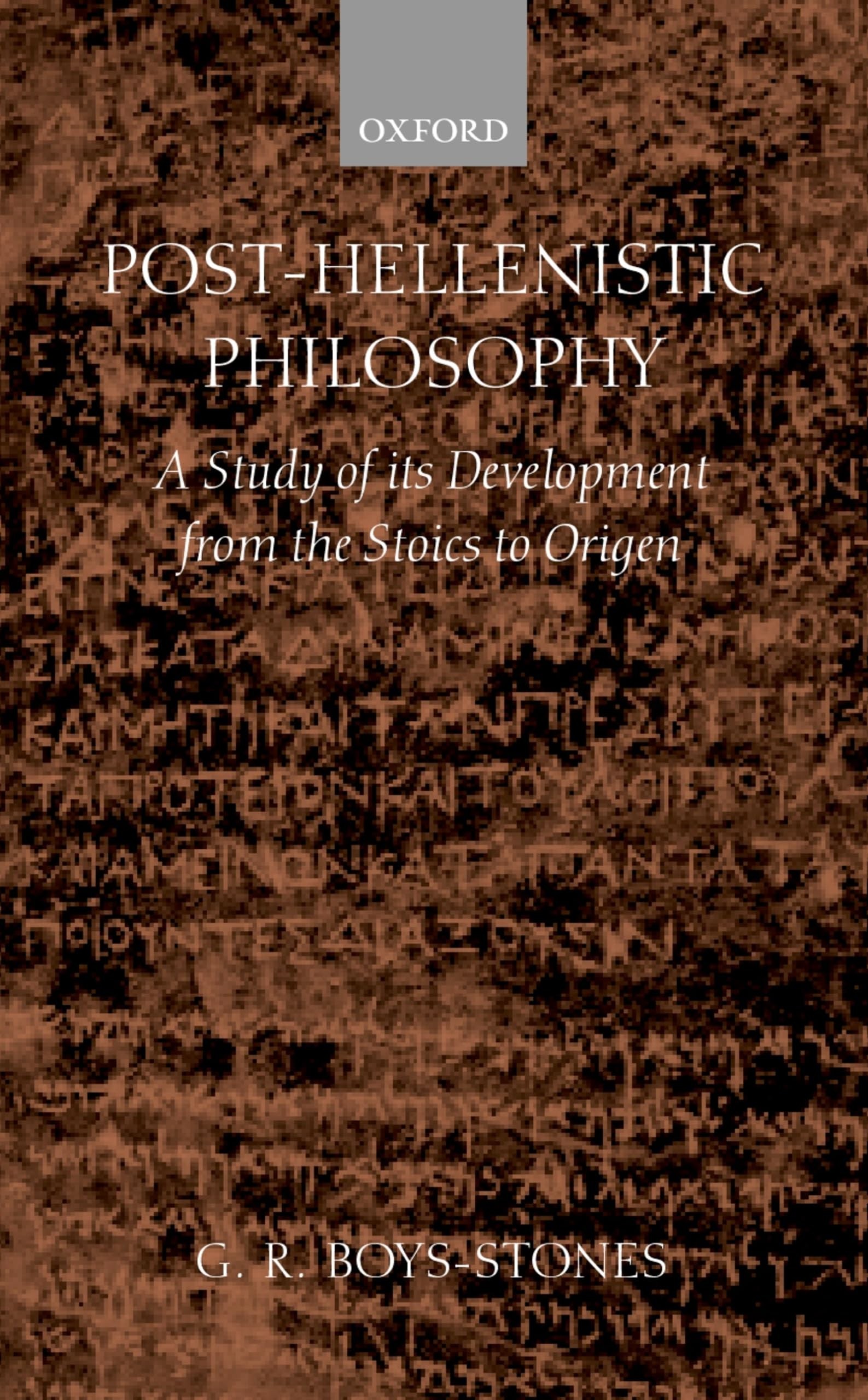
Post-Hellenistic Philosophy: A Study of its Development from the Stoics to Origen by G. R. Boys-Stones – Tracing the Roo
Inclusive of all applicable taxes. FREE shipping on all orders.
Available Offers
- 🚚Free Delivery — Free shipping on all orders
- 💵Cash on Delivery — Pay when your order arrives
- ↩️15-Day Easy Returns — Hassle-free return policy
- 🔒Cash on Delivery — Pay safely when your order arrives
Check Delivery
Product Description
Introduction
In the vast landscape of ancient philosophy, the centuries following the death of Alexander the Great are often overshadowed by the towering figures of Plato and Aristotle. Yet, it was during this period that some of the most transformative ideas in Western thought took shape. G. R. Boys-Stones' Post-Hellenistic Philosophy: A Study of its Development from the Stoics to Origen offers a groundbreaking exploration of this crucial but often neglected era. For Indian readers and students of philosophy, this book provides a unique lens to understand how ancient wisdom was preserved, reinterpreted, and contested across cultures and centuries.
Book Overview
This meticulously researched volume traces a profound intellectual revolution that unfolded during the early centuries of the Common Era. Boys-Stones reconstructs the philosophical foundations upon which the Stoics built their theory—that fragments of an ancient, divine wisdom could be recovered from mythological traditions. The book then reveals how Platonism itself was founded on the argument that Plato had already achieved a complete reconstruction of this primordial wisdom, and that later philosophies had regressed by attempting to 'improve' upon his work. Through parallel studies of Hellenistic debates over Jewish culture and the philosophical origins of Christianity, the author shows how notions of orthodoxy and heresy became tools for constructing a unified history of Christian philosophy stretching back to primitive antiquity.
Key Highlights
- First comprehensive study of the philosophical revolution between the Stoics and Origen
- Original reconstruction of Stoic theories about recovering ancient wisdom from mythology
- Insightful analysis of how Platonism positioned itself as the culmination of philosophical history
- Comparative study of Hellenistic debates on Jewish culture and their philosophical significance
- Groundbreaking exploration of how orthodoxy and heresy shaped early Christian philosophy
Inside the Book
The book is divided into well-structured chapters that guide the reader through this complex intellectual terrain. Boys-Stones begins by examining the Stoic concept of 'ancient wisdom' and their method of extracting philosophical truths from myths. He then traces how Middle Platonists developed their own historical narrative, arguing that Plato had perfectly recovered the wisdom of the ancients. The discussion moves to the Hellenistic period's engagement with Jewish culture, showing how philosophical categories were applied to non-Greek traditions. Finally, the author delves into early Christian philosophy, demonstrating how figures like Clement of Alexandria and Origen used historical arguments to define Christian orthodoxy against heresy. Throughout, the writing remains accessible without sacrificing scholarly depth.
Key Topics
- Stoic theories of ancient wisdom and mythological interpretation
- Platonic claims to philosophical authority and historical narrative
- Hellenistic debates on the status of Jewish culture and philosophy
- Philosophical foundations of early Christian orthodoxy and heresy
- The concept of 'primitive antiquity' in ancient philosophical traditions
- Comparative approaches to wisdom traditions across cultures
Reader Benefits
Indian readers will find this book particularly valuable as it offers a framework for understanding how ancient cultures engaged with questions of wisdom, tradition, and philosophical authority—themes that resonate deeply with India's own philosophical heritage. Students of comparative philosophy will gain tools for analyzing how different civilizations construct their intellectual histories. The book also provides essential context for anyone studying the development of Western philosophy, theology, or the history of ideas. By illuminating the philosophical debates that shaped early Christianity, it helps readers understand the intellectual environment from which many modern concepts of tradition and authority emerged.
Learning Outcomes
- Understand the philosophical revolution that transformed ancient thought in the early Common Era
- Analyze how Stoics and Platonists constructed competing narratives of philosophical history
- Evaluate the role of mythology in ancient philosophical methodology
- Trace the philosophical origins of concepts like orthodoxy and heresy
- Compare Hellenistic approaches to Jewish culture with other cross-cultural philosophical encounters
- Recognize the lasting influence of post-Hellenistic philosophy on later Western thought
Who Should Read
This book is ideal for advanced undergraduate and postgraduate students of philosophy, classics, religious studies, and intellectual history. It will also appeal to scholars working on Hellenistic philosophy, early Christianity, or comparative philosophy. Indian readers with an interest in how ancient traditions negotiate questions of wisdom and authority will find the book deeply engaging. Anyone curious about the philosophical background of the New Testament or the Church Fathers will discover invaluable insights. The work assumes some familiarity with ancient philosophy but remains accessible to dedicated non-specialists.
About the Author
G. R. Boys-Stones is a distinguished scholar of ancient philosophy, known for his rigorous and innovative work on post-Hellenistic thought. He has held academic positions at leading universities and is widely respected for his ability to bring clarity to complex philosophical debates. His research focuses on the intersection of philosophy, mythology, and religious traditions in the ancient world. Boys-Stones' work is characterized by meticulous scholarship combined with a rare gift for narrative synthesis, making him one of the most insightful commentators on this transformative period of intellectual history.
About the Publisher
OUP Oxford is one of the world's most prestigious academic publishers, renowned for its commitment to scholarly excellence. With a history spanning several centuries, Oxford University Press publishes works that set the standard in their fields. This volume is part of their distinguished philosophy list, which includes seminal works on ancient thought. Indian readers can trust the quality and authority of any OUP publication, as each book undergoes rigorous peer review and editorial oversight.
Conclusion
Post-Hellenistic Philosophy is an essential addition to any serious philosophy library. It fills a significant gap in our understanding of ancient thought and offers fresh perspectives on how philosophical traditions construct their own histories. For Indian students and scholars, it provides a valuable comparative model for thinking about how wisdom is transmitted, contested, and redefined across cultures. This hardcover edition from OUP Oxford is built to last, making it a worthy investment for anyone committed to deepening their understanding of the philosophical roots of Western civilization.
Quick Summary
Post-Hellenistic Philosophy: A Study of its Development from the Stoics to Origen by G. R. Boys-Stones is a groundbreaking academic work that traces a philosophical revolution in the early centuries of our era. The book reconstructs the Stoic theory that ancient divine wisdom could be gleaned from mythological traditions, and shows how Platonism emerged from the claim that Plato had fully recovered this wisdom. It then examines how subsequent philosophies regressed in attempts to 'improve' upon Plato. The work also delves into the Hellenistic debate over Jewish culture and the philosophical foundations of Christianity, revealing how notions of orthodoxy and heresy were tools in philosophical contestation. This book is ideal for graduate students, researchers, and scholars of ancient philosophy, early Christianity, and intellectual history. Readers will gain a nuanced understanding of the interplay between pagan, Jewish, and Christian thought during a transformative period. By purchasing from Bookshops.in, Indian readers can access this authoritative hardcover edition from OUP Oxford, ensuring a reliable and durable addition to their academic library.
Book Highlights
Book Specifications
| ISBN-13 | 9780198152644 |
| ISBN-10 | 0198152647 |
| Publisher | OUP Oxford |
| Language | English |
| Dimensions | 14.48 x 3.56 x 21.59 cm |
| Weight | 340 g |
| Category | Religious Studies › History of Religion |
| Genre | Non-fiction |
| Reading Age | Adult |
| Original Language | English |
Frequently Asked Questions
What is the main argument of Post-Hellenistic Philosophy?
Who is G. R. Boys-Stones?
Is this book suitable for undergraduate students?
Does the book cover early Christian philosophy?
What is the time period covered in this book?
How does this book relate to Plato?
Is the book available in hardcover?
Does the book discuss Jewish philosophy?
What makes this book unique?
Can this book help with research on heresy?
What is the price of this book?
Does the book include references to mythological traditions?
Where can I buy this book in India?
Readers Also Search For
Customers Also Bought
Islam
Spiritual Economies (English, Daromir Rudnyckyj)

Islam
Who Is Allah? (English, Bruce B. Lawrence)
Islam
Islam and Liberal Citizenship: The Search for an Overlapping Consensus by Andrew F. March

Islam
Fiqh Us-Sunnah: Funerals and Diggers by Al-Sayyid Sabiq – Islamic Funeral Guide

Christianity
Genetics (English, Thomas a. Shannon | Mark P. Aulisio | Françoise Baylis)

Hinduism
Karma and Creativity by Christopher Key Chapple – Indian Philosophy
Related Products
View All
Religion & Spirituality
Spiritual Competency in Psychotherapy | by Philip Brownell | Springer Publishing Company | by Philip Brownell | Springer Publishing Company | by Philip Brownell | Springer Publishing Company | by Philip Brownell | Springer Publishing Company | by Philip Brownell | Springer Publishing Company | by Philip Brownell | Springer Publishing Company | by Philip Brownell | Springer Publishing Company | by Philip Brownell | Springer Publishing Company | by Philip Brownell | Springer Publishing Company | b
Religion & Spirituality
Religion as a Conversation Starter | by Ina Merdjanova | Continuum | by Ina Merdjanova | Continuum | by Ina Merdjanova | Continuum | by Ina Merdjanova | Continuum | by Ina Merdjanova | Continuum | by Ina Merdjanova | Continuum | by Ina Merdjanova | Continuum | by Ina Merdjanova | Continuum | by Ina Merdjanova | Continuum | by Ina Merdjanova | Continuum | by Ina Merdjanova | Continuum | by Ina Merdjanova | Continuum | by Ina Merdjanova | Continuum | by Ina Merdjanova | Continuum | by Ina Merdjano
Religion & Spirituality
The Other Jewish Question: Identifying the Jew and Making Sense of Modernity
Religion & Spirituality
The Oxford Guide to People & Places of the Bible | by Bruce M. Metzger | Michael D. Coogan | Oxford University Press | by Bruce M. Metzger | Michael D. Coogan | Oxford University Press | by Bruce M. Metzger | Michael D. Coogan | Oxford University Press | by Bruce M. Metzger | Michael D. Coogan | Oxford University Press | by Bruce M. Metzger | Michael D. Coogan | Oxford University Press | by Bruce M. Metzger | Michael D. Coogan | Oxford University Press | by Bruce M. Metzger | Michael D. Coogan |

Religion & Spirituality
Anti-Judaism in Early Christianity | by Stephen G. Wilson | Wilfrid Laurier University Press | by Stephen G. Wilson | Wilfrid Laurier University Press | by Stephen G. Wilson | Wilfrid Laurier University Press | by Stephen G. Wilson | Wilfrid Laurier University Press | by Stephen G. Wilson | Wilfrid Laurier University Press | by Stephen G. Wilson | Wilfrid Laurier University Press | by Stephen G. Wilson | Wilfrid Laurier University Press | by Stephen G. Wilson | Wilfrid Laurier University Press |
Religion & Spirituality