
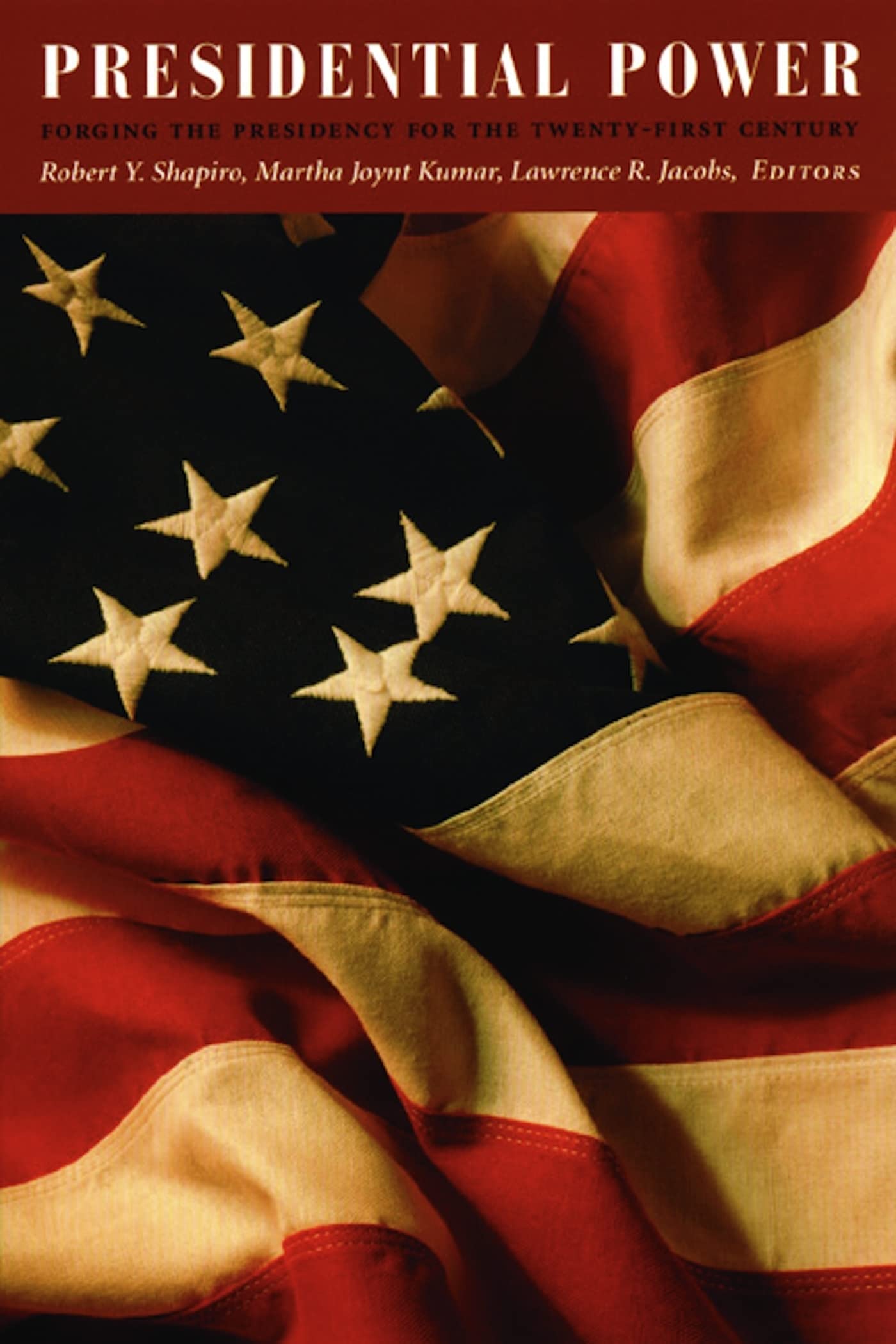
Presidential Power: Forging the Presidency for the Twenty-First Century by Robert Shapiro – A Scholarly Analysis of Amer
Inclusive of all applicable taxes. FREE shipping on all orders.
Available Offers
- 🚚Free Delivery — Free shipping on all orders
- 💵Cash on Delivery — Pay when your order arrives
- ↩️15-Day Easy Returns — Hassle-free return policy
- 🔒Cash on Delivery — Pay safely when your order arrives
Check Delivery
Product Description
Introduction
In the evolving landscape of American political leadership, few works have shaped scholarly discourse as profoundly as Richard Neustadt's classic Presidential Power: The Politics of Leadership. Now, Presidential Power: Forging the Presidency for the Twenty-First Century, edited by Robert Shapiro, offers a timely and rigorous re-examination of Neustadt's foundational ideas in light of modern challenges. This hardbound volume from Columbia University Press brings together leading thinkers to assess how presidential authority, persuasion, and institutional dynamics have transformed—and what they mean for the future of governance. For Indian students, scholars, and policy enthusiasts, this book provides a compelling lens through which to understand executive power in a global context.
Book Overview
Building upon and critically engaging with Neustadt's seminal arguments, this collection of essays addresses questions left unresolved by earlier scholarship. The volume reflects on the American presidency as it entered the twenty-first century, with particular attention to the post-impeachment era of Bill Clinton and the shifting nature of political bargaining. Each chapter offers fresh insights into how presidents navigate constraints, leverage personal influence, and adapt to an increasingly polarized environment. The book includes a new contribution by Neustadt himself, making it an indispensable resource for understanding the evolution of presidential power.
Key Highlights
- Authoritative Scholarship: Edited by Robert Shapiro, a distinguished political scientist, with contributions from top experts in American politics.
- Critical Engagement: Directly challenges and extends Neustadt's classic thesis on presidential persuasion and leadership.
- Contemporary Relevance: Analyzes the presidency in the wake of the Clinton impeachment, offering lessons for modern governance.
- Neustadt's Final Word: Includes a new essay by Richard Neustadt himself, providing a unique capstone to his life's work.
- Interdisciplinary Approach: Blends political theory, historical analysis, and institutional studies for a comprehensive view.
Inside the Book
This volume is structured around core themes that define presidential power today. The essays explore how presidents use persuasion, bargaining, and public communication to achieve their goals. They examine the constraints of bureaucracy, Congress, and the media, and consider how the informal powers of the office have expanded or contracted over time. A notable section focuses on presidential transitions, highlighting how new administrations inherit and reshape institutional relationships. The book also delves into the psychological and strategic dimensions of leadership, making it a rich resource for anyone interested in the mechanics of high-level decision-making.
Key Topics
- Neustadt's theory of presidential power and its critics
- The role of persuasion in a fragmented political landscape
- Executive authority during crises and scandals
- Presidential transitions and administrative strategy
- The impact of impeachment on institutional legitimacy
- Comparative perspectives on leadership and governance
Reader Benefits
Readers will gain a nuanced understanding of how the American presidency operates beyond formal constitutional provisions. The book equips students with analytical tools to evaluate executive leadership, while practitioners and policymakers can draw lessons on negotiation, communication, and institutional management. For Indian readers, the insights into federal structures and checks and balances offer valuable parallels for studying India's own presidential system and executive dynamics. The essays are written in accessible yet rigorous prose, making complex ideas understandable without sacrificing depth.
Learning Outcomes
- Articulate the key arguments of Neustadt's Presidential Power and their modern critiques.
- Analyze how informal powers like persuasion and bargaining shape presidential effectiveness.
- Evaluate the impact of historical events—such as impeachment—on institutional power.
- Compare different models of executive leadership across political systems.
- Apply theoretical frameworks to real-world case studies of presidential decision-making.
Who Should Read
This book is ideal for undergraduate and postgraduate students of political science, public administration, and American studies. It is also highly relevant for legal scholars, journalists, and anyone interested in the mechanics of power. Indian civil service aspirants and those preparing for competitive examinations will find the analytical frameworks useful for understanding executive authority in a comparative context. General readers with a curiosity about leadership and governance will also appreciate the engaging narrative and thought-provoking arguments.
About the Author
Robert Shapiro is a professor of political science at Columbia University and a leading scholar of American politics and public opinion. He has authored numerous works on the presidency, political communication, and policy-making. His editing of this volume reflects a deep commitment to advancing the study of executive power through rigorous, interdisciplinary scholarship.
About the Publisher
Columbia University Press is one of the world's premier academic publishers, known for its distinguished list of titles in the humanities, social sciences, and natural sciences. With a history spanning over a century, the press is committed to publishing works that shape intellectual discourse and inform public debate. This volume upholds that tradition by offering a vital contribution to the study of the American presidency.
Conclusion
Presidential Power: Forging the Presidency for the Twenty-First Century is more than a tribute to a classic—it is a vital rethinking of how executive leadership works in an age of uncertainty. By blending historical insight with contemporary analysis, Robert Shapiro and his contributors provide a roadmap for understanding the presidency as an evolving institution. Whether you are a student, scholar, or engaged citizen, this book will deepen your appreciation for the complexities of power and persuasion at the highest level. Order your copy today from Bookshops.in and add this essential volume to your library.
Quick Summary
Presidential Power: Forging the Presidency for the Twenty-First Century, edited by Robert Shapiro, is a critical scholarly work that reexamines Richard Neustadt's foundational text on presidential leadership. Published by Columbia University Press, this hardcover volume features essays from leading political scientists, including a new contribution by Neustadt himself, that analyze how the American presidency has transformed in the modern era—particularly in the wake of the Clinton impeachment. The book delves into themes of executive authority, institutional dynamics, media influence, and the balance of power between branches of government. It is designed for advanced students and researchers in political science, law, and public policy, offering both theoretical insights and practical case studies. Readers will gain a nuanced understanding of the challenges facing the presidency today and how historical precedents shape contemporary governance. By purchasing from Bookshops.in, Indian readers receive a premium imported edition with reliable delivery and customer support, making it an essential addition to any academic library focused on American politics.
Book Highlights
Book Specifications
| ISBN-13 | 9780231109321 |
| ISBN-10 | 0231109326 |
| Publisher | Columbia University Press |
| Language | English |
| Dimensions | 15.24 x 3.51 x 22.86 cm |
| Weight | 25 g |
| Country | USA |
| Category | History Textbooks › United States |
| Genre | Non-fiction |
| Original Language | English |
Frequently Asked Questions
What is Presidential Power: Forging the Presidency for the Twenty-First Century about?
Who is the author of this book?
Is this book suitable for Indian students?
Does the book include Richard Neustadt's original work?
What topics are covered in the essays?
Is this a textbook or a reference book?
Which publisher released this book?
What is the language of the book?
Is this book available in paperback?
What is the price of the book?
Can I use this book for my PhD research?
Where can I buy this book in India?
Readers Also Search For
Related Products
View All
Law
Autopoietic Law: A New Approach To Law And Society: 8 (European University Institute: Series A)
Law
Xenophon's Spartan Constitution: Introduction. Text. Commentary: 24 (Texte und Kommentare)
Law
ENVIRONMENTAL LAW P
Law
Leading Cases in the Common Law by A. W. Brian Simpson – Legal History

Law
New Technologies and Law of the Marine Environment: Nouvelles Technologies Et Droit De L'Environment Marin: 55 (International Enviornmental Law and Policy, 55)
Law