
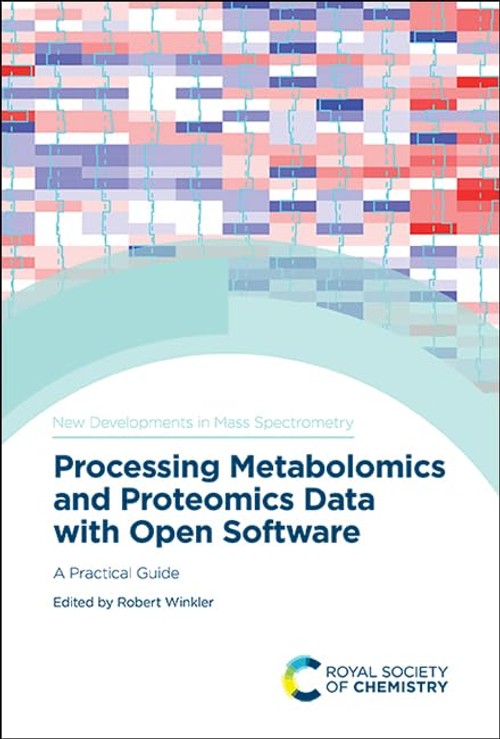
Processing Metabolomics and Proteomics Data with Open Software: A Practical Guide by Robert Winkler – A Comprehensive Re
Inclusive of all applicable taxes. FREE shipping on all orders.
Available Offers
- 🚚Free Delivery — Free shipping on all orders
- 💵Cash on Delivery — Pay when your order arrives
- ↩️15-Day Easy Returns — Hassle-free return policy
- 🔒Cash on Delivery — Pay safely when your order arrives
Check Delivery
Product Description
Introduction
In the rapidly evolving landscape of biological research, the ability to decode complex molecular data has become essential. Processing Metabolomics and Proteomics Data with Open Software: A Practical Guide by Robert Winkler is a timely and indispensable resource for Indian researchers, students, and bioinformaticians who seek to harness the power of open-source tools for mass spectrometry data analysis. This hardcover volume, published by the Royal Society of Chemistry, bridges the gap between experimental biology and computational data science, offering a hands-on approach to understanding metabolomics and proteomics without the constraints of expensive proprietary software.
Book Overview
This practical guide is designed to empower readers with the knowledge and skills to analyse metabolomics and proteomics data using freely available, community-driven software. Unlike commercial alternatives, open-source platforms foster transparency, collaboration, and rapid innovation. The book is structured in two comprehensive sections: the first covers foundational concepts—mass spectrometry basics, experimental strategies, data handling, the open-source philosophy, and statistical data mining. The second section features detailed descriptions of specific software packages, complete with tutorials, datasets, and code examples that enable readers to build custom workflows. It is a complete toolkit for anyone aiming to contribute to the open science movement while advancing their research in the life sciences.
Key Highlights
- Comprehensive coverage of metabolomics and proteomics data analysis using open-source tools
- Practical tutorials and real datasets for hands-on learning and workflow development
- Focus on open science principles, encouraging collaboration and reproducibility
- Written by an expert with deep experience in computational biology and mass spectrometry
- Published by the Royal Society of Chemistry, a trusted name in scientific literature
- Hardcover edition ideal for library or laboratory reference
Inside the Book
The book is divided into two major parts. Part I lays the theoretical and practical foundation: it introduces mass spectrometry instrumentation, experimental design, data preprocessing, and the philosophy behind open-source software. It also covers essential statistical methods and data mining techniques tailored for high-dimensional biological data. Part II is a treasure trove of practical knowledge, where active developers and users present popular software packages such as OpenMS, MZmine, XCMS, and others. Each chapter includes step-by-step tutorials, sample datasets, and code snippets that readers can adapt to their own projects. The final chapters invite readers to engage with the global open science community, sharing their workflows and contributing to collective knowledge.
Key Topics
- Fundamentals of mass spectrometry for metabolomics and proteomics
- Open-source software platforms and their advantages over commercial tools
- Data preprocessing, normalization, and quality control
- Statistical analysis and multivariate data mining
- Building custom analysis workflows using Python, R, and other tools
- Integration of metabolomics and proteomics data for systems biology
- Reproducible research and open science practices
Reader Benefits
- Cost-effective learning by using free, open-source software instead of expensive licenses
- Hands-on experience with real-world datasets and code examples
- Enhanced research skills in bioinformatics and computational biology
- Community connection through the open science movement and developer networks
- Career advancement for students and professionals in biotechnology, pharmaceuticals, and academia
Learning Outcomes
By the end of this book, readers will be able to confidently process and interpret metabolomics and proteomics data using open-source tools. They will understand the underlying principles of mass spectrometry, design robust experimental workflows, apply statistical methods to extract meaningful biological insights, and contribute to reproducible research. The book also equips learners with the skills to customize existing software and develop new analytical pipelines, making them valuable assets in any research team.
Who Should Read
This guide is ideal for graduate students, postdoctoral researchers, and faculty in biochemistry, molecular biology, bioinformatics, and related fields. It is also highly relevant for professionals in the Indian pharmaceutical, agricultural, and clinical research sectors who work with mass spectrometry data. Even beginners with basic knowledge of biology and computing will find the tutorials accessible and rewarding. The open-source focus makes it especially suitable for institutions with limited budgets for commercial software.
About the Author
Robert Winkler is a renowned researcher and educator in the field of computational mass spectrometry. With years of experience in developing and applying open-source tools for metabolomics and proteomics, he has contributed significantly to the open science movement. His work emphasizes accessibility, reproducibility, and collaboration, making him a trusted voice in the global bioinformatics community.
About the Publisher
The Royal Society of Chemistry (RSC) is one of the world's leading publishers of high-quality scientific literature. With a legacy spanning over 175 years, RSC is committed to advancing the chemical sciences through rigorous peer review and innovative publications. This book exemplifies their dedication to practical, cutting-edge resources that support researchers worldwide.
Conclusion
Processing Metabolomics and Proteomics Data with Open Software: A Practical Guide is more than just a textbook—it is a gateway to mastering the art of biological data analysis without financial barriers. For Indian students and researchers eager to embrace open science and gain practical, transferable skills, this hardcover edition from Bookshops.in is an investment in knowledge that will yield dividends for years to come. Whether you are setting up your first workflow or refining advanced pipelines, this book will be your trusted companion.
Quick Summary
Processing Metabolomics and Proteomics Data with Open Software: A Practical Guide by Robert Winkler is an essential resource for anyone looking to analyze complex biological data using free, open-source tools. The book demystifies mass spectrometry, experimental strategies, and data operations, making it accessible to students and researchers alike. It covers both metabolomics and proteomics, providing a unified approach to understanding the chemistry and physiology of biological systems. Readers will gain hands-on experience through tutorials, datasets, and code examples in R and Python, learning how to apply statistics and data mining techniques to real-world problems. Unlike commercial software, open-source platforms foster collaboration and innovation, and this book shows you how to leverage them effectively. Published by the Royal Society of Chemistry, this guide is perfect for Indian students in bioinformatics, biotechnology, and life sciences, as well as researchers seeking reproducible, cost-effective workflows. By choosing Bookshops.in, you get a genuine hardcover edition delivered to your doorstep, supporting your academic journey with reliable content.
Book Highlights
Book Specifications
| ISBN-13 | 9781788017213 |
| ISBN-10 | 1788017218 |
| Publisher | Royal Society of Chemistry |
| Language | English |
| Dimensions | 15.6 x 2.67 x 23.4 cm |
| Weight | 864 g |
| Category | Science & Mathematics › Chemistry |
| Genre | Non-fiction |
| Original Language | English |
Frequently Asked Questions
What is this book about?
Who is the author?
Do I need prior programming experience?
What software tools are covered?
Is this book suitable for Indian students?
Does the book include real datasets?
What is the difference between metabolomics and proteomics?
Can I use this book for self-study?
Is this book only for advanced researchers?
Does the book cover statistics?
Is this a hardcover book?
Can I find code examples in the book?
Why should I buy from Bookshops.in?
Readers Also Search For
Customers Also Bought
Mathematics
Stereotype Spaces and Algebras: 73 (De Gruyter Expositions in Mathematics, 73)

Mathematics
Semigroups in Algebra, Geometry and Analysis: 20 (De Gruyter Expositions in Mathematics, 20)

Mathematics
Geometry from the Pacific Rim: Proceedings of the Pacific Rim Geometry Conference held at National University of Singapore, Republic of Singapore, ... 1994 (De Gruyter Proceedings in Mathematics)
Mathematics
First International Tainan-Moscow Algebra Workshop: Proceedings of the International Conference held at National Cheng Kung University Tainan, Taiwan, ... 1994 (De Gruyter Proceedings in Mathematics)

Mathematics
Differential Geometry - Proceedings of the VIII International Colloquium (English, Jesus A. Alvarez Lopez | Eduardo Garcia-Rio)
Mathematics
Mathematical Theory of Optimal Processes (Classics of Soviet Mathematics)
Related Products
View All
Chemistry
Proceedings of the Third USSR - FRG Symposium, Makhachkala (USSR), October 2–6, 1980: 001
Chemistry
Confining Electrochemistry to Nanopores: From Fundamentals to Applications: Volume 17 (Detection Science)
Chemistry
Inorganic Chemistry of the Main-Group Elements: Volume 1 (Specialist Periodical Reports - Inorganic Chemistry of the Main-Group Elements)
Chemistry
SYNTHETIC POLYMER CHEMISTRY: INNOVATIONS AND OUTLOOK: Volume 32 (Polymer Chemistry Series)
Chemistry
Theoretical Chemistry for Electronic Excited States: Volume 12 (Theoretical and Computational Chemistry Series)

Chemistry