
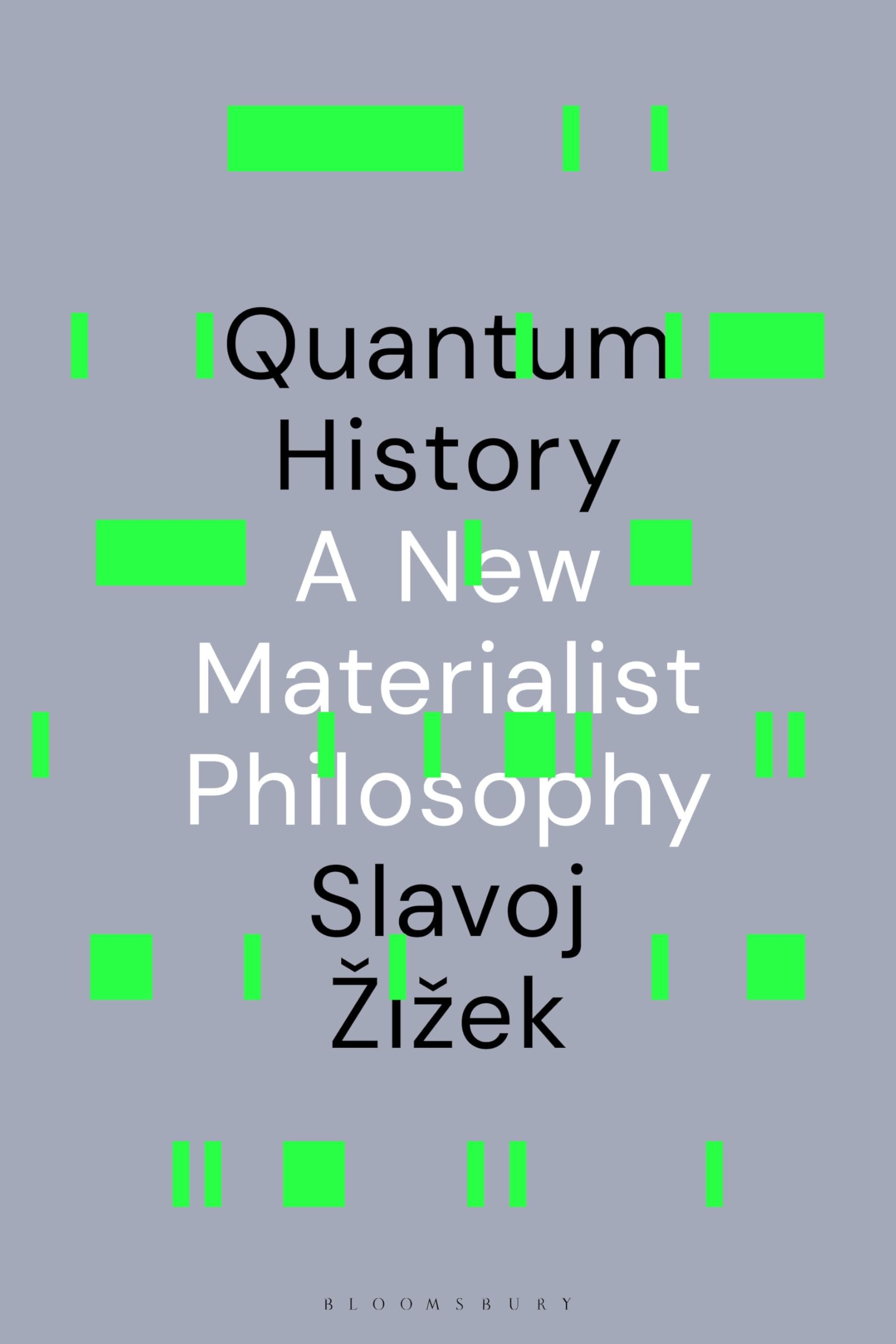
Quantum History: A New Materialist Philosophy by Slavoj Zizek – Rethinking Reality Through Quantum Mechanics and Dialect
Inclusive of all applicable taxes. FREE shipping on all orders.
Available Offers
- 🚚Free Delivery — Free shipping on all orders
- 💵Cash on Delivery — Pay when your order arrives
- ↩️15-Day Easy Returns — Hassle-free return policy
- 🔒Cash on Delivery — Pay safely when your order arrives
Check Delivery
Product Description
Introduction
Slavoj Žižek, one of the most provocative and intellectually audacious thinkers of our time, returns with a work that defies easy categorization. Quantum History: A New Materialist Philosophy is not just a book about physics or philosophy—it is a radical rethinking of how we understand time, reality, and political action. Published by Bloomsbury Academic and available in a durable hardcover edition, this volume challenges readers to step beyond conventional boundaries and engage with a materialist vision that is both deeply Hegelian and startlingly contemporary. For Indian readers and students drawn to critical theory, continental philosophy, or the intersections of science and society, this book offers a dense, rewarding, and often darkly humorous journey.
Book Overview
In Quantum History, Žižek takes up Lenin’s old challenge to revise materialism in light of each major scientific breakthrough. Rejecting the New Age spiritualism that often clings to quantum mechanics, he instead embraces its most unsettling implications. Drawing on concepts like the holographic universe, non-commutativity, and the collapse of superpositions, Žižek constructs a quantum-inspired ontology that reinvents historical materialism. This is not a simple summary of quantum theory, but a philosophical excavation that uses wave mechanics to rethink the very fabric of history, causality, and emancipatory politics. The book moves from the primordial void to the tensions of contemporary political moments, arguing that true radical change is possible only when we grasp the ontological incompleteness of reality itself.
Key Highlights
- Original synthesis: Merges Hegelian dialectics, Lacanian psychoanalysis, and quantum mechanics into a single, coherent philosophical framework.
- Political urgency: Connects abstract quantum concepts to concrete questions of revolutionary action and historical change.
- Critical edge: Offers a sharp critique of both scientific reductionism and vague spiritualist interpretations of quantum theory.
- Accessible erudition: Despite the complexity, Žižek’s characteristic wit and clarity make challenging ideas approachable for dedicated readers.
Inside the Book
The book is structured as a philosophical inquiry rather than a textbook. Early chapters establish the ontological stakes by examining the concept of the void and the paradoxes of quantum superposition. Žižek then moves through key themes such as non-commutativity—the idea that the order of measurement matters—and the holographic principle, which suggests that our three-dimensional reality might be a projection of information encoded on a distant surface. Each concept is used to illuminate a corresponding problem in Hegelian or Lacanian thought, from the nature of the subject to the logic of historical change. The final sections turn to politics, asking how a quantum-informed materialism can help us think about the possibility of radical emancipatory acts in a world that often seems locked into repetition.
Key Topics
- Quantum mechanics and ontological incompleteness
- Hegelian dialectics and the logic of contradiction
- Lacanian psychoanalysis and the Real
- The holographic universe and information theory
- Non-commutativity and the role of the observer
- Historical materialism in the age of quantum science
- Radical politics and the possibility of genuine change
Reader Benefits
- Deepen your philosophical toolkit: Gain a sophisticated understanding of how quantum theory can inform debates about reality, causality, and agency.
- Engage with contemporary critical theory: See how Žižek updates Marx, Hegel, and Lacan for the 21st century.
- Challenge your assumptions: The book forces readers to question linear notions of time and deterministic history.
- Enjoy intellectual provocation: Žižek’s signature style—equal parts rigorous and irreverent—makes even the most abstract ideas feel urgent.
Learning Outcomes
By reading Quantum History, you will be able to articulate the philosophical implications of quantum mechanics beyond popular science clichés. You will understand how concepts like superposition and entanglement can be used to rethink historical processes and political possibilities. You will also develop a critical perspective on both scientific realism and postmodern relativism, learning to navigate the tension between materialist necessity and contingent freedom. Ultimately, the book equips you to ask—and begin to answer—the question: what does it mean to act radically in a universe that is itself incomplete?
Who Should Read
- Students and scholars of philosophy, especially those interested in continental thought, Hegelianism, or Marxism.
- Readers of critical theory who want to explore the intersection of science and politics.
- Physics enthusiasts who are curious about the deeper philosophical stakes of quantum mechanics.
- Anyone who enjoys being intellectually challenged by one of the most original thinkers alive today.
About the Author
Slavoj Žižek is a Slovenian philosopher and psychoanalyst known for his provocative synthesis of Hegelian dialectics, Lacanian theory, and political critique. He is the author of dozens of books, including The Sublime Object of Ideology, Less Than Nothing, and Living in the End Times. A professor at the European Graduate School and a senior researcher at the University of Ljubljana, Žižek is celebrated for his ability to bring high theory into dialogue with popular culture, cinema, and current events. His work remains essential reading for anyone interested in the future of critical thought.
About the Publisher
Bloomsbury Academic is a leading international publisher of scholarly and educational books. Known for rigorous editorial standards and a commitment to innovative research, Bloomsbury Academic publishes works across the humanities and social sciences, including philosophy, cultural studies, and political theory. This hardcover edition reflects the publisher’s dedication to producing durable, high-quality books that serve students, researchers, and intellectually curious readers worldwide.
Conclusion
Quantum History: A New Materialist Philosophy is not a light read—it is a demanding, exhilarating, and transformative one. Slavoj Žižek invites you to rethink the foundations of reality and history through the lens of quantum mechanics, without ever losing sight of the political stakes. For those ready to grapple with the void, the observer, and the possibility of radical change, this book is an indispensable companion. Order your hardcover copy from Bookshops.in today and step into a new materialist universe.
Quick Summary
Quantum History: A New Materialist Philosophy by Slavoj Žižek is a groundbreaking work that fuses Hegelian dialectics, Lacanian psychoanalysis, and quantum mechanics to forge a radical materialist ontology. Rejecting the popular spiritualist interpretations of wave mechanics, Žižek instead embraces the philosophical implications of quantum theory—such as the holographic universe, non-commutativity, and the collapse of superpositions—to reinvent historical materialism. The book is aimed at advanced students and scholars of philosophy, political theory, and science studies, as well as anyone interested in a rigorous materialist approach to reality. Readers will learn to see history and political possibility through a quantum lens, challenging conventional notions of causality and determinism. This is not a pop-science book but a dense, provocative philosophical treatise that demands engagement. By purchasing from Bookshops.in, Indian readers gain access to a premium hardcover edition from Bloomsbury Academic, ensuring a durable and authoritative addition to their library.
Book Highlights
Book Specifications
| ISBN-13 | 9781350566422 |
| ISBN-10 | 135056642X |
| Publisher | Bloomsbury Academic |
| Language | English |
| Dimensions | 16.76 x 3.68 x 24.26 cm |
| Weight | 662 g |
| Category | Philosophy › History & Surveys |
| Genre | Philosophy |
| Original Language | English |
Frequently Asked Questions
What is Quantum History about?
Who is the author of Quantum History?
Do I need a background in physics to read this book?
Is this book suitable for Indian students?
What makes this book different from other quantum philosophy books?
Is Quantum History a political book?
Which publisher released Quantum History?
What is the ISBN of this book?
Is this book available in hardcover?
Can I use this book for my research on materialism?
Does Zizek engage with other philosophers in this book?
What is the price of Quantum History in India?
Where can I buy this book in India?
Readers Also Search For
Customers Also Bought
Islam
Spiritual Economies (English, Daromir Rudnyckyj)

Islam
Who Is Allah? (English, Bruce B. Lawrence)

Islam
Islam and Liberal Citizenship: The Search for an Overlapping Consensus by Andrew F. March

Islam
Fiqh Us-Sunnah: Funerals and Diggers by Al-Sayyid Sabiq – Islamic Funeral Guide

Christianity
Genetics (English, Thomas a. Shannon | Mark P. Aulisio | Françoise Baylis)

Hinduism
Karma and Creativity by Christopher Key Chapple – Indian Philosophy
Related Products
View All
Philosophy
Latin American Philosophy: Currents, Issues, Debates by Eduardo Mendieta

Philosophy
Al-Farabi's Short Commentary on Aristotle's Prior Analytics by Nicholas Rescher – Philosophy

Philosophy
Poetics of Imagining: Modern to Post-modern by Richard Kearney
Philosophy
The Metaphysics of Extrinsic Properties: 11 (Metaphysical Research, 11)
Philosophy
Dialogues on Metaphysics and on Religion by Nicolas Malebranche – Philosophy
Philosophy