
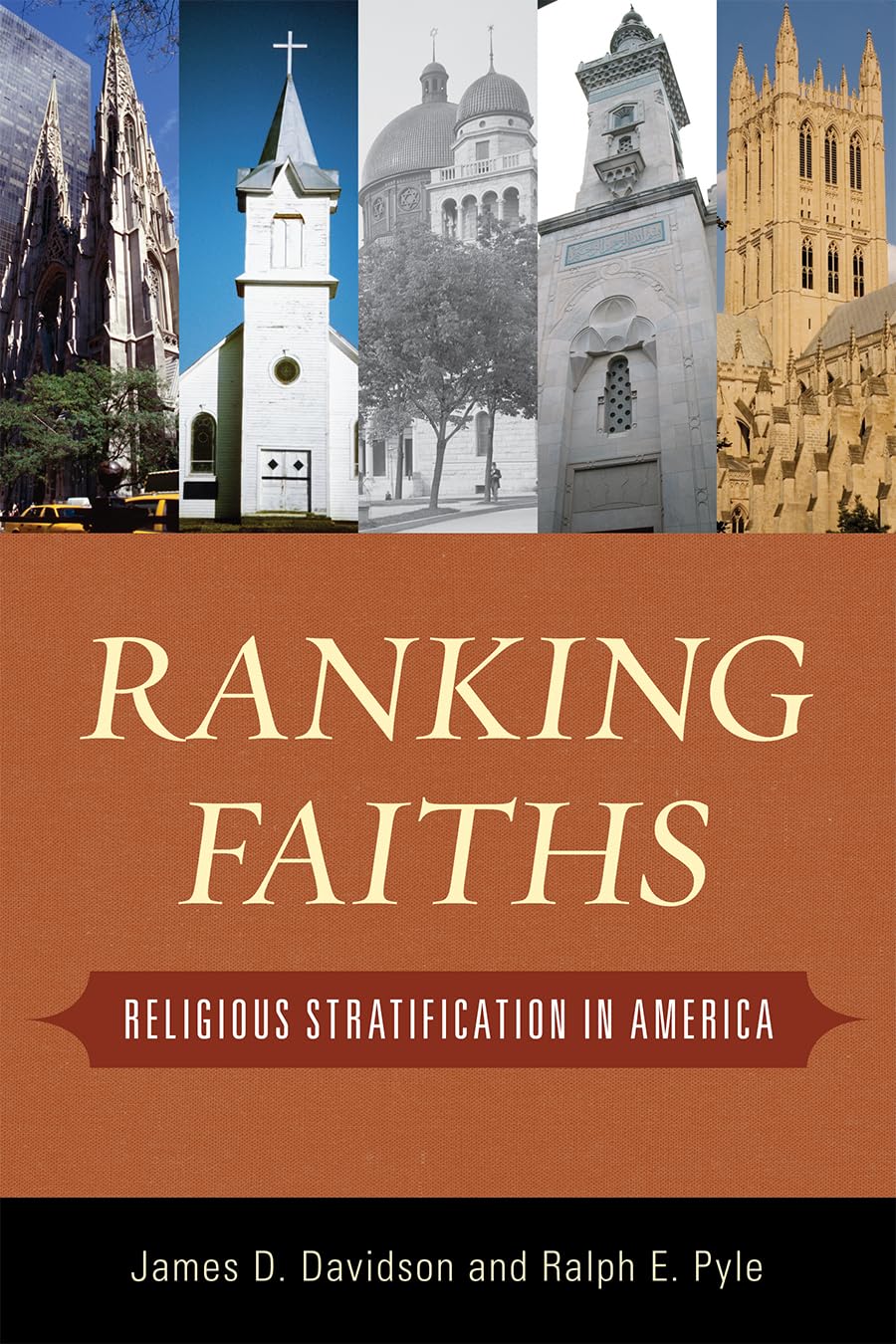
Ranking Faiths: Religious Stratification in America by James D. Davidson – A Deep Dive into Religion, Power, and Social
Inclusive of all applicable taxes. FREE shipping on all orders.
Available Offers
- 🚚Free Delivery — Free shipping on all orders
- 💵Cash on Delivery — Pay when your order arrives
- ↩️15-Day Easy Returns — Hassle-free return policy
- 🔒Cash on Delivery — Pay safely when your order arrives
Check Delivery
Product Description
Introduction
In a nation often celebrated for its commitment to freedom and equality, the role of religion as a silent architect of social hierarchy remains a deeply overlooked reality. Ranking Faiths: Religious Stratification in America by James D. Davidson is a groundbreaking work that challenges the popular myth of universal religious tolerance. For Indian readers, students of sociology, and anyone interested in the intersection of faith and power, this book offers a compelling lens through which to understand how religion—much like caste in other contexts—has historically shaped access to resources, status, and influence. This hardcover edition from Rowman & Littlefield Publishers is an essential addition to any serious library on social stratification.
Book Overview
This meticulously researched volume dismantles the idea that America was founded on a principle of equal respect for all faiths. Instead, Davidson and his co-author Ralph E. Pyle trace a clear lineage of religious inequality from the colonial era to the present day. The book argues that certain religious groups have consistently enjoyed greater access to economic opportunities, political power, and social prestige, while others have been systematically marginalized. By examining laws, customs, and institutional practices, Ranking Faiths reveals how religious hierarchies have persisted, evolved, and adapted over centuries. It is not merely a historical account but a critical analysis of the mechanisms that maintain religious stratification in modern society.
Key Highlights
- Historical Depth: Covers over 400 years of American history, from Puritan settlements to contemporary debates.
- Empirical Evidence: Uses data on income, education, occupational prestige, and political representation to map religious status.
- Comparative Framework: Offers a unique lens for Indian readers to compare religious stratification in America with caste and communal dynamics in India.
- Upward Mobility Analysis: Documents how groups like Catholics and Jews have risen in status, while others remain static.
- Policy Implications: Discusses how laws have historically favored some faiths over others, impacting everything from land ownership to marriage rights.
Inside the Book
The book is structured to guide readers through the evolution of religious inequality. It begins with the early colonial period, where established churches held legal and social dominance. Subsequent chapters explore the 19th-century waves of immigration, the rise of nativist movements, and the gradual—but incomplete—expansion of religious pluralism. The authors pay close attention to the experiences of minority faiths, including Mormons, Muslims, Hindus, and atheists. A particularly striking section examines how religious stratification intersects with race and ethnicity, creating compounded disadvantages. The final chapters address contemporary issues such as the role of religion in political elections, workplace discrimination, and the persistence of unspoken social hierarchies in everyday life.
Key Topics
- Origins of religious stratification in colonial America
- The Protestant establishment and its legal privileges
- Immigration, nativism, and religious prejudice
- The socioeconomic mobility of Catholics and Jews
- Stagnation of status for evangelical and sectarian groups
- Race, ethnicity, and religion as intersecting hierarchies
- Contemporary religious discrimination in housing, employment, and politics
- Comparative perspectives on faith and social power
Reader Benefits
This book empowers readers to see beyond surface-level narratives of religious freedom. For students of sociology, political science, and religious studies, it provides a rigorous theoretical framework supported by real-world data. Indian readers will find striking parallels to India's own religious hierarchies, making it a valuable resource for comparative analysis. The book also equips activists, policymakers, and educators with the language and evidence needed to challenge religious inequality. By understanding how privilege is structured and maintained, readers can become more critical participants in conversations about justice, inclusion, and secularism.
Learning Outcomes
- Understand the historical roots of religious inequality in America
- Identify the mechanisms—legal, economic, and cultural—that sustain religious stratification
- Analyze the socioeconomic status of different religious groups using empirical data
- Critique the myth of universal religious equality in democratic societies
- Apply comparative frameworks to understand religious dynamics in India and other pluralistic nations
- Develop informed perspectives on contemporary debates about religious freedom and discrimination
Who Should Read
This book is ideal for university students and faculty in sociology, religious studies, American history, and political science. It is also highly relevant for Indian scholars studying social stratification, caste, and communalism. Journalists, policymakers, and religious leaders seeking a deeper understanding of how faith shapes public life will find it indispensable. Additionally, general readers with an interest in social justice, inequality, or American culture will appreciate its accessible yet scholarly tone. Anyone who has ever wondered why some religions seem to carry more social weight than others will find this book enlightening.
About the Author
James D. Davidson is a distinguished professor emeritus of sociology at Purdue University, where he specialized in the sociology of religion and social stratification. With decades of research experience, Davidson has published extensively on how religious institutions interact with social class, race, and power. His work is known for its rigorous empirical grounding and its willingness to challenge conventional wisdom. Ranking Faiths represents the culmination of his career-long inquiry into the hidden hierarchies that shape American society. Davidson's co-author, Ralph E. Pyle, is a respected scholar in his own right, and together they bring a balanced, data-driven perspective to a topic often clouded by ideology.
About the Publisher
Rowman & Littlefield Publishers is a leading independent academic and trade publisher based in the United States. Known for producing high-quality scholarly works, the publisher has a strong reputation in the fields of sociology, political science, and religious studies. This hardcover edition is crafted with durable binding and premium paper, making it suitable for both library collections and personal study. Rowman & Littlefield's commitment to intellectual rigor and accessible scholarship aligns perfectly with the depth and relevance of Ranking Faiths.
Conclusion
Ranking Faiths: Religious Stratification in America is more than a book—it is a necessary corrective to the myths that surround religion and equality. For Indian readers, it offers a powerful mirror to examine their own society's religious hierarchies while providing a masterclass in sociological analysis. Whether you are a student, a scholar, or a curious citizen, this hardcover edition from Bookshops.in will challenge your assumptions and deepen your understanding of how faith truly operates in the public sphere. Do not miss the opportunity to own this essential work.
Quick Summary
Ranking Faiths: Religious Stratification in America by James D. Davidson is a groundbreaking sociological work that dismantles the popular myth of religious equality in the United States. The book traces how certain religious groups—primarily Protestant denominations—have historically enjoyed greater access to economic wealth, political power, and social prestige, while others like Catholics, Jews, and later non-Christian faiths have faced discrimination and marginalization. Drawing on extensive historical and sociological evidence, Davidson and co-author Ralph E. Pyle show that laws, customs, and social practices have systematically maintained religious inequality from the colonial era through the present day. The book also documents the significant upward mobility experienced by some groups, such as Catholics and Jews, over time. This title is ideal for Indian students and scholars of sociology, religious studies, American history, and social stratification. Readers will gain a nuanced understanding of how religion intersects with class, race, and power in one of the world's most influential democracies. By purchasing from Bookshops.in, customers receive an authentic hardcover edition with reliable delivery across India.
Book Highlights
Book Specifications
| ISBN-13 | 9781442208537 |
| ISBN-10 | 1442208538 |
| Publisher | Rowman & Littlefield Pub Inc |
| Language | English |
| Dimensions | 15.24 x 1.73 x 22.86 cm |
| Weight | 522 g |
| Category | Religious Studies › Theology & Philosophy of Religion |
| Genre | Nonfiction |
| Original Language | English |
Frequently Asked Questions
What is Ranking Faiths about?
Who is the author of Ranking Faiths?
Is this book suitable for Indian readers?
What time period does the book cover?
Does the book discuss only Christianity?
Is this a textbook or a general read?
What is the main argument of the book?
Does the book offer solutions to religious inequality?
Can I use this book for my sociology thesis?
Is the book based on original research?
What makes this book different from others on religion?
Is the book available in Indian bookstores?
Readers Also Search For
Customers Also Bought
Islam
Spiritual Economies (English, Daromir Rudnyckyj)

Islam
Who Is Allah? (English, Bruce B. Lawrence)
Islam
Islam and Liberal Citizenship: The Search for an Overlapping Consensus by Andrew F. March

Islam
Fiqh Us-Sunnah: Funerals and Diggers by Al-Sayyid Sabiq – Islamic Funeral Guide

Christianity
Genetics (English, Thomas a. Shannon | Mark P. Aulisio | Françoise Baylis)

Hinduism
Karma and Creativity by Christopher Key Chapple – Indian Philosophy
Related Products
View All
Religion & Spirituality
Spiritual Competency in Psychotherapy | by Philip Brownell | Springer Publishing Company | by Philip Brownell | Springer Publishing Company | by Philip Brownell | Springer Publishing Company | by Philip Brownell | Springer Publishing Company | by Philip Brownell | Springer Publishing Company | by Philip Brownell | Springer Publishing Company | by Philip Brownell | Springer Publishing Company | by Philip Brownell | Springer Publishing Company | by Philip Brownell | Springer Publishing Company | b
Religion & Spirituality
Religion as a Conversation Starter | by Ina Merdjanova | Continuum | by Ina Merdjanova | Continuum | by Ina Merdjanova | Continuum | by Ina Merdjanova | Continuum | by Ina Merdjanova | Continuum | by Ina Merdjanova | Continuum | by Ina Merdjanova | Continuum | by Ina Merdjanova | Continuum | by Ina Merdjanova | Continuum | by Ina Merdjanova | Continuum | by Ina Merdjanova | Continuum | by Ina Merdjanova | Continuum | by Ina Merdjanova | Continuum | by Ina Merdjanova | Continuum | by Ina Merdjano

Religion & Spirituality
The Other Jewish Question: Identifying the Jew and Making Sense of Modernity
Religion & Spirituality
The Oxford Guide to People & Places of the Bible | by Bruce M. Metzger | Michael D. Coogan | Oxford University Press | by Bruce M. Metzger | Michael D. Coogan | Oxford University Press | by Bruce M. Metzger | Michael D. Coogan | Oxford University Press | by Bruce M. Metzger | Michael D. Coogan | Oxford University Press | by Bruce M. Metzger | Michael D. Coogan | Oxford University Press | by Bruce M. Metzger | Michael D. Coogan | Oxford University Press | by Bruce M. Metzger | Michael D. Coogan |

Religion & Spirituality
Anti-Judaism in Early Christianity | by Stephen G. Wilson | Wilfrid Laurier University Press | by Stephen G. Wilson | Wilfrid Laurier University Press | by Stephen G. Wilson | Wilfrid Laurier University Press | by Stephen G. Wilson | Wilfrid Laurier University Press | by Stephen G. Wilson | Wilfrid Laurier University Press | by Stephen G. Wilson | Wilfrid Laurier University Press | by Stephen G. Wilson | Wilfrid Laurier University Press | by Stephen G. Wilson | Wilfrid Laurier University Press |

Religion & Spirituality