
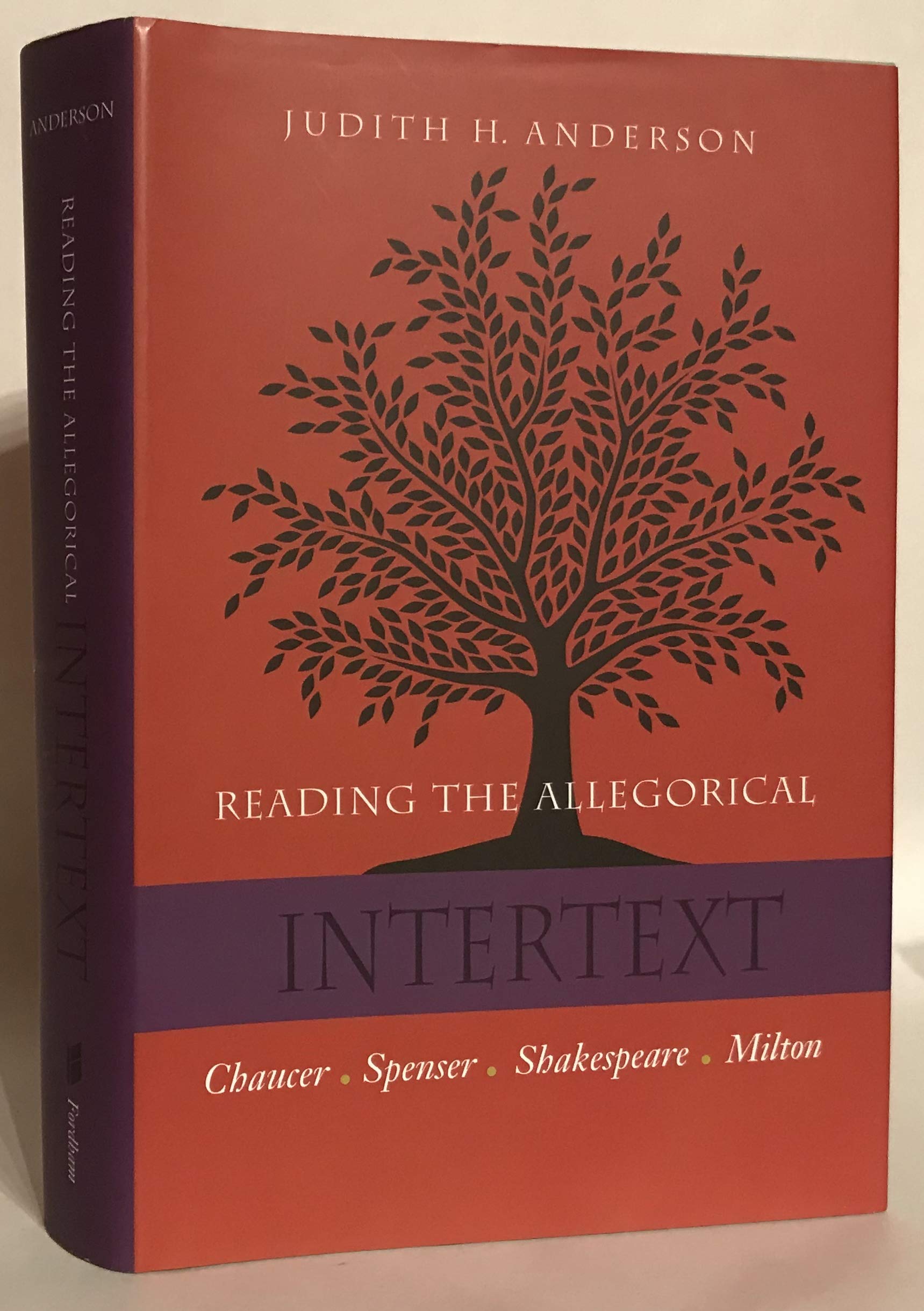
Reading the Allegorical Intertext: Chaucer, Spenser, Shakespeare, Milton by Judith H. Anderson – A Deep Dive into Allego
Inclusive of all applicable taxes. FREE shipping on all orders.
Available Offers
- 🚚Free Delivery — Free shipping on all orders
- 💵Cash on Delivery — Pay when your order arrives
- ↩️15-Day Easy Returns — Hassle-free return policy
- 🔒Cash on Delivery — Pay safely when your order arrives
Check Delivery
Product Description
Introduction
In the vast landscape of literary criticism, few works manage to bridge the medieval and early modern periods with the depth and nuance that Judith H. Anderson achieves in Reading the Allegorical Intertext: Chaucer, Spenser, Shakespeare, Milton. This hardcover volume, published by Fordham University Press, is a rigorous exploration of how allegory functions as a dynamic, connective tissue between some of the most influential texts in English literature. For Indian students and scholars of English literature, this book offers a sophisticated framework for understanding the intertextual conversations that shape canonical works.
Book Overview
Judith H. Anderson reimagines the concept of the intertext not merely as a network of influences and allusions, but as a living, allegorical space where meaning is continually generated. Centering on Edmund Spenser's The Faerie Queene, the book traces allegorical threads that weave through Geoffrey Chaucer's dream visions, William Shakespeare's late romances, and John Milton's epic poetry. Anderson argues that allegory is both a mimetic and psychic process—a form of thinking that merges emblem with narrative, mind with matter. This is not a dry academic treatise; it is a vibrant invitation to see literature as a conversation across centuries.
Key Highlights
- Intertextual Framework: Expands traditional notions of influence to include Kristevan intertextuality, linguistic play, and sociocultural determinism.
- Allegorical Focus: Treats allegory as a continued metaphor that magnifies the process of signification itself.
- Canonical Authors: Offers fresh readings of Chaucer, Spenser, Shakespeare, and Milton, demonstrating their interconnectedness.
- Critical Methodology: Provides a model for analyzing texts that is both historically grounded and theoretically sophisticated.
- Scholarly Rigor: Written with clarity and depth, suitable for advanced undergraduate and postgraduate study.
Inside the Book
The book is structured around close readings that move chronologically through English literary history. Anderson begins with Chaucer's allegorical dream visions, showing how they establish a mode of poetic thinking that Spenser would later expand. The central chapters on The Faerie Queene reveal how Spenser's allegory functions as a 'place of potential' where meaning is never fixed. The analysis then shifts to Shakespeare's use of allegorical elements in plays like The Winter's Tale and The Tempest, before culminating in Milton's Paradise Lost, where allegory becomes a vehicle for theological and political inquiry. Each chapter is dense with textual evidence and critical insight, making this a rewarding read for those who enjoy literary detective work.
Key Topics
- Allegory as continued metaphor and process thinking
- Intertextuality and the relationship between texts
- Influence, imitation, and citation in literary history
- The Faerie Queene as a pivotal allegorical work
- Chaucer's dream visions and their legacy
- Shakespeare's late romances and allegorical drama
- Milton's epic allegory and theological meaning
- Individual agency versus sociocultural determinism in literature
Reader Benefits
This book equips readers with a powerful lens for interpreting not just the four authors studied, but any text that employs allegory or engages with a literary tradition. Indian students preparing for competitive exams like UGC-NET or pursuing advanced degrees will find Anderson's methodology directly applicable to their own research. The book also enriches classroom discussions by showing how literature is never written in isolation. For teachers, it offers ready-made frameworks for designing courses on intertextuality or allegory. The hardcover edition is durable and well-bound, making it a lasting addition to any academic library.
Learning Outcomes
- Understand the concept of the allegorical intertext and its critical applications
- Analyze how Chaucer, Spenser, Shakespeare, and Milton influence one another
- Identify allegorical structures and metaphors in literary texts
- Evaluate the role of individual authorship within broader cultural contexts
- Apply intertextual reading strategies to other works of literature
- Develop a nuanced appreciation of allegory as both form and process
Who Should Read
This book is essential for postgraduate students of English literature, particularly those specializing in medieval, Renaissance, or early modern studies. It is also highly recommended for faculty members designing syllabi on allegory, intertextuality, or the history of criticism. Undergraduate honors students with a strong grounding in literary theory will find it challenging but accessible. Additionally, independent scholars and avid readers who enjoy deep, analytical approaches to classic texts will discover new layers of meaning in familiar works.
About the Author
Judith H. Anderson is a distinguished scholar of English literature, known for her expertise in medieval and Renaissance poetry. She has taught at Indiana University Bloomington and has published extensively on Spenser, allegory, and intertextuality. Her work is characterized by a rare combination of theoretical sophistication and meticulous close reading. In Reading the Allegorical Intertext, she brings decades of scholarship to bear on the question of how texts speak to one another across time.
About the Publisher
Fordham University Press, based in New York, is a respected academic publisher known for its contributions to literary studies, philosophy, and the humanities. Their catalog includes works that push the boundaries of critical thought while maintaining the highest standards of editorial quality. This hardcover edition reflects their commitment to producing durable, beautifully printed books that are a pleasure to own and read.
Conclusion
Reading the Allegorical Intertext is not just a book about four great authors; it is a masterclass in how to read literature itself. Judith H. Anderson shows us that allegory is not a dusty relic of the past but a living, breathing mode of thought that continues to shape how we understand the world. For anyone serious about the study of English literature, this volume is an indispensable companion. Order your copy from Bookshops.in today and begin a journey through the allegorical landscapes of Chaucer, Spenser, Shakespeare, and Milton.
Quick Summary
Reading the Allegorical Intertext by Judith H. Anderson is a rigorous scholarly work that examines how allegory operates as an intertextual phenomenon in the poetry of Chaucer, Spenser, Shakespeare, and Milton. Anderson redefines the intertext as both a theoretical space—drawing on Julia Kristeva’s concept of intertextuality—and a practical relationship encompassing influence, imitation, allusion, and citation. The book argues that allegory, understood as continuous or moving metaphor, magnifies the process of signification and reveals the interplay between authorial agency and sociocultural determinism. Spenser’s Faerie Queene serves as the pivotal text, but the study ranges widely to show how Chaucer’s dream visions, Shakespeare’s dramatic allegories, and Milton’s epic Paradise Lost engage in a dynamic intertextual dialogue. This book is ideal for Indian postgraduate students, researchers, and faculty in English literature who want to deepen their understanding of allegorical traditions and intertextual theory. Readers will gain critical tools for analyzing poetic influence and linguistic play. By purchasing from Bookshops.in, Indian readers receive a genuine hardcover edition with fast, reliable service, ensuring this essential academic resource arrives in pristine condition.
Book Highlights
Book Specifications
| ISBN-13 | 9780823228478 |
| ISBN-10 | 0823228479 |
| Publisher | Fordham Univ Pr |
| Language | English |
| Dimensions | 15.88 x 3.18 x 22.86 cm |
| Weight | 771 g |
| Country | India |
| Category | Literature › English Literature |
| Genre | Literary Criticism |
| Original Language | English |
Frequently Asked Questions
What is Reading the Allegorical Intertext about?
Who is Judith H. Anderson?
Is this book suitable for Indian students?
What literary theory does the book use?
Does the book cover Shakespeare’s plays?
Why is Spenser’s Faerie Queene central?
What is the ISBN of this book?
Is this book available in paperback?
Can I use this book for my PhD research?
What language is the book written in?
How does this book differ from other studies on allegory?
Does the book include a bibliography?
Why buy from Bookshops.in?
Readers Also Search For
Customers Also Bought

McFarland & Company
Playing with the Guys | by Marc A. Ouellette | Matthew Wilhelm Kapell | McFarland & Company | by Marc A. Ouellette | Matthew Wilhelm Kapell | McFarland & Company | by Marc A. Ouellette | Matthew Wilhelm Kapell | McFarland & Company | by Marc A. Ouellette | Matthew Wilhelm Kapell | McFarland & Company | by Marc A. Ouellette | Matthew Wilhelm Kapell | McFarland & Company | by Marc A. Ouellette | Matthew Wilhelm Kapell | McFarland & Company | by Marc A. Ouellette | Matthew W
Rowman & Littlefield Publishers
Joss Whedon's Dollhouse: Confounding Purpose, Confusing Identity (Science Fiction Television)

State University of New York Press
Mexico Unmanned: The Cultural Politics of Masculinity in Mexican Cinema (SUNY series in Latin American Cinema)

McFarland & Company
Valley Forge to Monmouth | by Jim Stempel | McFarland & Company | by Jim Stempel | McFarland & Company | by Jim Stempel | McFarland & Company | by Jim Stempel | McFarland & Company | by Jim Stempel | McFarland & Company | by Jim Stempel | McFarland & Company | by Jim Stempel | McFarland & Company | by Jim Stempel | McFarland & Company | by Jim Stempel | McFarland & Company | by Jim Stempel | McFarland & Company | by Jim Stempel | McFarland & Company |
University of Toronto Press
Structures of Feeling in Seventeenth-Century Cultural Expression (UCLA Center Clark Library)
McFarland & Company
Welcome to Arkham Asylum | by Sharon Packer | Daniel R. Fredrick | McFarland & Company | by Sharon Packer | Daniel R. Fredrick | McFarland & Company | by Sharon Packer | Daniel R. Fredrick | McFarland & Company | by Sharon Packer | Daniel R. Fredrick | McFarland & Company | by Sharon Packer | Daniel R. Fredrick | McFarland & Company | by Sharon Packer | Daniel R. Fredrick | McFarland & Company | by Sharon Packer | Daniel R. Fredrick | McFarland & Company | by Sharon P
Related Products
View All
Fordham University Press
Between Page and Screen: Remaking Literature Through Cinema and Cyberspace (Verbal Arts : Studies in Poetics)
Fordham University Press
G.K. Chesterton: Philosopher Without Portfolio

Fordham University Press
Imperfect Equality: African Americans and the Confines of White Racial Attitudes in Post-Emancipation Maryland (Reconstructing America, 2)
Fordham University Press
Communicating When Your Company Is Under Siege: Surviving Public Crisis

Fordham University Press
Vertigo: The Temptation of Identity by Andrea Cavalletti – Philosophy
Fordham University Press