
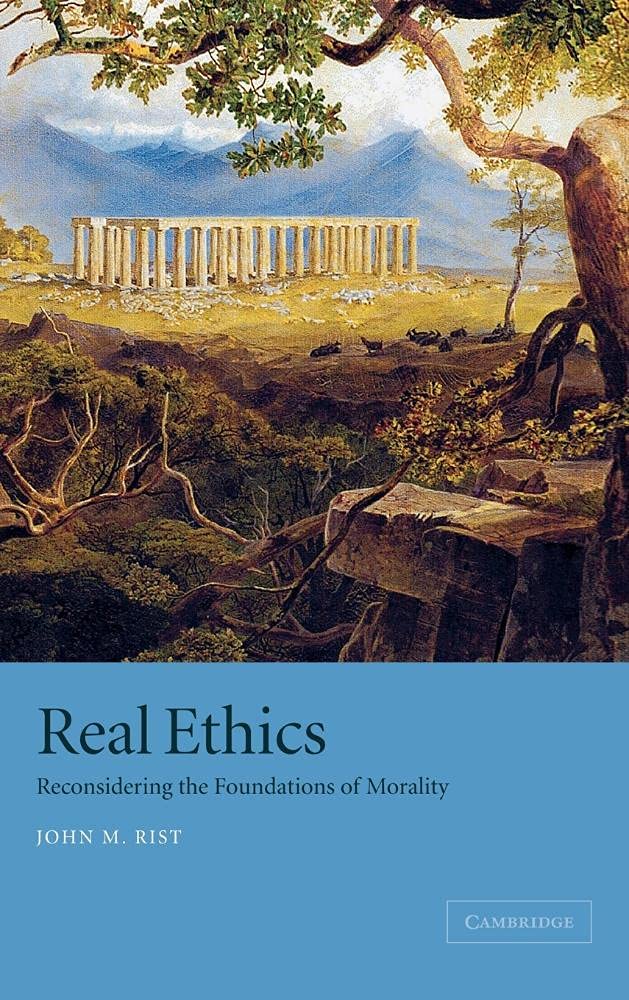
Real Ethics: Reconsidering the Foundations of Morality by John M. Rist – A Philosophical Defence of Platonic Realism in
Inclusive of all applicable taxes. FREE shipping on all orders.
Available Offers
- 🚚Free Delivery — Free shipping on all orders
- 💵Cash on Delivery — Pay when your order arrives
- ↩️15-Day Easy Returns — Hassle-free return policy
- 🔒Cash on Delivery — Pay safely when your order arrives
Check Delivery
Product Description
Introduction
In an age where moral certainties are often questioned and ethical frameworks seem to shift with cultural tides, John M. Rist’s Real Ethics: Reconsidering the Foundations of Morality offers a profound and timely re-examination of the very ground on which our moral judgments rest. This hardcover edition, published by the prestigious Cambridge University Press, is an essential acquisition for Indian students, scholars, and anyone seeking a rigorous yet accessible exploration of ethics. Rist takes the reader on a sweeping intellectual journey from Plato to the present, making a compelling case for a revitalised Platonic realism as the only coherent basis for morality in a post-Christian world.
Book Overview
Real Ethics is not merely a history of moral philosophy; it is a bold philosophical argument. John Rist surveys the major ethical traditions—from ancient Greek thought through to Enlightenment theories and contemporary postmodern critiques—and demonstrates why most modern ethical systems are, in his view, built on borrowed metaphysical capital. The book argues that without a grounding in a transcendent moral order, theories of practical reason, choice, and justice become arbitrary. Written in a lively and engaging style, this 2001 study remains startlingly relevant for readers in India, where debates about tradition, modernity, and moral authority are ever-present.
Key Highlights
- A sweeping historical survey of Western ethics from Plato and Aristotle to Epicurus, Hobbes, Hume, Kant, and Nietzsche.
- A robust defence of Platonic realism as a foundation for objective moral values.
- Critical analysis of post-Enlightenment ethical theories, exposing their reliance on abandoned Christian metaphysics.
- Engaging with contemporary choice-based theories in both ethics and politics, showing their ultimate arbitrariness.
- Accessible prose that makes complex philosophical ideas understandable for students and general readers alike.
Inside the Book
Rist begins by revisiting Plato’s ethical realism, arguing that the Forms—especially the Form of the Good—provide a non-arbitrary standard for human conduct. He then traces how later philosophers, from Epicurus to the moderns, attempted to ground morality in human desire, reason, or social contract, only to encounter insurmountable problems. The book devotes significant attention to Immanuel Kant’s deontological ethics and David Hume’s sentimentalism, highlighting their strengths and weaknesses. Perhaps most provocatively, Rist argues that Nietzsche’s attack on morality, as well as contemporary postmodern scepticism, gains its force only because the Christian worldview that once supported moral objectivity has been abandoned, leaving a vacuum that no secular theory can fill.
Key Topics
- Platonic realism and the Form of the Good
- Epicurean and Hobbesian egoism
- Hume’s moral sentimentalism and the is-ought problem
- Kantian deontology and the categorical imperative
- Nietzsche’s critique of morality and the will to power
- Contemporary practical reason theories and their limitations
- The relationship between metaphysics, religion, and ethics
- Moral objectivity in a pluralistic world
Reader Benefits
This book offers Indian readers a unique opportunity to engage with Western philosophy from a perspective that respects tradition while confronting modern challenges. It helps clarify why many contemporary ethical debates—whether about justice, rights, or the good life—often reach an impasse. By understanding Rist’s argument, readers will gain a deeper appreciation for the intellectual history behind moral concepts and develop the tools to critically evaluate ethical claims in academia, law, politics, and everyday life.
Learning Outcomes
- Gain a comprehensive understanding of major ethical theories from antiquity to the present.
- Learn to critically analyse the assumptions behind modern moral and political philosophies.
- Develop the ability to articulate and defend a realist position in ethics.
- Understand the historical and metaphysical underpinnings of contemporary moral debates.
- Enhance your philosophical reasoning and argumentation skills.
Who Should Read
Real Ethics is ideal for undergraduate and postgraduate students of philosophy, ethics, and political science in Indian universities. It will also appeal to teachers, researchers, and general readers with an interest in moral philosophy, intellectual history, or the intersection of religion and ethics. Anyone puzzled by the relativism of modern discourse and seeking a reasoned alternative will find this book intellectually stimulating and deeply rewarding.
About the Author
John M. Rist is a renowned scholar of ancient and moral philosophy, having taught at prestigious institutions including the University of Cambridge, the University of Toronto, and the Catholic University of America. His extensive work on Plato, Aristotle, and early Christian thought has earned him international acclaim. In Real Ethics, he brings together decades of philosophical insight to address one of the most pressing questions of our time: can morality survive without a transcendent foundation?
About the Publisher
Cambridge University Press is one of the world’s oldest and most respected academic publishers, with a history dating back to 1534. Known for its rigorous editorial standards and scholarly excellence, Cambridge University Press is a trusted source for authoritative works in philosophy, science, and the humanities. This hardcover edition is produced to the highest quality, making it a durable addition to any personal or institutional library.
Conclusion
In a philosophical landscape often dominated by relativism and scepticism, Real Ethics: Reconsidering the Foundations of Morality stands as a courageous and intellectually rigorous work. John Rist’s defence of Platonic realism offers a coherent and compelling alternative for those who believe that moral values are more than mere preferences or social constructs. For Indian readers seeking to understand the roots of ethical thought and to engage with the most profound questions of human existence, this book is an indispensable companion. Order your copy from Bookshops.in today and embark on a journey to the very foundations of morality.
Quick Summary
'Real Ethics: Reconsidering the Foundations of Morality' by John M. Rist is a profound exploration of the history of Western moral philosophy, from Plato to Nietzsche and beyond. Rist argues that most post-Enlightenment ethical theories—whether derived from Epicurus, Hobbes, Hume, Kant, or contemporary practical reasoners—are unintelligible without the Christian metaphysic they have abandoned. He offers a vigorous defence of a revised Platonic realism as the only coherent foundation for objective morality. The book is ideal for Indian students and scholars of philosophy, ethics, and theology who seek a rigorous yet accessible critique of modern moral theories. Readers will gain a deep understanding of the philosophical underpinnings of ethical systems and learn why choice-based ethics may be ultimately arbitrary. By purchasing from Bookshops.in, you get a genuine Cambridge University Press hardcover delivered free across India, along with our commitment to quality and customer satisfaction.
Book Highlights
Book Specifications
| ISBN-13 | 9780521809214 |
| ISBN-10 | 0521809215 |
| Publisher | Cambridge University Press |
| Language | English |
| Dimensions | 15.88 x 1.91 x 22.86 cm |
| Weight | 528 g |
| Country | India |
| Category | Philosophy › Ethics |
| Genre | Non-fiction |
| Original Language | English |
Frequently Asked Questions
What is 'Real Ethics: Reconsidering the Foundations of Morality' about?
Who is the author of this book?
Is this book suitable for beginners in philosophy?
Which philosophers are discussed in the book?
What is the main argument of the book?
Is this a textbook or a scholarly monograph?
Does the book cover Eastern or Indian ethical traditions?
Can I use this book for a university course on ethics?
What is the price of the book on Bookshops.in?
Does Bookshops.in deliver across India?
What is the ISBN of this book?
Is this book part of a series?
Readers Also Search For
Customers Also Bought
Islam
Spiritual Economies (English, Daromir Rudnyckyj)

Islam
Who Is Allah? (English, Bruce B. Lawrence)
Islam
Islam and Liberal Citizenship: The Search for an Overlapping Consensus by Andrew F. March
Islam
Fiqh Us-Sunnah: Funerals and Diggers by Al-Sayyid Sabiq – Islamic Funeral Guide

Christianity
Genetics (English, Thomas a. Shannon | Mark P. Aulisio | Françoise Baylis)

Hinduism
Karma and Creativity by Christopher Key Chapple – Indian Philosophy
Related Products
View All
Philosophy
Latin American Philosophy: Currents, Issues, Debates by Eduardo Mendieta

Philosophy
Al-Farabi's Short Commentary on Aristotle's Prior Analytics by Nicholas Rescher – Philosophy
Philosophy
Poetics of Imagining: Modern to Post-modern by Richard Kearney

Philosophy
The Metaphysics of Extrinsic Properties: 11 (Metaphysical Research, 11)
Philosophy
Dialogues on Metaphysics and on Religion by Nicolas Malebranche – Philosophy
Philosophy