
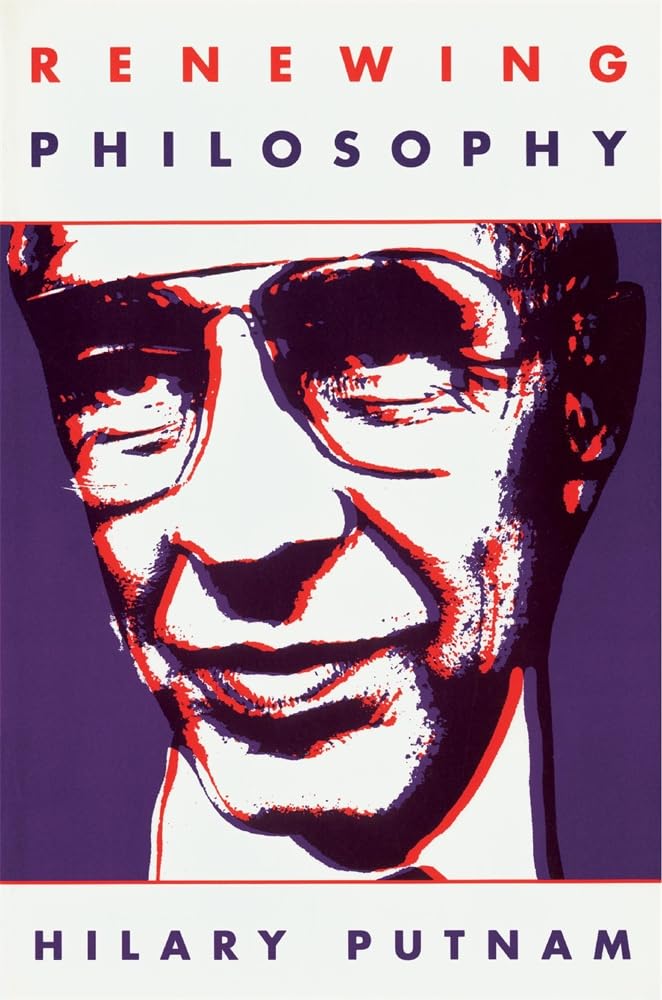
Renewing Philosophy: A Critical Examination of Scientism and the Case for Normative Inquiry by Hilary Putnam
Inclusive of all applicable taxes. FREE shipping on all orders.
Available Offers
- 🚚Free Delivery — Free shipping on all orders
- 💵Cash on Delivery — Pay when your order arrives
- ↩️15-Day Easy Returns — Hassle-free return policy
- 🔒Cash on Delivery — Pay safely when your order arrives
Check Delivery
Product Description
Introduction
In an age where scientific reasoning often dominates intellectual discourse, philosophy faces a critical question: can it reclaim its rightful place as a distinct mode of inquiry? Hilary Putnam's Renewing Philosophy offers a compelling answer. This landmark work challenges the reductionist trends that have long confined philosophical thought within the narrow boundaries of scientific methodology. For Indian students and scholars navigating the crossroads of tradition and modernity, Putnam's insights provide a refreshing perspective on how philosophy can engage with the deepest questions of meaning, ethics, and reality without surrendering to the allure of purely empirical models.
Book Overview
Renewing Philosophy is a bold and sweeping critique of the idea that only the natural sciences can serve as a legitimate model for philosophical inquiry. Hilary Putnam, one of the most influential American philosophers of the twentieth century, argues that this reductive approach has impoverished philosophy by ignoring the normative dimensions of human experience—such as values, intentions, and meanings. Through a series of incisive essays, Putnam examines topics ranging from artificial intelligence to evolutionary theory, demonstrating how these scientific paradigms, when applied uncritically, lead to philosophical dead ends. He calls for a renewal that restores philosophy's autonomy and its capacity to address normative questions on their own terms.
Key Highlights
- A bold defence of philosophy's independence from the dominance of scientific reductionism.
- Engaging critiques of influential theories in artificial intelligence, cognitive science, and natural selection.
- Clear, accessible prose that makes complex philosophical arguments understandable to non-specialists.
- Integration of analytic and pragmatic traditions, showing how American pragmatism can revitalise contemporary philosophy.
- Thought-provoking discussions on ethics, meaning, and the nature of reality.
Inside the Book
The book is structured as a collection of interconnected essays, each tackling a specific philosophical problem. Putnam begins by questioning the assumption that philosophy must imitate science to be credible. He then moves through a series of case studies: the limits of artificial intelligence in capturing human understanding, the misuse of evolutionary theory to explain moral behaviour, and the failure of reductive accounts of mental content. Throughout, Putnam weaves in references to classical pragmatists like William James and John Dewey, as well as contemporary thinkers, to build a case for a philosophy that is both rigorous and humane. The final chapters offer a vision of how philosophy can renew itself by embracing fallibilism, pluralism, and a commitment to normative inquiry.
Key Topics
- The relationship between philosophy and science
- Reductionism and its limits
- Artificial intelligence and the nature of mind
- Natural selection and ethical theory
- The role of values in philosophical reasoning
- Pragmatism and its relevance today
- Meaning, truth, and interpretation
- The normative dimension of human life
Reader Benefits
- Gain a deeper understanding of why philosophy cannot be reduced to science.
- Learn to critically evaluate claims made by AI researchers, evolutionary psychologists, and cognitive scientists.
- Develop philosophical tools to engage with ethical and metaphysical questions in a non-reductive way.
- Appreciate the legacy of pragmatism and its potential to address contemporary issues.
- Enhance your analytical skills through Putnam's rigorous yet accessible arguments.
Learning Outcomes
- Understand the key arguments against scientific reductionism in philosophy.
- Identify the pitfalls of applying scientific models to normative questions.
- Articulate a vision for philosophy that maintains its distinct identity.
- Evaluate the contributions of pragmatism to modern philosophical debates.
- Apply critical thinking to interdisciplinary issues involving science and values.
Who Should Read
This book is essential for undergraduate and postgraduate students of philosophy, especially those interested in the philosophy of science, ethics, and American pragmatism. It is also highly valuable for scholars in cognitive science, artificial intelligence, and sociology who wish to understand the philosophical limitations of their fields. General readers with a curiosity about the big questions of life and meaning will find Putnam's writing engaging and thought-provoking. Indian readers, in particular, will appreciate how Putnam's arguments resonate with traditions that emphasise the unity of knowledge and the importance of normative inquiry.
About the Author
Hilary Putnam (1926–2016) was one of the most original and influential philosophers of the twentieth century. He taught at Harvard University for decades and made groundbreaking contributions to the philosophy of mind, language, mathematics, and science. Known for his willingness to change his views in light of new arguments, Putnam's work is characterised by intellectual honesty and a deep concern for the human condition. His books, including Reason, Truth and History and The Many Faces of Realism, have shaped contemporary philosophy across the globe.
About the Publisher
Harvard University Press is a prestigious academic publisher based in Cambridge, Massachusetts. Established in 1913, it is known for publishing works of enduring scholarly value across the humanities, social sciences, and sciences. Its philosophy list includes many seminal texts by leading thinkers, making it a trusted source for serious students and researchers worldwide.
Conclusion
Renewing Philosophy is not merely a critique—it is a constructive vision for the future of philosophical thought. Hilary Putnam challenges us to rethink the boundaries of knowledge and to embrace a philosophy that is both rigorous and open to the richness of human experience. For anyone seeking to understand how philosophy can remain vital in a world dominated by science, this book is an indispensable guide. Order your copy from Bookshops.in today and embark on a journey to renew your own philosophical understanding.
Quick Summary
Renewing Philosophy by Hilary Putnam is a seminal work that challenges the prevailing view that science offers the only legitimate model for philosophical inquiry. Putnam, one of America's most distinguished philosophers, surveys a wide range of topics—from artificial intelligence to natural selection—to expose the insuperable problems that arise when philosophy ignores the normative or attempts to reduce it to something else. He argues that reductive scientific models fail to capture the richness of human experience, values, and meaning. This book is ideal for advanced undergraduate and graduate students of philosophy, researchers in philosophy of science and mind, and anyone interested in the limits of scientific explanation. Readers will learn to critically evaluate scientism, appreciate the irreducibility of normative concepts, and explore a renewed vision for philosophy that embraces humanistic values. By purchasing from Bookshops.in, you support a trusted Indian bookstore that offers genuine, high-quality editions with reliable delivery across India.
Book Highlights
Book Specifications
| ISBN-13 | 9780674760943 |
| ISBN-10 | 0674760948 |
| Publisher | Harvard Univ Pr |
| Language | English |
| Dimensions | 13.97 x 1.57 x 21.59 cm |
| Weight | 294 g |
| Category | Philosophy › History & Surveys |
| Genre | Non-fiction |
| Original Language | English |
Frequently Asked Questions
What is Renewing Philosophy about?
Who is the author of Renewing Philosophy?
Is this book suitable for beginners in philosophy?
Does the book discuss artificial intelligence?
What is the main argument of the book?
How does Putnam critique scientism?
Can this book help me understand pragmatism?
What is the ISBN for Renewing Philosophy?
Is this book relevant to Indian philosophy students?
Does the book cover ethics?
What makes this book different from other philosophy books?
Where can I buy Renewing Philosophy in India?
Readers Also Search For
Customers Also Bought
Islam
Spiritual Economies (English, Daromir Rudnyckyj)

Islam
Who Is Allah? (English, Bruce B. Lawrence)
Islam
Islam and Liberal Citizenship: The Search for an Overlapping Consensus by Andrew F. March

Islam
Fiqh Us-Sunnah: Funerals and Diggers by Al-Sayyid Sabiq – Islamic Funeral Guide

Christianity
Genetics (English, Thomas a. Shannon | Mark P. Aulisio | Françoise Baylis)

Hinduism
Karma and Creativity by Christopher Key Chapple – Indian Philosophy
Related Products
View All
Philosophy
Latin American Philosophy: Currents, Issues, Debates by Eduardo Mendieta

Philosophy
Al-Farabi's Short Commentary on Aristotle's Prior Analytics by Nicholas Rescher – Philosophy
Philosophy
Poetics of Imagining: Modern to Post-modern by Richard Kearney

Philosophy
The Metaphysics of Extrinsic Properties: 11 (Metaphysical Research, 11)
Philosophy
Dialogues on Metaphysics and on Religion by Nicolas Malebranche – Philosophy
Philosophy