
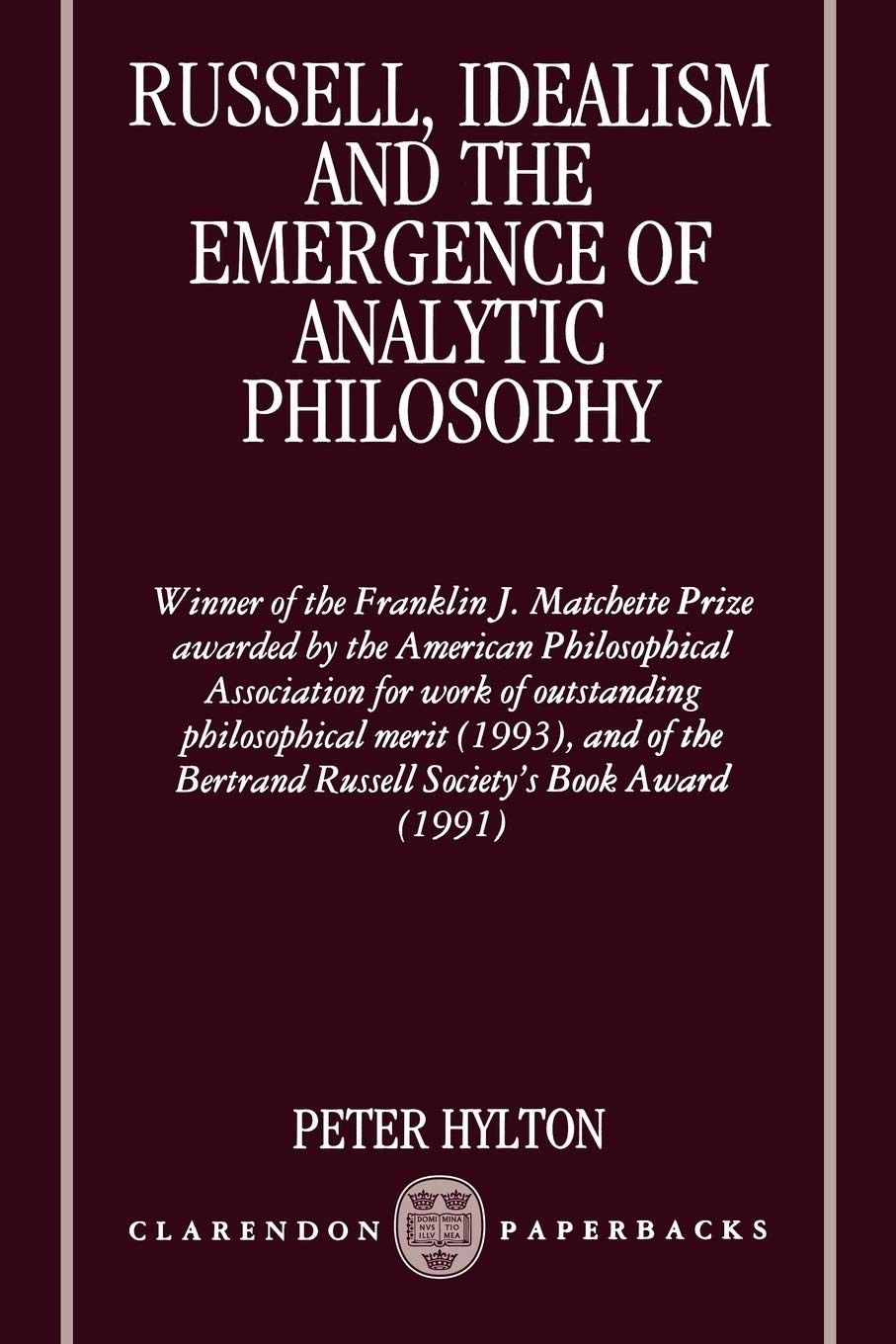
Russell, Idealism, and the Emergence of Analytic Philosophy by Peter Hylton – A Deep Historical Study of Bertrand Russel
Inclusive of all applicable taxes. FREE shipping on all orders.
Available Offers
- 🚚Free Delivery — Free shipping on all orders
- 💵Cash on Delivery — Pay when your order arrives
- ↩️15-Day Easy Returns — Hassle-free return policy
- 🔒Cash on Delivery — Pay safely when your order arrives
Check Delivery
Product Description
Introduction
For students and scholars of philosophy in India, understanding the roots of analytic philosophy is essential to grasping the intellectual currents that shape modern thought. Peter Hylton's Russell, Idealism, and the Emergence of Analytic Philosophy offers a rigorous yet accessible exploration of a pivotal moment in philosophical history. This hardcover volume from OUP Oxford is an indispensable resource for anyone seeking to comprehend how Bertrand Russell and G.E. Moore broke away from the dominant Idealist tradition and laid the groundwork for the analytic movement that continues to influence philosophy departments across the globe, including in India.
Book Overview
This scholarly work examines the transformation of philosophy in the English-speaking world during the late nineteenth and early twentieth centuries. Hylton focuses on the period just before the First World War, when Russell and Moore challenged the prevailing Idealism of thinkers like F.H. Bradley and J.M.E. McTaggart. The book provides a detailed account of how Russell's early work, especially The Principles of Mathematics and Principia Mathematica (co-authored with Alfred North Whitehead), emerged from this critical engagement. It is not merely a biography but a deep philosophical analysis of the ideas, arguments, and commitments that defined this transition. The author traces the evolution of Russell's thought from his early Idealist sympathies to his development of logical atomism, showing how the rejection of Idealism was a complex, gradual process rather than a sudden break.
Key Highlights
- Authoritative scholarship: Written by Peter Hylton, a leading expert on Russell and analytic philosophy, known for his meticulous research and clear exposition.
- Historical depth: Covers the crucial period from 1890 to 1914, situating Russell's work within the broader context of British Idealism and early analytic philosophy.
- Critical analysis: Offers a balanced evaluation of the strengths and weaknesses of both Idealist and analytic positions, avoiding simplistic narratives of progress.
- Focus on Russell's development: Traces the evolution of Russell's views on logic, language, and metaphysics, showing how his early engagement with Idealism shaped his later innovations.
- Relevance to contemporary philosophy: Demonstrates how the issues debated a century ago—such as the nature of truth, the structure of reality, and the role of logic—remain central to philosophical inquiry today.
Inside the Book
The book is structured to guide readers through the philosophical terrain. It begins with an overview of British Idealism, explaining the key doctrines of Bradley and McTaggart. Subsequent chapters examine Russell's early Idealist phase and his subsequent criticisms, including his famous 1903 essay 'The Principles of Mathematics'. Hylton then analyzes the development of Russell's theory of descriptions, his theory of judgment, and his logical atomism. The final chapters consider the implications of these ideas for metaphysics, epistemology, and the philosophy of language. Throughout, the author engages with primary texts and secondary literature, providing footnotes and references that are valuable for further study.
Key Topics
- The nature and influence of British Idealism in the late nineteenth century
- Russell's critique of Idealism and his arguments for realism
- The development of analytic philosophy as a distinct tradition
- Russell's theory of descriptions and its philosophical significance
- Logical atomism and the relationship between language and reality
- The role of mathematics and logic in reshaping philosophical method
- G.E. Moore's defense of common sense and its impact on Russell
- The legacy of the Idealist–analytic debate for contemporary philosophy
Reader Benefits
This book offers significant advantages to Indian readers. It provides a clear, historically grounded introduction to the origins of analytic philosophy, which is often taught in Indian universities but rarely with such contextual depth. The hardcover edition is durable for library use or personal reference. By reading this volume, students will gain a nuanced understanding of why analytic philosophy emphasizes clarity, argument, and logical rigor. Scholars will appreciate the detailed engagement with original sources and the careful reconstruction of arguments. The book also helps readers appreciate the philosophical diversity of the early twentieth century, showing that the triumph of analytic philosophy was not inevitable but the result of specific intellectual choices.
Learning Outcomes
- Understand the main doctrines of British Idealism and why they were challenged
- Trace the historical development of Russell's thought from 1890 to 1914
- Analyze key arguments in Russell's philosophy, including the theory of descriptions and logical atomism
- Evaluate the strengths and weaknesses of both Idealist and analytic approaches
- Connect historical philosophical debates to contemporary issues in metaphysics and epistemology
- Develop skills in reading and interpreting complex philosophical texts
Who Should Read
This book is ideal for undergraduate and postgraduate students of philosophy in India, especially those enrolled in courses on analytic philosophy, history of philosophy, or logic. It is also suitable for researchers in philosophy, cognitive science, and linguistics who wish to understand the intellectual background of modern analytic thought. Teachers and professors will find it a valuable resource for course preparation. General readers with a serious interest in philosophy—particularly those curious about how Western philosophy evolved in the twentieth century—will also benefit from this accessible yet scholarly work.
About the Author
Peter Hylton is a distinguished professor of philosophy at the University of Illinois at Chicago. He is widely recognized for his expertise in the history of analytic philosophy, especially the work of Bertrand Russell and Gottlob Frege. Hylton has published numerous articles and books on these topics, and his scholarship is known for its clarity, depth, and historical sensitivity. He brings to this book a lifetime of research and a passion for making complex ideas understandable without oversimplification.
About the Publisher
Oxford University Press (OUP) is a world-renowned academic publisher with a strong presence in India. OUP Oxford, its flagship imprint, is celebrated for producing authoritative scholarly works across all disciplines. This hardcover edition reflects OUP's commitment to high-quality production, with durable binding and clear typography that ensures a pleasant reading experience. For Indian readers, OUP's distribution network ensures easy availability of this title through bookstores like Bookshops.in.
Conclusion
Russell, Idealism, and the Emergence of Analytic Philosophy is more than a historical study—it is a key to understanding the philosophical foundations of the modern world. Peter Hylton's masterful analysis illuminates the intellectual struggles that gave birth to analytic philosophy, making this book essential reading for anyone serious about philosophy. Whether you are a student preparing for examinations, a researcher seeking deeper insights, or a curious reader wanting to explore the origins of contemporary thought, this volume will reward your attention. Order your copy from Bookshops.in today and add this cornerstone of philosophical scholarship to your library.
Quick Summary
Peter Hylton's 'Russell, Idealism, and the Emergence of Analytic Philosophy' is a definitive historical study of the period when Bertrand Russell and G.E. Moore broke away from British idealism and laid the foundations for the analytic tradition that dominates English-speaking philosophy today. The book meticulously traces Russell's intellectual journey from his early idealist phase through his development of logical analysis, the theory of descriptions, and logical atomism, all set against the backdrop of Cambridge philosophy before the First World War. Hylton draws on a wealth of primary sources to show how the problems and methods of analytic philosophy emerged from a critical engagement with idealist thought. This volume is essential reading for philosophy students, researchers, and anyone interested in the intellectual history of the 20th century. By purchasing from Bookshops.in, Indian readers receive a genuine hardcover edition with reliable delivery and excellent customer service, making it a valuable addition to any academic library.
Book Highlights
Book Specifications
| ISBN-13 | 9780198240181 |
| ISBN-10 | 019824018X |
| Publisher | Clarendon Pr |
| Language | English |
| Dimensions | 23.6 x 15.7 x 2.39 cm |
| Weight | 726 g |
| Category | Philosophy › History & Surveys |
| Genre | Non-fiction |
| Original Language | English |
Frequently Asked Questions
What is this book about?
Who is the author?
Is this book suitable for beginners?
Does the book cover G.E. Moore's philosophy?
What time period does the book cover?
What is the ISBN?
Can I use this book for my university coursework?
Does the book include primary sources?
What makes this book different from other histories of analytic philosophy?
Is the book written in English?
What is the price in India?
How can I buy this book?
Readers Also Search For
Customers Also Bought
Islam
Spiritual Economies (English, Daromir Rudnyckyj)

Islam
Who Is Allah? (English, Bruce B. Lawrence)
Islam
Islam and Liberal Citizenship: The Search for an Overlapping Consensus by Andrew F. March
Islam
Fiqh Us-Sunnah: Funerals and Diggers by Al-Sayyid Sabiq – Islamic Funeral Guide

Christianity
Genetics (English, Thomas a. Shannon | Mark P. Aulisio | Françoise Baylis)

Hinduism
Karma and Creativity by Christopher Key Chapple – Indian Philosophy
Related Products
View All
Philosophy
Latin American Philosophy: Currents, Issues, Debates by Eduardo Mendieta

Philosophy
Al-Farabi's Short Commentary on Aristotle's Prior Analytics by Nicholas Rescher – Philosophy
Philosophy
Poetics of Imagining: Modern to Post-modern by Richard Kearney
Philosophy
The Metaphysics of Extrinsic Properties: 11 (Metaphysical Research, 11)
Philosophy
Dialogues on Metaphysics and on Religion by Nicolas Malebranche – Philosophy
Philosophy