
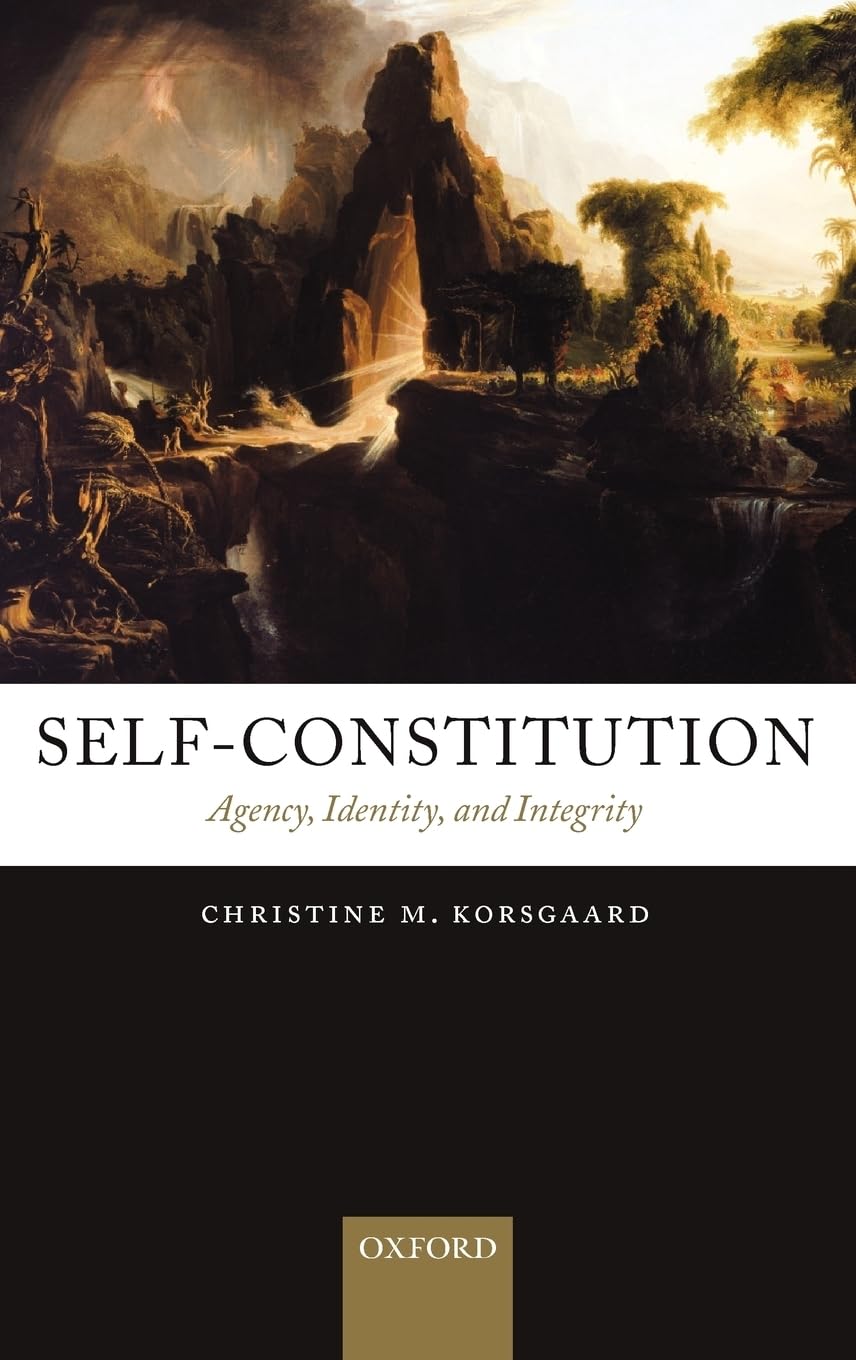
Self-Constitution: Agency, Identity, and Integrity by Christine M. Korsgaard – A Foundational Work in Moral Philosophy a
Inclusive of all applicable taxes. FREE shipping on all orders.
Available Offers
- 🚚Free Delivery — Free shipping on all orders
- 💵Cash on Delivery — Pay when your order arrives
- ↩️15-Day Easy Returns — Hassle-free return policy
- 🔒Cash on Delivery — Pay safely when your order arrives
Check Delivery
Product Description
Introduction
What makes an action good or bad? Is there a deeper connection between who we are and what we do? In Self-Constitution: Agency, Identity, and Integrity, Christine M. Korsgaard offers a powerful answer: your actions are not just things you do—they are the very acts that build your identity as a person. This book is a must-read for Indian students and scholars of philosophy, law, and ethics who want to understand the foundations of moral responsibility and personal integrity.
Book Overview
This hardcover volume from OUP Oxford presents Korsgaard’s groundbreaking theory of practical reason and moral obligation. Drawing on Plato, Aristotle, and Kant, she argues that the function of an action is to constitute the agent’s own identity. Just as a good heart is one that pumps blood effectively, a good action is one that successfully constitutes the agency of the person performing it. The book explores how rational beings are aware of and control the principles guiding their actions, making moral goodness a matter of self-constitution rather than external rules.
Key Highlights
- Original and rigorous philosophical argument linking action, identity, and morality
- Engages deeply with classical and modern thought, including Plato, Aristotle, and Kant
- Clear and accessible writing, suitable for advanced students and professionals
- Addresses fundamental questions about free will, moral responsibility, and integrity
- Published by the prestigious Oxford University Press in a durable hardcover edition
Inside the Book
The book is structured to first establish the idea that actions have a function, just like organs or tools. Korsgaard then develops a theory of agency where your practical identity—the description under which you value yourself—determines what you have reason to do. She examines how we constitute ourselves through our choices and actions, and how failure to act with integrity leads to a loss of self. The final chapters connect this to moral obligation, showing that being a good person means being a good agent.
Key Topics
- The function of action and the concept of a good action
- Practical identity and self-constitution
- Autonomy, freedom, and the categorical imperative
- Integrity, weakness of will, and moral failure
- The role of reflection in practical reason
Reader Benefits
- Gain a deep understanding of how your daily choices shape your identity
- Learn a unified framework for ethics that connects ancient and modern philosophy
- Develop clarity on the relationship between freedom, morality, and selfhood
- Enhance your critical thinking and philosophical reasoning skills
- Appreciate the practical relevance of abstract philosophical ideas
Learning Outcomes
By reading this book, you will be able to articulate why actions are not merely events but expressions of who you are. You will understand how moral obligation arises from the need to maintain your own integrity. You will also be equipped to engage with contemporary debates in ethics, metaethics, and action theory, and apply these insights to real-life moral dilemmas.
Who Should Read
- Undergraduate and postgraduate students of philosophy, especially ethics and action theory
- Law students and legal professionals interested in the foundations of responsibility
- Scholars and researchers in moral psychology and political theory
- General readers with a serious interest in personal identity and moral philosophy
- Anyone preparing for competitive exams that include ethics and philosophy components
About the Author
Christine M. Korsgaard is one of the most influential contemporary moral philosophers. She is Arthur Kingsley Porter Professor of Philosophy at Harvard University. Her work on Kantian ethics, practical reason, and agency has shaped modern philosophical thought. She is also the author of The Sources of Normativity and Creating the Kingdom of Ends.
About the Publisher
OUP Oxford is the world’s oldest and largest university press, known for its rigorous academic publishing. Their philosophy list includes landmark works by leading thinkers, making them the ideal publisher for a book that bridges classical and contemporary thought.
Conclusion
Self-Constitution: Agency, Identity, and Integrity is not just a book about ethics—it is a guide to understanding yourself as a moral agent. For Indian readers who value deep reflection and intellectual growth, this hardcover edition is a worthy addition to any library. Order your copy from Bookshops.in today and begin the journey of understanding how your actions define who you are.
Quick Summary
Self-Constitution: Agency, Identity, and Integrity by Christine M. Korsgaard is a landmark work in moral philosophy that rethinks the foundation of practical reason and moral obligation. Korsgaard argues that human actions are morally evaluable because they are acts of self-constitution: we constitute our agency and identity through our choices and actions. Drawing on Plato, Aristotle, and Kant, she develops a Kantian constructivist account where moral goodness is a matter of acting in ways that successfully constitute a unified self. The book is intended for philosophy students, scholars, and anyone interested in ethics, personal identity, and the nature of moral responsibility. Readers will learn how integrity, autonomy, and practical reason are interconnected, and how moral obligations arise from the very structure of agency. By purchasing from Bookshops.in, Indian readers receive an authentic hardcover edition from OUP Oxford, with fast delivery and excellent customer service.
Book Highlights
Book Specifications
| ISBN-13 | 9780199552795 |
| ISBN-10 | 0199552797 |
| Publisher | Oxford Univ Pr on Demand |
| Language | English |
| Dimensions | 23.37 x 2.29 x 15.75 cm |
| Weight | 522 g |
| Category | Philosophy › Ethics |
| Genre | Non-fiction |
| Original Language | English |
Frequently Asked Questions
What is the main thesis of Self-Constitution?
Who is Christine M. Korsgaard?
Is this book suitable for beginners in philosophy?
How does Korsgaard use Plato and Aristotle?
What is the relationship between agency and identity in this book?
Does the book address contemporary ethical issues?
What is Kantian constructivism?
Is this book part of a series?
Can I use this book for a university course?
Is the book available in other languages?
What is the price of this book on Bookshops.in?
Does the book include a bibliography?
Why should I buy from Bookshops.in?
Readers Also Search For
Customers Also Bought
Islam
Spiritual Economies (English, Daromir Rudnyckyj)

Islam
Who Is Allah? (English, Bruce B. Lawrence)
Islam
Islam and Liberal Citizenship: The Search for an Overlapping Consensus by Andrew F. March
Islam
Fiqh Us-Sunnah: Funerals and Diggers by Al-Sayyid Sabiq – Islamic Funeral Guide

Christianity
Genetics (English, Thomas a. Shannon | Mark P. Aulisio | Françoise Baylis)

Hinduism
Karma and Creativity by Christopher Key Chapple – Indian Philosophy
Related Products
View All
Philosophy
Latin American Philosophy: Currents, Issues, Debates by Eduardo Mendieta

Philosophy
Al-Farabi's Short Commentary on Aristotle's Prior Analytics by Nicholas Rescher – Philosophy
Philosophy
Poetics of Imagining: Modern to Post-modern by Richard Kearney
Philosophy
The Metaphysics of Extrinsic Properties: 11 (Metaphysical Research, 11)
Philosophy
Dialogues on Metaphysics and on Religion by Nicolas Malebranche – Philosophy
Philosophy