
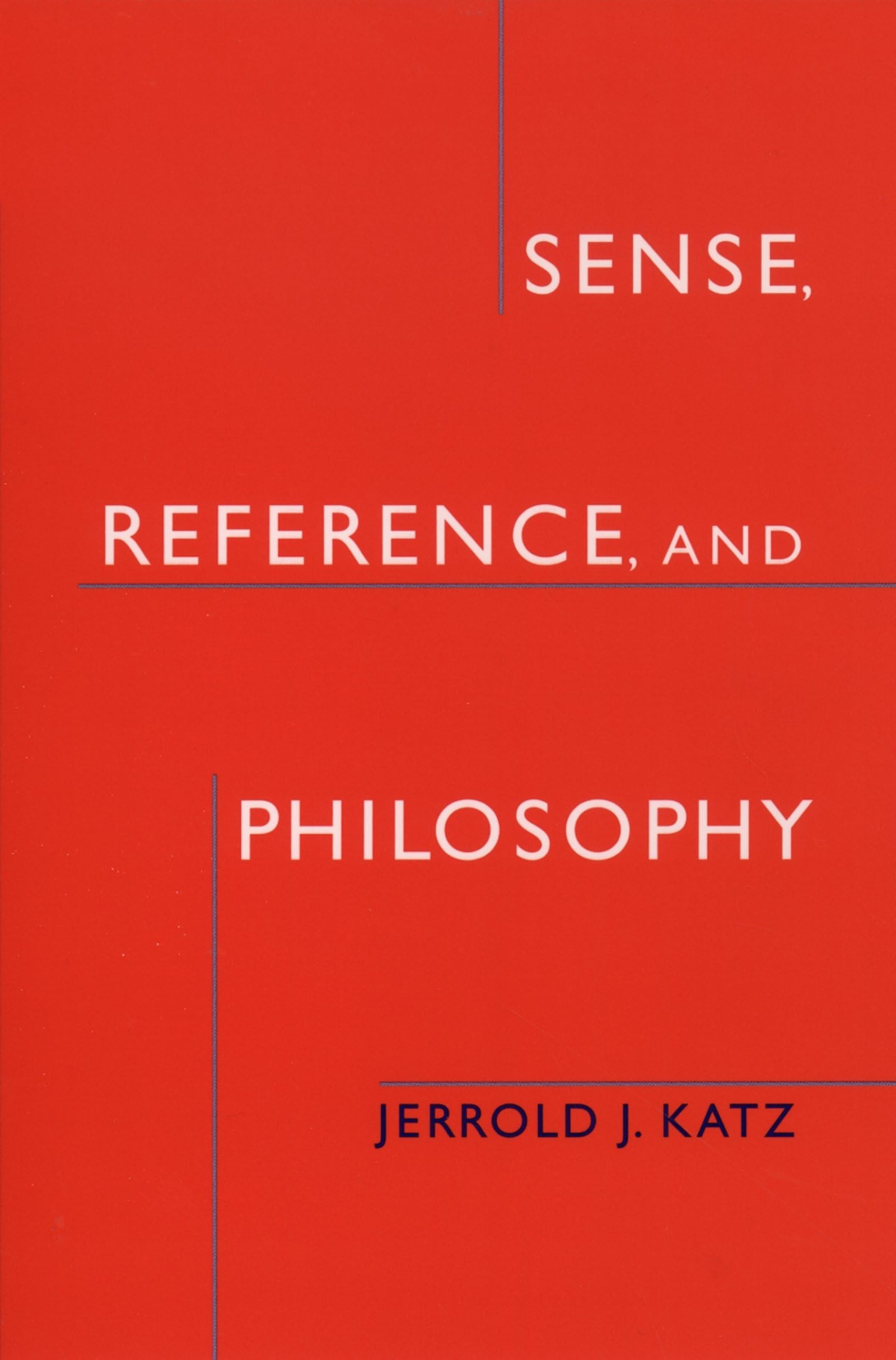
Sense, Reference, and Philosophy by Jerrold J. Katz – A Revolutionary Approach to Analytic Philosophy and Philosophy of
Inclusive of all applicable taxes. FREE shipping on all orders.
Available Offers
- 🚚Free Delivery — Free shipping on all orders
- 💵Cash on Delivery — Pay when your order arrives
- ↩️15-Day Easy Returns — Hassle-free return policy
- 🔒Cash on Delivery — Pay safely when your order arrives
Check Delivery
Product Description
Introduction
In the vast landscape of analytic philosophy, few works have dared to challenge the foundational assumptions laid down by Gottlob Frege as boldly as Jerrold J. Katz's Sense, Reference, and Philosophy. This seminal hardcover volume, published by Oxford University Press, presents a rigorous and original defence of non-Fregean intensionalism—a framework that reimagines the relationship between meaning, reference, and truth. For Indian students and scholars of philosophy, linguistics, and cognitive science, this book offers a gateway to re-examining classic puzzles with fresh eyes. Katz’s work is not merely a critique; it is a constructive philosophical project that promises to resolve longstanding paradoxes in the philosophy of language, logic, and metaphysics. Whether you are preparing for advanced research or simply wish to deepen your understanding of how language connects to the world, this book is an indispensable addition to your library.
Book Overview
Sense, Reference, and Philosophy systematically develops the implications of adopting a non-Fregean intensionalist approach to meaning. Katz argues that Frege’s distinction between sense and reference, while revolutionary, leads to intractable problems when applied to natural language. By rethinking the nature of senses as abstract, mind-independent objects, Katz shows how we can resolve issues that have haunted philosophers for decades. The book moves from foundational theory to concrete applications, tackling specific problems such as the semantics of proper names, natural kind terms, the Liar Paradox, the logical versus extra-logical vocabulary distinction, and the Raven Paradox. Each chapter builds a case for why intensionalism—when properly understood—offers a more philosophically satisfying solution than its Fregean or extensionalist rivals. Katz’s prose is clear and methodical, making complex arguments accessible without sacrificing depth.
Key Highlights
- Original Theoretical Framework: Presents a fully developed non-Fregean intensionalist system that challenges mainstream analytic philosophy.
- Problem-Solving Focus: Offers new solutions to six major philosophical puzzles, including the Liar Paradox and the Raven Paradox.
- Interdisciplinary Reach: Bridges philosophy of language, logic, metaphysics, and philosophy of science in a unified argument.
- Rigorous Yet Accessible: Written for advanced undergraduates, graduate students, and professional philosophers alike.
- Oxford Quality: Published by Oxford University Press, ensuring high editorial and academic standards.
Inside the Book
The book is structured into well-organised chapters that alternate between theoretical exposition and case-study analysis. Katz begins by laying out the core tenets of intensionalism, distinguishing his view from both Fregean sense-reference semantics and direct reference theories. He then applies this framework to the problem of proper names, arguing that names carry descriptive senses that determine reference without collapsing into description theories. The discussion of natural kind terms—like 'water' and 'gold'—shows how intensionalism handles the Kripke-Putnam challenge. Later chapters delve into the Liar Paradox, where Katz proposes a solution based on the distinction between sense and reference in self-referential sentences. The final chapters address the demarcation of logical vocabulary and the Raven Paradox, demonstrating the power of intensionalism in philosophy of science. Each section includes careful argumentation, critical engagement with opposing views, and a clear summary of conclusions.
Key Topics
- Non-Fregean Intensionalism: A detailed exposition of Katz’s alternative to Frege’s theory of sense and reference.
- Philosophy of Language: The semantics of proper names, definite descriptions, and natural kind terms.
- Logic and Paradox: The Liar Paradox and its resolution through intensional distinctions.
- Logical Vocabulary: Distinguishing between logical and extra-logical terms in formal systems.
- Induction and Confirmation: The Raven Paradox and its implications for scientific reasoning.
- Metaphysics of Meaning: The ontological status of senses as abstract objects.
Reader Benefits
- Deepen Your Analytical Skills: Engage with sophisticated arguments that sharpen your ability to critique and construct philosophical theories.
- Master a Key Debate: Gain a thorough understanding of one of the most important debates in 20th and 21st century philosophy.
- Solve Persistent Puzzles: Learn how to apply intensionalist principles to classic problems that continue to challenge philosophers.
- Enhance Your Research: Equip yourself with a framework that can be extended to new areas of inquiry, from linguistics to cognitive science.
- Build a Strong Foundation: Ideal for students preparing for competitive exams, research proposals, or advanced coursework in philosophy.
Learning Outcomes
By reading this book, you will be able to: articulate the key differences between Fregean and non-Fregean intensionalism; critically evaluate solutions to the Liar Paradox and the Raven Paradox; analyse the semantics of proper names and natural kind terms using intensionalist tools; defend the view that senses are abstract objects independent of minds and languages; and apply these insights to contemporary debates in philosophy of language and logic. Katz’s systematic approach ensures that each concept builds on the previous, so by the final chapter you will possess a coherent, powerful philosophical toolkit.
Who Should Read
- Philosophy Students: Especially those specialising in analytic philosophy, philosophy of language, or logic at the postgraduate level.
- Linguists: Researchers interested in semantics, pragmatics, and the philosophy of linguistics.
- Logicians: Scholars working on paradoxes, formal semantics, and the foundations of logical theory.
- Cognitive Scientists: Those exploring the nature of concepts, meaning, and mental representation.
- Indian Academics: Professors and researchers in Indian universities seeking to strengthen their library with high-impact analytic philosophy texts.
About the Author
Jerrold J. Katz (1932–2002) was a distinguished American philosopher and linguist, best known for his contributions to the philosophy of language and generative linguistics. A student of Noam Chomsky, Katz was a leading figure in the development of the interpretive theory of semantics. He taught at the City University of New York and the Massachusetts Institute of Technology, and his work profoundly influenced debates on meaning, reference, and the relationship between language and thought. Sense, Reference, and Philosophy represents the culmination of his lifelong project to defend a rationalist, intensionalist approach to meaning against both empiricist and naturalist trends.
About the Publisher
Oxford University Press (OUP) is one of the world’s oldest and most respected academic publishers, with a history spanning over five centuries. OUP is renowned for its rigorous editorial standards and its commitment to advancing scholarship across disciplines. This hardcover edition is produced with the high-quality binding and acid-free paper that OUP is known for, ensuring durability for years of study. For Indian readers, OUP’s global network guarantees that this book meets the highest academic benchmarks, making it a trusted resource for universities and research institutions across the country.
Conclusion
Sense, Reference, and Philosophy is not just a book—it is an intellectual adventure that challenges the very foundations of how we think about meaning and truth. Jerrold J. Katz’s non-Fregean intensionalism offers a bold, coherent, and deeply satisfying alternative to dominant theories in philosophy of language. For anyone serious about understanding the deepest puzzles of language and logic, this hardcover volume from Oxford University Press is an essential investment. Order your copy today from Bookshops.in and add a transformative work to your philosophical collection.
Quick Summary
Sense, Reference, and Philosophy by Jerrold J. Katz is a landmark work in analytic philosophy that introduces and defends non-Fregean intensionalism. Katz argues that meanings are intensional entities—independent of reference—and that this framework can solve persistent puzzles in philosophy of language. The book tackles the problem of names, natural kind terms, the Liar Paradox, the logical/extra-logical vocabulary distinction, and the Raven paradox, offering original solutions that challenge Fregean orthodoxy. Written in clear yet rigorous prose, it is ideal for postgraduate students and researchers in philosophy, linguistics, and cognitive science. This hardcover edition from Oxford University Press is a durable addition to any academic library. Buy it from Bookshops.in, India's trusted online bookstore for premium scholarly titles, and enjoy reliable delivery across the country.
Book Highlights
Book Specifications
| ISBN-13 | 9780195158137 |
| ISBN-10 | 019515813X |
| Publisher | OUP Oxford |
| Language | English |
| Dimensions | 22.86 x 1.75 x 15.24 cm |
| Weight | 567 g |
| Category | Humanities › Philosophy |
| Genre | Non-fiction |
| Original Language | English |
Frequently Asked Questions
What is the main thesis of Sense, Reference, and Philosophy?
Who is Jerrold J. Katz?
Is this book suitable for beginners in philosophy?
Does the book cover the Liar Paradox?
How does Katz's approach differ from Frege's?
What is the Raven paradox?
Is this book used in Indian university courses?
Does the book engage with Kripke's work?
Is the book available in paperback?
Can I use this book for my PhD research?
Does the book discuss natural kind terms?
What is the price of this book?
Is this book part of a series?
Readers Also Search For
Customers Also Bought
Islam
Spiritual Economies (English, Daromir Rudnyckyj)

Islam
Who Is Allah? (English, Bruce B. Lawrence)
Islam
Islam and Liberal Citizenship: The Search for an Overlapping Consensus by Andrew F. March
Islam
Fiqh Us-Sunnah: Funerals and Diggers by Al-Sayyid Sabiq – Islamic Funeral Guide

Christianity
Genetics (English, Thomas a. Shannon | Mark P. Aulisio | Françoise Baylis)

Hinduism
Karma and Creativity by Christopher Key Chapple – Indian Philosophy
Related Products
View All
Philosophy
Latin American Philosophy: Currents, Issues, Debates by Eduardo Mendieta

Philosophy
Al-Farabi's Short Commentary on Aristotle's Prior Analytics by Nicholas Rescher – Philosophy
Philosophy
Poetics of Imagining: Modern to Post-modern by Richard Kearney
Philosophy
The Metaphysics of Extrinsic Properties: 11 (Metaphysical Research, 11)
Philosophy
Dialogues on Metaphysics and on Religion by Nicolas Malebranche – Philosophy
Philosophy