
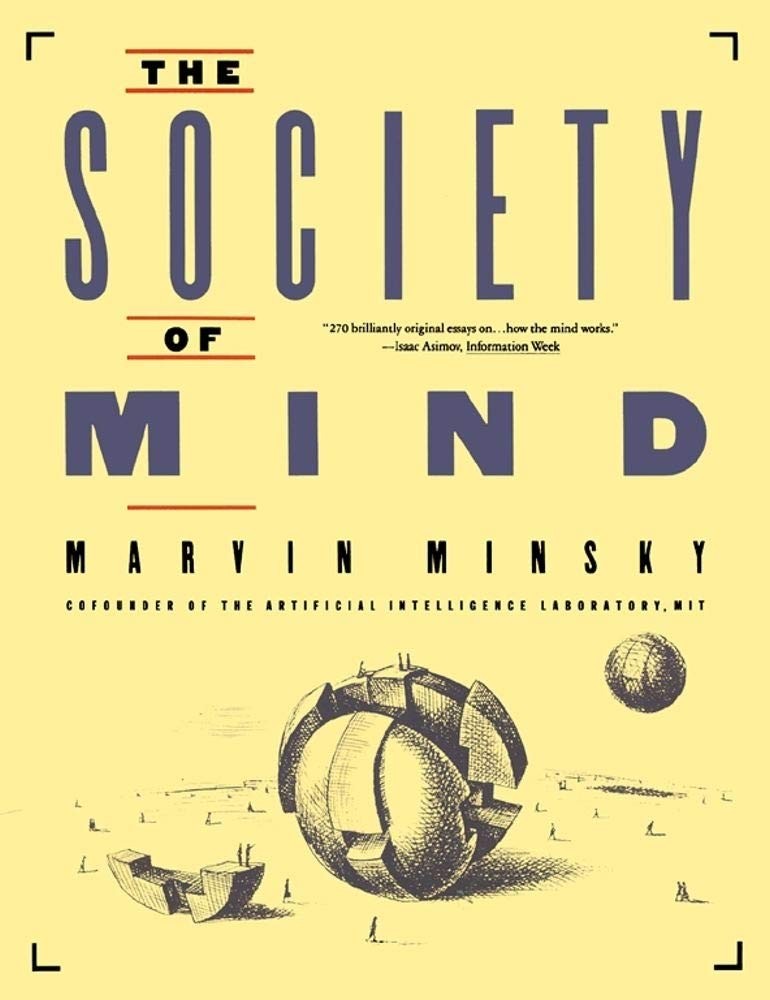
The Society of Mind by Marvin Minsky – A Groundbreaking Theory of How the Human Mind Really Works
Inclusive of all applicable taxes. FREE shipping on all orders.
Available Offers
- 🚚Free Delivery — Free shipping on all orders
- 💵Cash on Delivery — Pay when your order arrives
- ↩️15-Day Easy Returns — Hassle-free return policy
- 🔒Cash on Delivery — Pay safely when your order arrives
Check Delivery
Product Description
Introduction
The Society of Mind by Marvin Minsky is one of the most influential books ever written about how intelligence arises in the human brain. Minsky, a founding figure of artificial intelligence and cofounder of the Artificial Intelligence Laboratory at MIT, spent decades studying how thought, memory and learning actually work. In this book he distils that lifetime of research into a bold and accessible theory: the mind is not a single unified thing, but a vast society of small, individually mindless processes working together.
Book Overview
Rather than writing a conventional linear argument, Minsky structures the book as a puzzle assembled piece by piece. Each short, self-contained chapter presents one idea, and as the chapters accumulate, page by page, a complete picture of how the mind might function begins to emerge, much like a mosaic coming together from individual tiles. This unconventional structure lets readers explore concepts such as memory, learning, language, consciousness and problem-solving as separate but interconnected components of a larger system, rather than as abstract, disconnected topics.
Key Highlights
- Written by Marvin Minsky, a founding father of artificial intelligence and cofounder of the MIT AI Laboratory.
- Introduces the influential "society of mind" theory of intelligence and cognition.
- Structured as short, self-contained chapters that build toward a unified idea.
- Explores how memory, learning, language and reasoning might emerge from simple interacting parts.
- Bridges computer science, psychology and philosophy of mind in a single accessible narrative.
- Presents complex cognitive science concepts in clear, non-technical language.
- Has shaped decades of subsequent research in artificial intelligence and cognitive modelling.
- Combines rigorous theory with an engaging, almost playful writing style.
- Frequently cited as essential reading for students of AI, computer science and psychology.
- Offers a framework still referenced in modern discussions of machine intelligence.
- Encourages readers to rethink assumptions about consciousness and free will.
- Suitable for both technical readers and curious general audiences.
- A foundational text bridging early AI research with modern cognitive science.
- Written with wit and clarity rare in academic-level writing on the mind.
Inside the Book
The book moves through dozens of interlinked short chapters, each examining a specific mechanism the mind might use, from how a young child learns to stack blocks to how memories connect to form larger ideas. Minsky introduces concepts like "agents," "agencies," and "K-lines" as building blocks of thought, gradually constructing an argument that what we experience as a single unified consciousness is really the coordinated activity of countless simple sub-processes, none of which is intelligent on its own.
Key Topics
Readers will encounter discussions on how the brain organises knowledge, how learning and memory interact, how language emerges from simpler cognitive building blocks, and how seemingly simple human behaviours like picking up a cup or feeling anger might be explained through cooperating "agents" rather than a single decision-making centre. The book also touches on creativity, problem-solving and the nature of consciousness itself.
Reader Benefits
- Gain a foundational understanding of one of the most important theories in cognitive science.
- Learn to think about intelligence as an emergent property rather than a single mechanism.
- Understand core ideas that continue to influence artificial intelligence research today.
- Enjoy accessible, chapter-sized explanations that make dense ideas easy to digest.
- Develop a richer, more nuanced view of how memory, learning and language connect.
- Build a strong conceptual base for further study in AI, psychology or philosophy of mind.
Learning Outcomes
By the end of the book, readers come away with a working mental model of intelligence as a layered system of interacting simple processes. They gain vocabulary and concepts, such as agents and agencies, that recur throughout modern AI and cognitive science literature, along with a deeper appreciation for why building genuinely intelligent machines is such a difficult and multidimensional problem.
Who Should Read
- Students and researchers in artificial intelligence and computer science.
- Psychology and cognitive science students exploring theories of mind.
- Philosophy readers interested in consciousness and the nature of thought.
- Technology professionals working in AI, robotics or machine learning.
- General readers curious about how the human brain actually works.
About the Author
Marvin Minsky was a cofounder of the Artificial Intelligence Laboratory at the Massachusetts Institute of Technology and is widely regarded as one of the founding fathers of the field of artificial intelligence. Over a career spanning decades, his research shaped how scientists think about machine learning, robotics and the mechanics of human cognition, and his ideas continue to influence AI research to this day.
About the Publisher
This edition is published by Simon & Schuster, a long-established publishing house known for bringing influential works of science, philosophy and general non-fiction to readers around the world.
Conclusion
The Society of Mind remains a landmark work for anyone who wants to understand intelligence, whether human or artificial, from the ground up. Its unusual structure, playful tone and rigorous ideas make it as rewarding today as when it was first published, offering readers a genuinely original way of thinking about the mind.
Quick Summary
The Society of Mind by Marvin Minsky is a foundational work in artificial intelligence and cognitive science that reimagines how intelligence arises in the human brain. Minsky, a cofounder of the MIT Artificial Intelligence Laboratory and one of the field's founding figures, argues that the mind is not a single unified process but a society of small, individually mindless components, or agents, working together. Rather than presenting this theory as a conventional linear argument, Minsky structures the book as an assembled puzzle, with each short, self-contained chapter contributing one piece to a larger picture. Readers move through discussions of memory, learning, language and reasoning, gradually building a picture of how simple interacting mechanisms might explain even the most complex human behaviours. The book introduces enduring concepts such as agents, agencies and K-lines that continue to shape modern research in artificial intelligence and cognitive modelling. Written with clarity and an engaging, almost playful tone, it remains accessible to general readers while offering real depth for students and researchers in computer science, psychology and philosophy. Decades after its first publication, The Society of Mind continues to be cited as essential reading for anyone who wants to understand intelligence, whether human or artificial, from first principles.
Book Highlights
Book Specifications
| ISBN-13 | 9780671657130 |
| ISBN-10 | 0671657135 |
| Publisher | Simon & Schuster |
| Language | English |
| Dimensions | 21.59 x 1.78 x 27.94 cm |
| Weight | 748 g |
| Country | United Kingdom |
| Category | Health, Family & Personal Development › Personal Transformation |
| Genre | Artificial Intelligence / Cognitive Science |
| Reading Age | Adult |
| Original Language | English |
Frequently Asked Questions
What is The Society of Mind about?
Who wrote this book?
Is this book technical or accessible to general readers?
How is the book structured?
Is this book still relevant today?
What subjects does the book cover?
Who should read this book?
What makes this book different from other AI books?
What language is this book written in?
Readers Also Search For
Customers Also Bought

Psychology
Koinonia: From Hate, Through Dialogue, to Culture in the Large Group by Patrick B. Demare

Psychology
Mindfulness-Based Interventions for Trauma and Its Consequences (Concise Guides on Trauma Care, 4)

Psychology
Handbook for Teaching Statistics and Research Methods by Mark E. Ware

Psychology
Psychoanalysis and the Nuclear Threat: Clinical and Theoretical Studies

Psychology
Humor and Psyche: Psychoanalytic Perspectives by James W. Barron

Relationships
The Experience and Expression of Uncertainty in Close Relationships by Jennifer A. Theiss
Related Products
View All
Health, Family & Personal Development
Making the Transition to Home: Simple Modifications to Encourage Independent Living

Health, Family & Personal Development
Asian Functional Foods (Nutraceutical Science and Technology)

Health, Family & Personal Development
State of the Marital Union: Rhetoric, Identity, and Nineteenth-Century Marriage Controversies

Health, Family & Personal Development
My Mindset, My Asset: Laying Hold on the Potentials of the Mind
Health, Family & Personal Development
Paraverbal Communication in Psychotherapy: Beyond the Words

Health, Family & Personal Development