
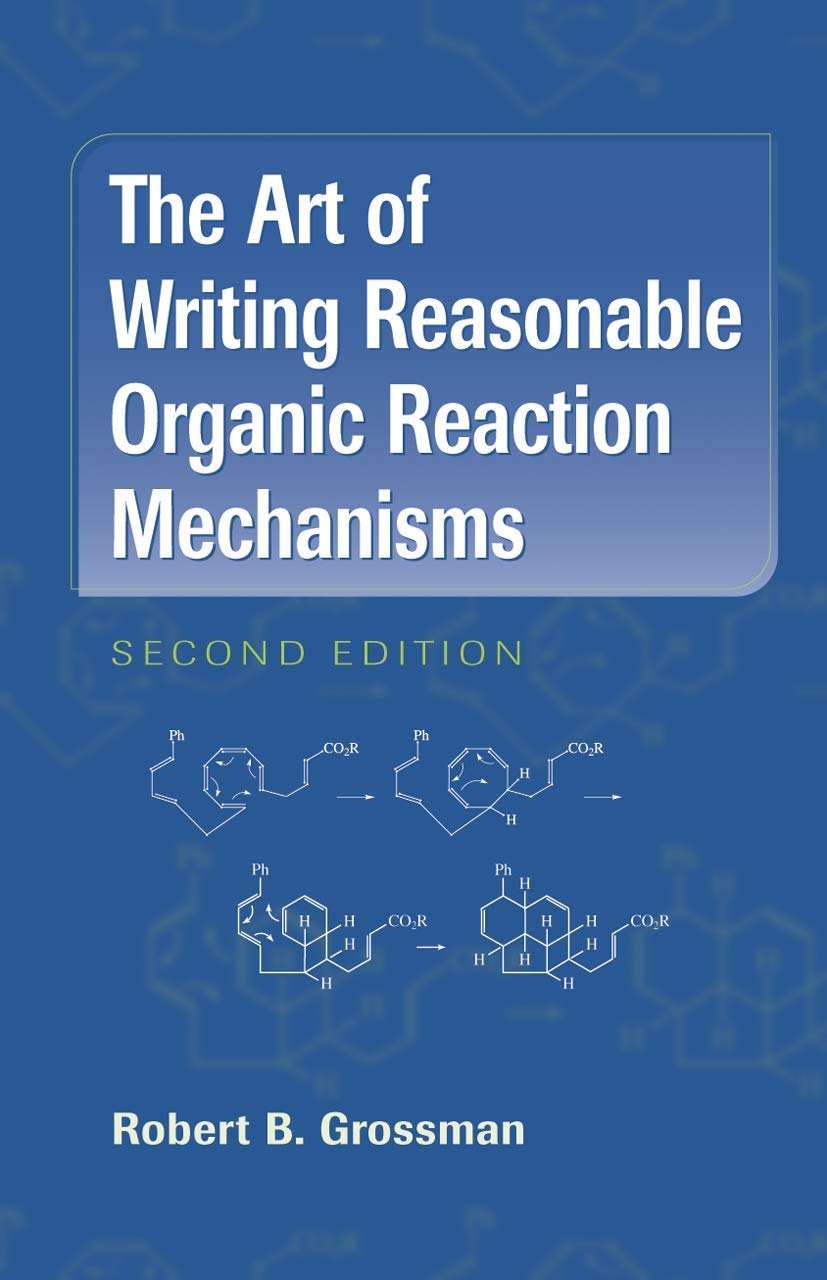
The Art of Writing Reasonable Organic Reaction Mechanisms by Robert B. Grossman – A Comprehensive Guide for Intermediate
Inclusive of all applicable taxes. FREE shipping on all orders.
Available Offers
- 🚚Free Delivery — Free shipping on all orders
- 💵Cash on Delivery — Pay when your order arrives
- ↩️15-Day Easy Returns — Hassle-free return policy
- 🔒Cash on Delivery — Pay safely when your order arrives
Check Delivery
Product Description
Introduction
Mastering the art of writing reasonable organic reaction mechanisms is a rite of passage for every serious chemistry student. The Art of Writing Reasonable Organic Reaction Mechanisms by Robert B. Grossman is a definitive guide that bridges the gap between rote memorization and true conceptual understanding. Published by Springer in a durable hardcover edition, this book is an indispensable companion for Indian students pursuing advanced organic chemistry at the undergraduate and postgraduate levels.
Book Overview
Unlike conventional textbooks that organize content by reaction type, Grossman’s approach is refreshingly mechanism-centric. The book teaches you how to think like a chemist—analyzing reaction conditions, electron flow, and intermediate stability to construct plausible mechanisms from scratch. Each chapter is built around unifying principles, showing how common mechanistic pathways connect seemingly unrelated reactions. With worked problems, practical tips, and 'common error alerts' scattered throughout, this text transforms complex concepts into accessible knowledge.
Key Highlights
- Mechanism-first pedagogy: Learn to reason step-by-step rather than memorizing outcomes.
- Extensive problem sets: Each chapter ends with a large set of practice problems to reinforce learning.
- Modern examples: Draws on current literature and the author’s own research to keep content relevant.
- Unique coverage: Includes a dedicated chapter on mechanisms under special conditions (photochemical, thermal, and catalytic).
- Error alerts: Highlights common pitfalls that trip up students, saving you from repeated mistakes.
Inside the Book
The book is divided into logical sections that progress from fundamental concepts to advanced topics. Early chapters cover ionic mechanisms, radical reactions, and pericyclic processes. Later chapters delve into organometallic chemistry, enzyme mechanisms, and photochemical transformations. Each mechanism is illustrated with clear, annotated diagrams, and every discussion is followed by worked examples that show exactly how to apply the principles. The 'Common Error Alerts' appear in grey boxes, warning you about misconceptions like confusing nucleophilicity with basicity or misassigning oxidation states.
Key Topics
- Nucleophilic substitution and elimination mechanisms
- Addition and elimination reactions across multiple bonds
- Rearrangements and carbocation chemistry
- Radical chain reactions and fragmentations
- Pericyclic reactions (cycloadditions, sigmatropic shifts, electrocyclic reactions)
- Organometallic mechanisms (cross-coupling, insertion, oxidative addition)
- Photochemical and thermal reactions
- Enzyme-catalyzed mechanisms and bioorganic pathways
Reader Benefits
- Builds intuition: Develop the ability to predict reaction outcomes instead of just memorizing them.
- Exam-ready: Perfect for JEE Advanced, GATE, CSIR-UGC NET, and university exams that test mechanism-writing skills.
- Self-study friendly: Clear explanations and abundant practice make it ideal for independent learners.
- Time-saving: Error alerts and practical tips reduce trial-and-error during problem solving.
Learning Outcomes
By the end of this book, you will be able to: write complete, arrow-pushing mechanisms for unfamiliar reactions; identify the most likely pathway under given conditions; rationalize stereochemical outcomes; troubleshoot common errors in your own writing; and connect mechanistic principles across different areas of organic chemistry. These skills are foundational for research in synthetic chemistry, pharmaceutical science, and materials chemistry.
Who Should Read
This book is designed for intermediate organic chemistry students—typically those in their second or third year of a B.Sc. or M.Sc. program in India. It is also highly recommended for students preparing for competitive exams, as well as early-career researchers who want to solidify their mechanistic reasoning. Teachers and tutors will find it an excellent resource for designing assignments and clarifying tricky concepts.
About the Author
Robert B. Grossman is a distinguished professor of chemistry at the University of Kentucky, where he has taught organic chemistry for over two decades. His research focuses on synthetic methodology and natural product synthesis, and he has published extensively in leading journals. Grossman’s teaching philosophy emphasizes conceptual clarity over memorization, a principle that shines through every page of this book.
About the Publisher
Springer is one of the world’s most respected academic publishers, known for producing high-quality scientific and technical books. Their chemistry catalog is trusted by universities and research institutions globally, and this hardcover edition reflects their commitment to durable, long-lasting bindings suitable for heavy use in libraries and labs.
Conclusion
The Art of Writing Reasonable Organic Reaction Mechanisms is more than a textbook—it is a mentor in print. For Indian students who want to move beyond surface-level learning and truly master the logic of organic reactions, this book is an investment that pays lifelong dividends. Whether you are preparing for exams or embarking on research, Grossman’s methodical, encouraging approach will equip you with the confidence to tackle any mechanism. Add this essential volume to your collection today from Bookshops.in and take a decisive step toward chemical mastery.
Quick Summary
The Art of Writing Reasonable Organic Reaction Mechanisms by Robert B. Grossman is an authoritative guide for intermediate organic chemistry students who want to master the skill of constructing logical, step-by-step mechanisms. Unlike conventional textbooks that organize content by reaction type, this book groups mechanisms by the conditions under which reactions occur, highlighting common patterns and unifying principles. Each chapter opens with practical tips for drawing mechanisms, followed by worked problems that illustrate key concepts. Special 'common error alerts' warn students about frequent misunderstandings. The book covers a wide range of topics including nucleophilic substitution, elimination, addition, pericyclic, and radical reactions. Extensive problem sets at the end of each chapter reinforce learning. Published by Springer, this hardcover edition is built for serious study. Indian students pursuing B.Sc., M.Sc., or preparing for competitive exams will find it invaluable. By focusing on reasoning rather than rote memorization, the book equips readers to tackle unfamiliar reactions with confidence. Order your copy from Bookshops.in, India’s premium online bookstore, for reliable service and fast delivery.
Book Highlights
Book Specifications
| ISBN-13 | 9780387954684 |
| ISBN-10 | 0387954686 |
| Publisher | Springer Nature |
| Language | English |
| Dimensions | 16.26 x 2.79 x 23.62 cm |
| Weight | 635 g |
| Country | India |
| Category | Basic Sciences › Pharmacology |
| Genre | Non-fiction |
| Original Language | English |
Frequently Asked Questions
What is the main focus of this book?
Who is the author?
Is this book suitable for beginners?
How is this book different from standard textbooks?
Does the book include practice problems?
What are 'common error alerts'?
Which publisher released this book?
What is the language of the book?
Is this book available in hardcover?
Can I use this for CSIR-NET or GATE preparation?
Does it cover pericyclic reactions?
Is this book used in Indian universities?
What is the ISBN?
Why buy from Bookshops.in?
Readers Also Search For
Customers Also Bought

Anatomy
Ultrastructure of the Digestive Tract: 4 (Electron Microscopy in Biology and Medicine)

Anatomy
Ultrastructure of the Connective Tissue Matrix: 3 (Electron Microscopy in Biology and Medicine)

Anatomy
Reproductive Genetics (Royal College of Obstetricians and Gynaecologists Study Group)

Anatomy
Human Gross Anatomy: An Outline Text by Robert J. Leonard – Medical Anatomy

Pharmacology
Mathematical Modeling and Simulation in Enteric Neurobiology

Anatomy
Nature’s Patterns and the Fractional Calculus: 2 (Fractional Calculus in Applied Sciences and Engineering, 2)
Related Products
View All
Pharmacology
A Handbook of Artificial Intelligence in Drug Delivery (English, Anil K. Philip)
Pharmacology
Plant Microevolution and Conservation in Human-influenced Ecosystems by David Briggs
Pharmacology
Electrochemotherapy, Electrogenetherapy, and Transdermal Drug Delivery by Mark J. Jaroszeski – Biome
Pharmacology
A Guide to the Extrapyramidal Side-Effects of Antipsychotic Drugs by D. G. Cunningham Owens
Pharmacology
Progress in Heterocyclic Chemistry: A Critical Review of the 2000 Literature by G. W. Gribble
Pharmacology