
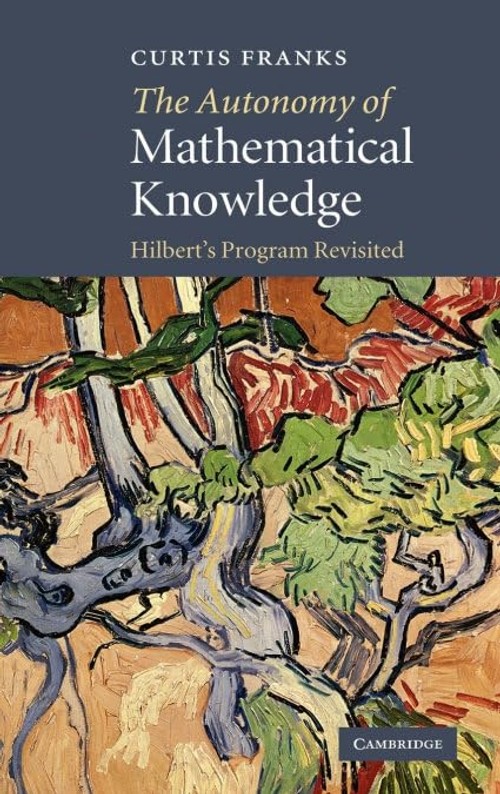
The Autonomy of Mathematical Knowledge: Hilbert's Program and the Foundations of Mathematics by Curtis Franks
Inclusive of all applicable taxes. FREE shipping on all orders.
Available Offers
- 🚚Free Delivery — Free shipping on all orders
- 💵Cash on Delivery — Pay when your order arrives
- ↩️15-Day Easy Returns — Hassle-free return policy
- 🔒Cash on Delivery — Pay safely when your order arrives
Check Delivery
Product Description
Introduction
In the vast landscape of mathematical philosophy, few names command as much reverence as David Hilbert. For decades, scholars have viewed Hilbert's program as a grand but ultimately failed attempt to ground mathematics in absolute certainty. However, Curtis Franks, in his incisive work The Autonomy of Mathematical Knowledge, turns this conventional wisdom on its head. Published by Cambridge University Press, this hardcover volume offers a fresh and provocative reinterpretation of Hilbert's deepest intentions. Franks argues that Hilbert's true legacy was not a failed foundational quest, but a powerful demonstration that mathematics stands on its own, independent of any external philosophical or metaphysical support. This book is an essential read for anyone interested in the philosophy of mathematics, logic, and the history of modern scientific thought.
Book Overview
The Autonomy of Mathematical Knowledge is a meticulously researched and elegantly argued monograph that challenges the standard narrative surrounding Hilbert's program. Rather than seeing Hilbert as a frustrated foundationalist, Franks presents him as a thinker who recognized that mathematical practice itself—its techniques, methods, and internal rigor—is sufficient to validate its own truth. The book weaves together historical scholarship, philosophical analysis, and original technical work in meta-mathematics. Franks focuses on weak systems of arithmetic to demonstrate how Hilbert's ideas, when properly understood, reveal the self-sufficient nature of mathematics. The result is a compelling vision of early modern logic, highlighting the rich interplay between conceptual problems and technical developments.
Key Highlights
- Radical Reinterpretation: Challenges the long-held view that Hilbert's program was a failure, offering a fresh perspective on its philosophical significance.
- Historical Depth: Provides a detailed account of the early history of modern logic, connecting Hilbert's work to broader intellectual currents.
- Technical Rigor: Includes original developments in the meta-mathematics of weak arithmetic systems, making the argument concrete and substantive.
- Philosophical Clarity: Explains complex ideas in a way that is accessible to students and scholars alike, without oversimplifying.
- Interdisciplinary Appeal: Bridges the gap between mathematics, logic, and philosophy, offering insights for readers from all three fields.
Inside the Book
The book is structured to guide the reader through a careful unraveling of Hilbert's thought. Franks begins by situating Hilbert's program within the broader context of early twentieth-century mathematics and philosophy. He then examines the technical obstacles that have been traditionally cited as reasons for the program's failure, showing how these very obstacles actually illuminate Hilbert's core insight. Through a detailed analysis of weak systems of arithmetic, Franks demonstrates that mathematical knowledge does not require a foundation outside itself—it is autonomous. The narrative is enriched with historical anecdotes, philosophical reflections, and step-by-step logical reasoning, making it both intellectually stimulating and accessible.
Key Topics
- Hilbert's program and its philosophical foundations
- The relationship between mathematics and logic
- Meta-mathematics and weak systems of arithmetic
- The concept of mathematical autonomy
- Early history of modern logic and proof theory
- The role of formalism in mathematical practice
- Critiques of foundationalist approaches to mathematics
Reader Benefits
- Deepen Your Understanding: Gain a nuanced appreciation of Hilbert's contributions beyond the standard textbook narrative.
- Engage with Original Ideas: Encounter a bold and original thesis that redefines a major chapter in the history of mathematics.
- Enhance Analytical Skills: Follow complex logical arguments and learn to think critically about foundational issues.
- Bridge Theory and Practice: See how technical mathematical work can illuminate philosophical questions.
- Stay Current: Engage with contemporary debates in the philosophy of mathematics.
Learning Outcomes
By reading this book, you will be able to: critically evaluate the traditional interpretation of Hilbert's program; understand the technical challenges and successes of meta-mathematics; articulate the concept of mathematical autonomy and its implications; trace the historical development of modern logic from Hilbert to the present; and apply these insights to broader questions about the nature of knowledge and truth in mathematics.
Who Should Read
- Students of Philosophy: Especially those specializing in the philosophy of mathematics or logic.
- Mathematics Enthusiasts: Anyone curious about the deep questions underlying mathematical practice.
- Historians of Science: Scholars interested in the intellectual history of the twentieth century.
- Logicians and Proof Theorists: Researchers looking for a fresh perspective on foundational issues.
- Graduate and Advanced Undergraduate Students: Those seeking a challenging but rewarding exploration of mathematical philosophy.
About the Author
Curtis Franks is a philosopher of mathematics and logic with a deep expertise in the history and foundations of mathematics. His research focuses on the interplay between technical developments in logic and broader philosophical questions. Franks has published extensively in leading journals and is known for his clear, rigorous, and original thinking. In The Autonomy of Mathematical Knowledge, he brings together his skills as a historian, philosopher, and logician to offer a transformative reading of Hilbert's work.
About the Publisher
Cambridge University Press is one of the oldest and most prestigious academic publishers in the world. With a history dating back to 1534, the Press is renowned for its commitment to scholarly excellence and its publication of groundbreaking works across all disciplines. This book is a testament to Cambridge's tradition of fostering innovative and rigorous scholarship in mathematics, philosophy, and the sciences.
Conclusion
The Autonomy of Mathematical Knowledge is more than a book—it is a intellectual adventure that will change how you think about mathematics. Curtis Franks has crafted a work that is at once historically informed, philosophically profound, and technically sophisticated. Whether you are a student, a researcher, or simply a curious mind, this volume offers a rare opportunity to engage with one of the most important debates in modern thought. Order your copy today from Bookshops.in and add this essential work to your library.
Quick Summary
The Autonomy of Mathematical Knowledge by Curtis Franks offers a radical reinterpretation of David Hilbert's foundational program. Contrary to the prevailing view that Hilbert's project failed due to technical obstacles, Franks argues that Hilbert's core insight was the autonomy of mathematics—the idea that mathematical practices and techniques do not require grounding in any philosophical principles. The book combines a detailed historical account of early modern logic, philosophical analysis, and original work in the meta-mathematics of weak systems of arithmetic. Readers will discover how Hilbert's program, when properly understood, reveals the self-sufficiency of mathematical knowledge. This work is intended for advanced students and researchers in philosophy of mathematics, logic, and related fields. It challenges conventional narratives and provides a fresh perspective on one of the most important debates in the foundations of mathematics. By presenting a coherent vision of mathematics as an autonomous discipline, Franks invites readers to reconsider the relationship between mathematics and philosophy. Purchase your copy from Bookshops.in, India's trusted source for academic books, and delve into this thought-provoking study.
Book Highlights
Book Specifications
| ISBN-13 | 9780521514378 |
| ISBN-10 | 0521514371 |
| Publisher | Cambridge University Press |
| Language | English |
| Dimensions | 15.88 x 1.91 x 23.5 cm |
| Weight | 500 g |
| Country | India |
| Category | Humanities › Philosophy |
| Genre | Non-fiction |
| Original Language | English |
Frequently Asked Questions
What is The Autonomy of Mathematical Knowledge about?
Who is the author of this book?
Is this book suitable for beginners?
What is the main argument of the book?
Does the book cover technical mathematics?
Which publisher released this book?
Is this a hardcover or paperback?
What is the ISBN?
How does this book differ from other works on Hilbert?
Can Indian students benefit from this book?
Does the book include historical context?
What are weak systems of arithmetic?
Is the book only for philosophers?
Where can I buy this book in India?
Readers Also Search For
Customers Also Bought

Islam
Spiritual Economies (English, Daromir Rudnyckyj)

Islam
Who Is Allah? (English, Bruce B. Lawrence)
Islam
Islam and Liberal Citizenship: The Search for an Overlapping Consensus by Andrew F. March

Islam
Fiqh Us-Sunnah: Funerals and Diggers by Al-Sayyid Sabiq – Islamic Funeral Guide

Christianity
Genetics (English, Thomas a. Shannon | Mark P. Aulisio | Françoise Baylis)

Hinduism
Karma and Creativity by Christopher Key Chapple – Indian Philosophy
Related Products
View All
Philosophy
Latin American Philosophy: Currents, Issues, Debates by Eduardo Mendieta

Philosophy
Al-Farabi's Short Commentary on Aristotle's Prior Analytics by Nicholas Rescher – Philosophy

Philosophy
Poetics of Imagining: Modern to Post-modern by Richard Kearney
Philosophy
The Metaphysics of Extrinsic Properties: 11 (Metaphysical Research, 11)
Philosophy
Dialogues on Metaphysics and on Religion by Nicolas Malebranche – Philosophy
Philosophy