
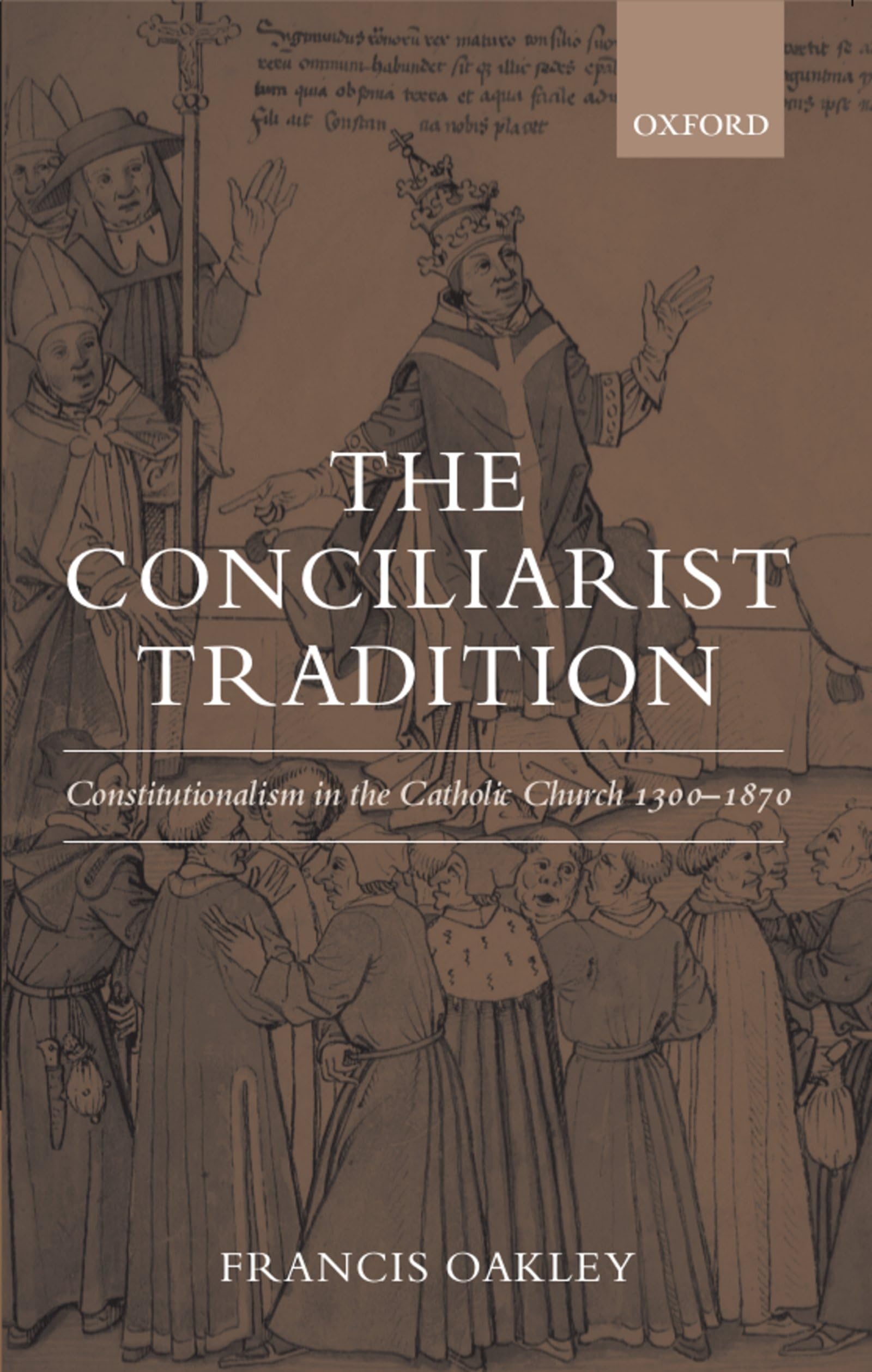
The Conciliarist Tradition: Constitutionalism in the Catholic Church 1300-1870 by Francis Oakley – A Deep Dive into Conc
Inclusive of all applicable taxes. FREE shipping on all orders.
Available Offers
- 🚚Free Delivery — Free shipping on all orders
- 💵Cash on Delivery — Pay when your order arrives
- ↩️15-Day Easy Returns — Hassle-free return policy
- 🔒Cash on Delivery — Pay safely when your order arrives
Check Delivery
Product Description
Introduction
The history of the Catholic Church is often told from the perspective of papal supremacy, but there exists a fascinating and largely forgotten alternative—a tradition that championed the authority of general councils over the pope himself. The Conciliarist Tradition: Constitutionalism in the Catholic Church 1300-1870 by Francis Oakley offers a groundbreaking exploration of this constitutionalist strand within Catholicism. For scholars, students of law, and anyone interested in the evolution of governance structures, this book uncovers a rich intellectual heritage that shaped debates on authority, representation, and legality for over five centuries.
Book Overview
This meticulously researched volume traces the development of conciliarist thought from its medieval origins through to its eventual suppression at the First Vatican Council in 1870. Oakley demonstrates how the Council of Constance (1414-1418) asserted its right to judge and even depose a pope, setting forth a vision of church governance that was constitutional, representative, and legally bounded. The book follows this tradition as it competed with growing papal monarchism, influencing political thinkers across Europe and leaving a lasting imprint on Western constitutionalism. Written with clarity and depth, it recovers a vital chapter in the history of ideas.
Key Highlights
- Original Research: Draws on extensive primary sources from the 14th to 19th centuries, including conciliar decrees, theological treatises, and legal commentaries.
- Interdisciplinary Approach: Bridges church history, political theory, and legal constitutionalism, making it relevant for multiple academic fields.
- Chronological Scope: Covers over 500 years of development, from the Avignon papacy to the triumph of papal infallibility in 1870.
- Critical Reassessment: Challenges the dominant narrative that equates Catholicism solely with monarchical papalism, offering a more pluralistic understanding.
Inside the Book
The book is organized into thematic and chronological chapters that guide the reader through the complex evolution of conciliarist ideas. Oakley begins with the crisis of the Great Schism and the bold actions of the Council of Constance. He then examines the theological and legal arguments of key figures such as Jean Gerson, Nicholas of Cusa, and Francisco de Vitoria. Later chapters explore the survival of conciliarist thought during the Reformation and Counter-Reformation, its influence on Gallicanism and Febronianism, and its final defeat at Vatican I. Each chapter is richly footnoted, providing a roadmap for further study.
Key Topics
- The Great Schism and the Council of Constance (1414-1418)
- Conciliarist theories of papal accountability and deposition
- Constitutional limits on ecclesiastical authority
- The relationship between church governance and secular political thought
- Gallicanism, Febronianism, and Josephinism as later expressions
- The First Vatican Council and the definition of papal infallibility
- Comparisons with early modern constitutionalism in Europe
Reader Benefits
Readers will gain a nuanced understanding of how constitutional ideas flourished even within an ostensibly absolute institution. The book reveals the deep roots of representative governance in Western thought, challenging simplistic binaries between religious and secular authority. For Indian students of law, political science, and history, it offers a unique case study of how legal norms and institutional checks evolved in a non-state context. The work also provides valuable context for contemporary debates about authority, democracy, and the rule of law.
Learning Outcomes
- Understand the historical origins and development of conciliarist constitutionalism from 1300 to 1870.
- Analyze the theological and legal arguments for and against papal supremacy.
- Identify the key figures, councils, and texts that shaped this tradition.
- Evaluate the influence of conciliarist ideas on modern constitutional thought.
- Critically assess the relationship between religious institutions and political governance.
Who Should Read
This book is essential for graduate students and scholars of church history, canon law, political theory, and medieval studies. It is equally valuable for legal historians interested in the premodern roots of constitutionalism. Advanced undergraduates in history or law will find it a challenging yet rewarding read. For Indian readers, it offers a comparative perspective on how authority structures are debated and contested across cultures. Anyone curious about alternative visions of church governance will be captivated by Oakley's lucid presentation.
About the Author
Francis Oakley is a distinguished historian of medieval and early modern political thought. A former president of Williams College in the United States, he has authored numerous works on conciliarism, including The Conciliarist Tradition, which won the American Historical Association's John Gilmary Shea Prize. His scholarship is known for its depth, clarity, and ability to connect medieval ideas to modern constitutional questions. Oakley's work remains a cornerstone in the study of ecclesiastical governance and its intersections with secular law.
About the Publisher
Oxford University Press (OUP) is a globally respected academic publisher, known for its rigorous editorial standards and authoritative titles in law, history, and theology. This hardcover edition from OUP Oxford ensures durability and scholarly quality, making it a lasting addition to any library. OUP's commitment to excellence guarantees that readers receive a well-edited, thoroughly researched text.
Conclusion
The Conciliarist Tradition: Constitutionalism in the Catholic Church 1300-1870 is a masterful recovery of a lost constitutional tradition. Francis Oakley's work challenges us to rethink the history of authority, representation, and legality within one of the world's oldest institutions. For Indian scholars and students seeking to understand the deep roots of constitutional governance, this book offers invaluable insights. It is a must-read for anyone interested in the complex interplay between religion, law, and political power.
Quick Summary
The Conciliarist Tradition: Constitutionalism in the Catholic Church 1300-1870 by Francis Oakley is a definitive scholarly work that traces the constitutionalist movement within the Latin Catholic Church over nearly six centuries. Starting with the Council of Constance, which ended the Western Schism by asserting the authority of general councils over the pope, Oakley examines the persistent tension between conciliarism and papal monarchism. The book argues that conciliarism was not a marginal heresy but a robust tradition that shaped debates on church governance, influencing later political constitutionalism. Ideal for law students, theologians, and historians, this work provides deep insights into how the church grappled with questions of authority, representation, and legal limits. Readers will learn about key councils, figures, and texts that defined this tradition, culminating in the triumph of papal supremacy at Vatican I in 1870. Why buy from Bookshops.in? As a premium Indian online bookstore, Bookshops.in offers authentic imported editions, competitive pricing, and reliable delivery, making it the trusted choice for academic readers across India.
Book Highlights
Book Specifications
| ISBN-13 | 9780199541249 |
| ISBN-10 | 0199541248 |
| Publisher | Oxford Univ Pr on Demand |
| Language | English |
| Dimensions | 2.03 x 13.72 x 21.34 cm |
| Weight | 390 g |
| Category | Religious Studies › History of Religion |
| Genre | Academic |
| Original Language | English |
Frequently Asked Questions
What is the main thesis of The Conciliarist Tradition?
Who is Francis Oakley?
What time period does the book cover?
Is this book suitable for Indian students?
What is the Council of Constance's significance?
How does this book relate to Vatican I?
Is the book academic or accessible to general readers?
Does the book cover non-Western church traditions?
What primary sources does Oakley use?
Why is conciliarism important today?
Can I use this book for a university course?
What is the binding type?
Is the book available in Indian bookstores?
Does the book include illustrations?
Readers Also Search For
Customers Also Bought
Islam
Spiritual Economies (English, Daromir Rudnyckyj)

Islam
Who Is Allah? (English, Bruce B. Lawrence)
Islam
Islam and Liberal Citizenship: The Search for an Overlapping Consensus by Andrew F. March
Islam
Fiqh Us-Sunnah: Funerals and Diggers by Al-Sayyid Sabiq – Islamic Funeral Guide

Christianity
Genetics (English, Thomas a. Shannon | Mark P. Aulisio | Françoise Baylis)

Hinduism
Karma and Creativity by Christopher Key Chapple – Indian Philosophy
Related Products
View All
Religion & Spirituality
Religion as a Conversation Starter | by Ina Merdjanova | Continuum | by Ina Merdjanova | Continuum | by Ina Merdjanova | Continuum | by Ina Merdjanova | Continuum | by Ina Merdjanova | Continuum | by Ina Merdjanova | Continuum | by Ina Merdjanova | Continuum | by Ina Merdjanova | Continuum | by Ina Merdjanova | Continuum | by Ina Merdjanova | Continuum | by Ina Merdjanova | Continuum | by Ina Merdjanova | Continuum | by Ina Merdjanova | Continuum | by Ina Merdjanova | Continuum | by Ina Merdjano
Religion & Spirituality
The Other Jewish Question: Identifying the Jew and Making Sense of Modernity
Religion & Spirituality
The Oxford Guide to People & Places of the Bible | by Bruce M. Metzger | Michael D. Coogan | Oxford University Press | by Bruce M. Metzger | Michael D. Coogan | Oxford University Press | by Bruce M. Metzger | Michael D. Coogan | Oxford University Press | by Bruce M. Metzger | Michael D. Coogan | Oxford University Press | by Bruce M. Metzger | Michael D. Coogan | Oxford University Press | by Bruce M. Metzger | Michael D. Coogan | Oxford University Press | by Bruce M. Metzger | Michael D. Coogan |

Religion & Spirituality
Anti-Judaism in Early Christianity | by Stephen G. Wilson | Wilfrid Laurier University Press | by Stephen G. Wilson | Wilfrid Laurier University Press | by Stephen G. Wilson | Wilfrid Laurier University Press | by Stephen G. Wilson | Wilfrid Laurier University Press | by Stephen G. Wilson | Wilfrid Laurier University Press | by Stephen G. Wilson | Wilfrid Laurier University Press | by Stephen G. Wilson | Wilfrid Laurier University Press | by Stephen G. Wilson | Wilfrid Laurier University Press |
Religion & Spirituality
Moral Philosophy on the Threshold of Modernity: 57 (The New Synthese Historical Library)
Religion & Spirituality