
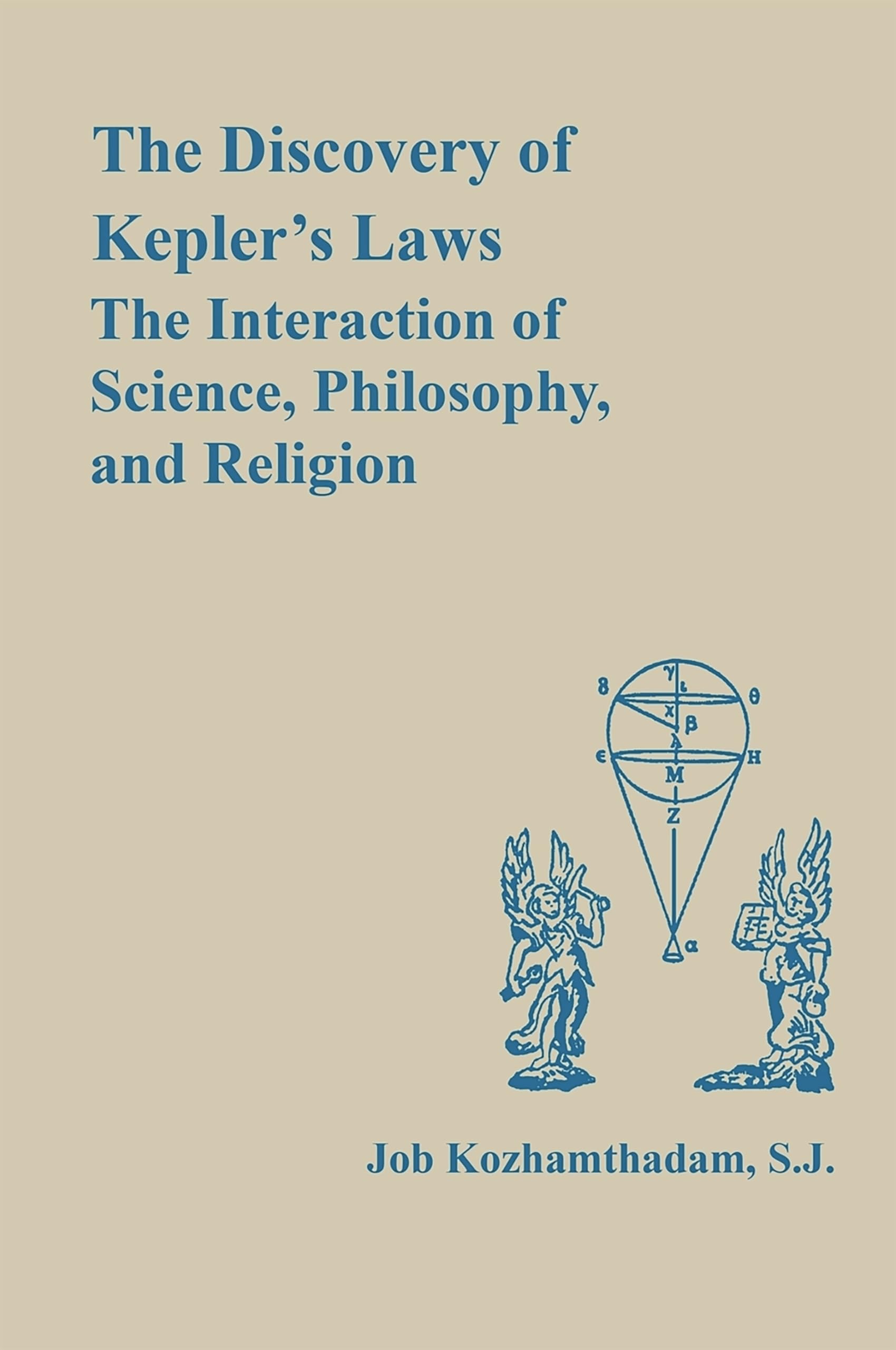
The Discovery of Kepler's Laws: The Interaction of Science, Philosophy, and Religion by Job Kozhamthadam – A Scholarly E
Inclusive of all applicable taxes. FREE shipping on all orders.
Available Offers
- 🚚Free Delivery — Free shipping on all orders
- 💵Cash on Delivery — Pay when your order arrives
- ↩️15-Day Easy Returns — Hassle-free return policy
- 🔒Cash on Delivery — Pay safely when your order arrives
Check Delivery
Product Description
Introduction
In the vast tapestry of scientific history, few figures stand as tall as Johannes Kepler, the German astronomer whose revolutionary laws of planetary motion forever changed humanity's understanding of the cosmos. The Discovery of Kepler's Laws: The Interaction of Science, Philosophy, and Religion by Job Kozhamthadam offers a rare and illuminating journey into the mind of a genius. Published by the prestigious University of Notre Dame Press, this hardcover volume is not merely a chronicle of scientific breakthroughs; it is a profound exploration of how faith, reason, and empirical observation intertwined to produce one of the most pivotal moments in the history of science. For Indian readers, students, and scholars alike, this book provides a unique lens through which to appreciate the unity of knowledge—a theme deeply resonant with our own intellectual traditions.
Book Overview
Job Kozhamthadam, a Jesuit scholar and philosopher of science, takes us beyond the dry equations of Kepler's three laws. He delves into the rich intellectual ferment of the early 17th century, a time when the boundaries between science, philosophy, and religion were fluid and often contested. The book meticulously reconstructs Kepler's worldview, showing how his deep Christian faith, his Neoplatonic philosophical leanings, and his relentless pursuit of mathematical harmony all converged to shape his discoveries. Unlike conventional histories that treat Kepler as a purely rational scientist, this work reveals a man who saw the universe as a divine creation, ordered by geometrical beauty and governed by a Creator whose mind could be glimpsed through careful observation. This is a story of intellectual courage, where a devout Lutheran challenged both Aristotelian dogma and Copernican orthodoxy to forge a new synthesis.
Key Highlights
- First comprehensive study of the interplay between Kepler's religious beliefs, philosophical commitments, and scientific methodology.
- Accessible yet scholarly writing that bridges the gap between technical astronomy and the humanities.
- Rich contextual analysis of the political, religious, and academic environment of early modern Europe.
- Original insights into how Kepler's concept of 'physical astronomy' laid the groundwork for Newton's theory of universal gravitation.
- Critical examination of Kepler's use of Tycho Brahe's data and his own struggles with elliptical orbits.
Inside the Book
The book is structured into eight tightly argued chapters, each focusing on a different dimension of Kepler's intellectual journey. Beginning with the young Kepler's education at the University of Tübingen, where he absorbed both Copernican astronomy and Lutheran theology, the narrative traces his evolving ideas through his years as a mathematics teacher in Graz, his collaboration with Tycho Brahe in Prague, and his final years in Linz. Kozhamthadam dedicates significant attention to Kepler's Mysterium Cosmographicum, his first major work that attempted to explain the distances of the planets using Platonic solids. The author then walks us through the painstaking calculations that led to the first and second laws, revealing the crucial role of Kepler's belief in the sun as a physical and spiritual center of the universe. The third law—the harmonic law—is presented not as a sudden flash of genius but as the culmination of decades of searching for a divine symphony in the heavens.
Key Topics
- The historical context of the Scientific Revolution and the Reformation.
- Kepler's Neoplatonism and its influence on his concept of celestial physics.
- The relationship between empirical data and theoretical imagination in scientific discovery.
- Kepler's theological arguments for a heliocentric universe.
- The philosophical debate between realism and instrumentalism in astronomy.
- The role of aesthetic and mathematical harmony in Kepler's thought.
Reader Benefits
This book offers Indian readers a rare opportunity to see science as a deeply human endeavor, shaped by culture, faith, and philosophy—perspectives often missing from standard textbooks. Students pursuing physics, astronomy, or history of science will gain a richer understanding of how scientific theories are born, not in a vacuum, but within a web of beliefs and values. For those interested in the dialogue between religion and science, Kozhamthadam provides a balanced, non-polemical account that respects both faith and reason. Philosophy enthusiasts will appreciate the nuanced discussion of causality, explanation, and the nature of scientific proof. Moreover, the book serves as an inspiring example of interdisciplinary scholarship, showing how rigorous inquiry can transcend artificial boundaries.
Learning Outcomes
- Understand the full historical and intellectual context of Kepler's three laws of planetary motion.
- Analyze how religious and philosophical presuppositions can both facilitate and constrain scientific discovery.
- Evaluate the interplay between observation, mathematics, and metaphysical commitments in the development of modern science.
- Gain insight into the life and work of one of history's most underappreciated scientific pioneers.
- Develop a nuanced perspective on the 'conflict thesis' between science and religion.
Who Should Read
This book is ideal for undergraduate and postgraduate students of physics, astronomy, history, philosophy, and religious studies. It is equally valuable for educators seeking to enrich their teaching with historical depth, and for general readers with a curiosity about the great minds that shaped our understanding of the universe. Indian readers, in particular, will find resonance in the book's emphasis on the unity of knowledge—a theme that echoes the ancient Indian ideal of vidya (knowledge) as a holistic pursuit. Whether you are a science enthusiast, a philosophy lover, or a person of faith wondering about the compatibility of science and religion, this book has something profound to offer.
About the Author
Job Kozhamthadam, S.J., is a Jesuit priest and a distinguished professor of philosophy and history of science. He has taught at several universities in India and abroad, and his research focuses on the interface between science, philosophy, and religion. A former director of the Jnana-Deepa Vidyapeeth in Pune, he brings a unique interdisciplinary perspective that combines rigorous scholarship with deep spiritual insight. His work on Kepler is widely regarded as a seminal contribution to the field, offering a balanced and empathetic portrait of a scientist whose faith and reason were not at odds but worked in harmony.
About the Publisher
University of Notre Dame Press is one of the most respected academic publishers in the United States, known for its high-quality works in philosophy, theology, history, and the sciences. With a commitment to scholarly excellence and intellectual integrity, the press has published numerous award-winning books that bridge the humanities and the sciences. This hardcover edition reflects the press's dedication to producing durable, beautifully crafted volumes that will last for generations—a fitting vessel for a book that explores eternal truths.
Conclusion
The Discovery of Kepler's Laws is more than a history of astronomy; it is a meditation on the very nature of discovery itself. Job Kozhamthadam shows us that Kepler's genius lay not only in his mathematical prowess but in his willingness to let his whole being—his faith, his philosophy, his passion for beauty—inform his science. In an age of increasing specialization, this book reminds us of the power of integrative thinking. For anyone who has ever looked up at the night sky and wondered about the forces that govern the dance of the planets, this book will be a trusted guide and an enduring source of inspiration. Add this remarkable volume to your library today and embark on a journey that spans the heavens and the human soul.
Quick Summary
The Discovery of Kepler's Laws by Job Kozhamthadam is a profound scholarly work that delves into the intellectual, philosophical, and religious forces that shaped Johannes Kepler's groundbreaking discovery of planetary motion laws. Unlike conventional biographies, this book uniquely integrates Kepler's scientific achievements with his deep religious convictions and philosophical worldview. Readers will journey through Kepler's life, his collaboration with Tycho Brahe, and his meticulous analysis of astronomical data that led to the three laws. The book is ideal for graduate students, researchers in history and philosophy of science, and anyone fascinated by the intersection of faith and reason. It provides a nuanced understanding of how Kepler's belief in a harmonious cosmos drove his empirical work, ultimately paving the way for Newtonian physics. By purchasing from Bookshops.in, Indian readers gain access to this rare, high-quality hardcover edition from a prestigious academic press, ensuring a lasting addition to their library.
Book Highlights
Book Specifications
| ISBN-13 | 9780268008680 |
| ISBN-10 | 026800868X |
| Publisher | Univ of Notre Dame Pr |
| Language | English |
| Dimensions | 15.24 x 2.24 x 22.86 cm |
| Weight | 544 g |
| Category | Philosophy › History & Surveys |
| Genre | Nonfiction |
| Reading Age | 18+ |
| Original Language | English |
Frequently Asked Questions
What is the main theme of The Discovery of Kepler's Laws?
Who is Job Kozhamthadam?
Is this book suitable for undergraduate students?
Does the book cover Kepler's personal religious beliefs?
How does this book differ from other Kepler biographies?
What are Kepler's three laws?
Can I use this book for research papers?
Does the book discuss Copernicus?
Is the book available in hardcover?
Does the book include illustrations?
What is the price in INR?
Is this book recommended for Indian readers?
Where can I buy this book?
Readers Also Search For
Customers Also Bought

Islam
Spiritual Economies (English, Daromir Rudnyckyj)

Islam
Who Is Allah? (English, Bruce B. Lawrence)

Islam
Islam and Liberal Citizenship: The Search for an Overlapping Consensus by Andrew F. March

Islam
Fiqh Us-Sunnah: Funerals and Diggers by Al-Sayyid Sabiq – Islamic Funeral Guide

Christianity
Genetics (English, Thomas a. Shannon | Mark P. Aulisio | Françoise Baylis)

Hinduism
Karma and Creativity by Christopher Key Chapple – Indian Philosophy
Related Products
View All
Philosophy
Latin American Philosophy: Currents, Issues, Debates by Eduardo Mendieta

Philosophy
Al-Farabi's Short Commentary on Aristotle's Prior Analytics by Nicholas Rescher – Philosophy

Philosophy
Poetics of Imagining: Modern to Post-modern by Richard Kearney

Philosophy
The Metaphysics of Extrinsic Properties: 11 (Metaphysical Research, 11)

Philosophy
Dialogues on Metaphysics and on Religion by Nicolas Malebranche – Philosophy
Philosophy