
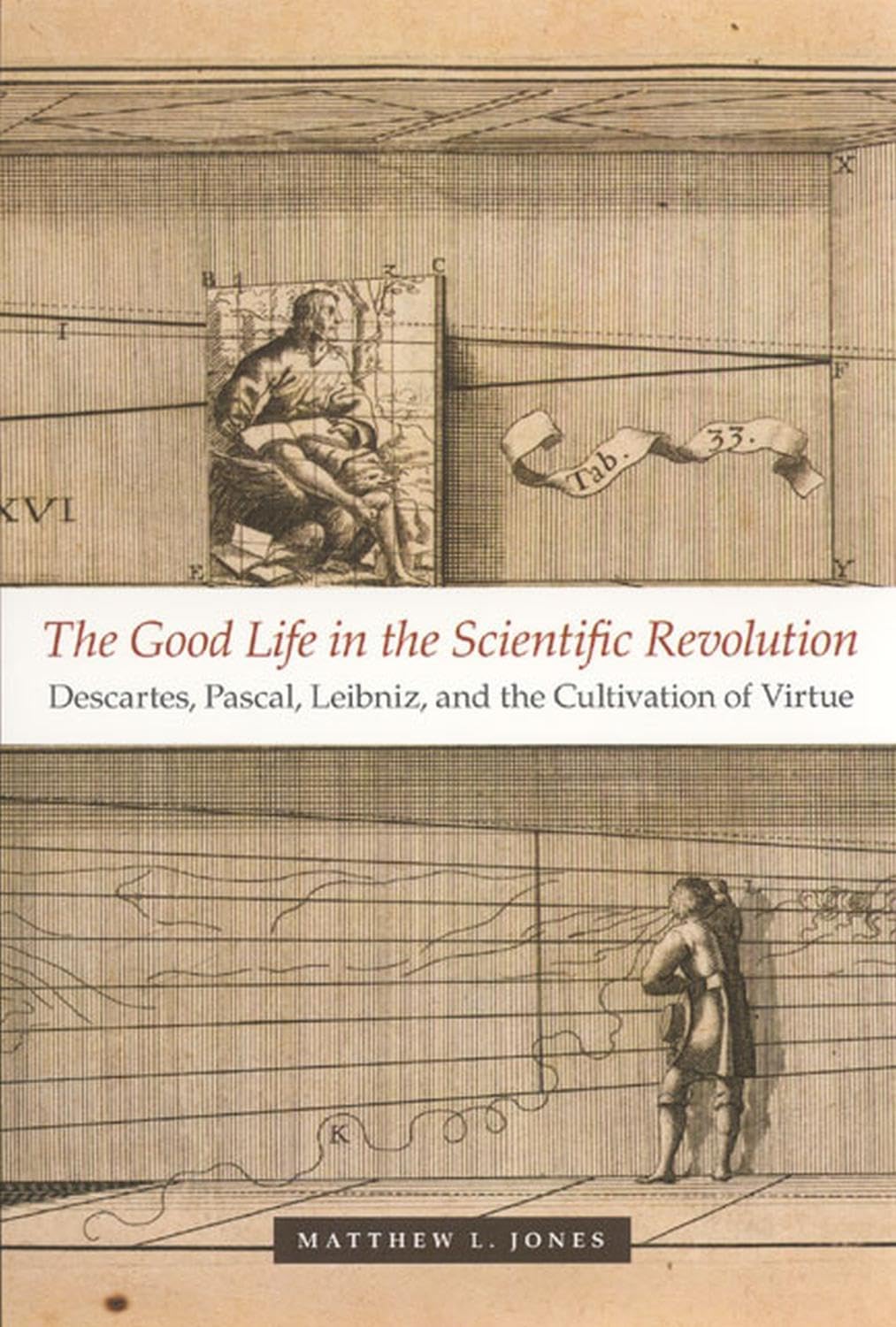
The Good Life in the Scientific Revolution: Descartes, Pascal, Leibniz, and the Cultivation of Virtue by Matthew L. Jone
Inclusive of all applicable taxes. FREE shipping on all orders.
Available Offers
- 🚚Free Delivery — Free shipping on all orders
- 💵Cash on Delivery — Pay when your order arrives
- ↩️15-Day Easy Returns — Hassle-free return policy
- 🔒Cash on Delivery — Pay safely when your order arrives
Check Delivery
Product Description
Introduction
In an age of political upheaval, religious conflict, and profound uncertainty, the seventeenth century in Europe was a time when thinkers sought not only to understand the natural world but also to find a path to a virtuous and meaningful life. The Good Life in the Scientific Revolution: Descartes, Pascal, Leibniz, And the Cultivation of Virtue by Matthew L. Jones offers a compelling exploration of how three towering figures of early modern science and philosophy—René Descartes, Blaise Pascal, and Gottfried Leibniz—used their groundbreaking work in mathematics and natural philosophy as tools for moral and spiritual cultivation. This hardcover volume, published by the University of Chicago Press, is a must-read for students, scholars, and anyone curious about the intersection of science, ethics, and the quest for human flourishing.
Book Overview
Matthew L. Jones weaves a rich narrative that reimagines the Scientific Revolution not merely as a series of discoveries about the physical universe, but as a deeply human endeavor aimed at shaping character and achieving the good life. The book presents a triptych: Descartes, Pascal, and Leibniz each emerge as figures who saw mathematics and science as cognitive and spiritual exercises—disciplines that could train the mind, conquer fear, and cultivate virtue. From Descartes’ geometry to Pascal’s arithmetical triangle and Leibniz’s calculus, Jones demonstrates that these innovations were inseparable from their creators’ moral ambitions. The result is a fresh perspective that challenges conventional histories of science and offers timeless insights into how intellectual work can serve as a path to personal excellence.
Key Highlights
- Original Thesis: Argues that the Scientific Revolution was driven by a quest for moral therapeutics, not just empirical knowledge.
- Three Iconic Thinkers: In-depth analysis of Descartes, Pascal, and Leibniz as philosophers of virtue.
- Historical Context: Situates scientific ideas within the turmoil of seventeenth-century Europe, making the era come alive.
- Interdisciplinary Approach: Bridges history of science, philosophy, and ethics in a seamless narrative.
- Rigorous Scholarship: Based on primary sources and original research, yet accessible to non-specialists.
Inside the Book
Jones takes readers on a journey through the intellectual workshops of Descartes, Pascal, and Leibniz. He shows how Descartes’ method of doubt and geometric reasoning was designed to rebuild knowledge on a firm foundation, but also to free the mind from error and passion. Pascal’s work on probability and the arithmetical triangle is revealed as a meditation on human finitude and the need for humility. Leibniz’s calculus and his concept of pre-established harmony emerge as part of a grand vision of a rational, virtuous universe. Each chapter combines biographical detail with philosophical analysis, making complex ideas feel immediate and relevant. The book also explores how these thinkers engaged with ancient Stoic and Christian traditions of spiritual exercises, adapting them to the new science.
Key Topics
- The role of mathematics as a spiritual discipline in early modern Europe
- Descartes’ moral philosophy and his unfinished work on the passions
- Pascal’s wager and the cultivation of belief through mathematical reasoning
- Leibniz’s theodicy and his vision of a harmonious universe
- Virtue ethics and the pursuit of happiness in the Scientific Revolution
- The relationship between cognitive training and moral improvement
- Historical connections between science, religion, and self-cultivation
Reader Benefits
- Deepen Your Understanding: Gain a nuanced view of the Scientific Revolution as a moral and spiritual project.
- Connect Ideas: See how philosophy, mathematics, and ethics are intertwined in the works of great thinkers.
- Enhance Critical Thinking: Learn how these historical figures used reason to overcome uncertainty and develop resilience.
- Broaden Perspective: Discover how the quest for a good life has shaped science and technology from the very beginning.
- Inspire Personal Growth: Reflect on how intellectual disciplines can cultivate virtues like patience, humility, and clarity of mind.
Learning Outcomes
By reading this book, you will be able to: articulate how Descartes, Pascal, and Leibniz integrated ethics into their scientific work; analyze the historical context that shaped their ideas; evaluate the relevance of their moral philosophies for contemporary life; and appreciate the enduring connection between knowledge and virtue. The book equips readers with a richer vocabulary for discussing the purposes of science and the nature of human flourishing.
Who Should Read
- Students of History and Philosophy: Ideal for undergraduate and postgraduate courses on the Scientific Revolution, early modern philosophy, or history of science.
- Academics and Researchers: A valuable resource for scholars working on Descartes, Pascal, Leibniz, or virtue ethics.
- General Readers: Anyone interested in the intersection of science, spirituality, and the search for meaning will find this book engaging and thought-provoking.
- Indian Readers: With its focus on self-cultivation and disciplined practice, the book resonates with Indian traditions of yoga, meditation, and philosophical inquiry.
About the Author
Matthew L. Jones is a distinguished historian of science and philosophy. He has taught at Columbia University and other leading institutions, and his research focuses on the intellectual and cultural history of early modern Europe. Jones is known for his ability to make complex historical ideas accessible and relevant to modern readers. His work has been widely praised for its depth, clarity, and originality.
About the Publisher
The University of Chicago Press is one of the most respected academic publishers in the world. With a legacy of excellence spanning over a century, it is renowned for producing rigorous, beautifully crafted books that advance knowledge across disciplines. This hardcover edition reflects the press’s commitment to quality, making it a lasting addition to any library.
Conclusion
The Good Life in the Scientific Revolution is more than a history book—it is an invitation to rethink the purpose of science and knowledge itself. By showing how Descartes, Pascal, and Leibniz used their genius to pursue virtue, Matthew L. Jones reminds us that the quest for a good life is as urgent today as it was in the seventeenth century. Whether you are a student, a scholar, or a curious reader, this book will enrich your understanding of the past and inspire your own journey toward wisdom and excellence. Order your copy from Bookshops.in today and add this transformative work to your collection.
Quick Summary
The Good Life in the Scientific Revolution by Matthew L. Jones is a scholarly yet accessible exploration of how three titans of early modern science—René Descartes, Blaise Pascal, and Gottfried Leibniz—viewed their intellectual work as a means of cultivating virtue and achieving a good life. Set against the backdrop of 17th-century Europe's upheavals, the book reveals that these thinkers saw mathematics and scientific inquiry not merely as tools for understanding nature but as cognitive and spiritual exercises that could transform the self. Jones masterfully weaves together intellectual history, philosophy, and ethics to show how the Scientific Revolution was also a moral revolution. This book is perfect for Indian students and academics in philosophy, history of science, and ethics, as well as general readers curious about the deeper purpose of knowledge. By purchasing from Bookshops.in, you get an authentic, brand-new hardcover edition with reliable delivery across India.
Book Highlights
Book Specifications
| ISBN-13 | 9780226409559 |
| ISBN-10 | 0226409554 |
| Publisher | Univ of Chicago Pr |
| Language | English |
| Dimensions | 15.24 x 2.57 x 22.86 cm |
| Weight | 544 g |
| Country | India |
| Category | Philosophy › Ethics |
| Genre | Nonfiction |
| Original Language | English |
Frequently Asked Questions
What is The Good Life in the Scientific Revolution about?
Who is the author of this book?
Which publisher released this book?
Is this book suitable for Indian students?
What is the binding of this edition?
Does the book cover only Descartes?
What is the ISBN-13 of this book?
What language is the book in?
What price is listed for this book?
What rating does the book have?
What category does this book fall under?
Does the book discuss virtue ethics?
Where can I buy this book in India?
Readers Also Search For
Customers Also Bought
Islam
Spiritual Economies (English, Daromir Rudnyckyj)

Islam
Who Is Allah? (English, Bruce B. Lawrence)
Islam
Islam and Liberal Citizenship: The Search for an Overlapping Consensus by Andrew F. March

Islam
Fiqh Us-Sunnah: Funerals and Diggers by Al-Sayyid Sabiq – Islamic Funeral Guide

Christianity
Genetics (English, Thomas a. Shannon | Mark P. Aulisio | Françoise Baylis)

Hinduism
Karma and Creativity by Christopher Key Chapple – Indian Philosophy
Related Products
View All
Philosophy
Latin American Philosophy: Currents, Issues, Debates by Eduardo Mendieta

Philosophy
Al-Farabi's Short Commentary on Aristotle's Prior Analytics by Nicholas Rescher – Philosophy
Philosophy
Poetics of Imagining: Modern to Post-modern by Richard Kearney

Philosophy
The Metaphysics of Extrinsic Properties: 11 (Metaphysical Research, 11)
Philosophy
Dialogues on Metaphysics and on Religion by Nicolas Malebranche – Philosophy
Philosophy