
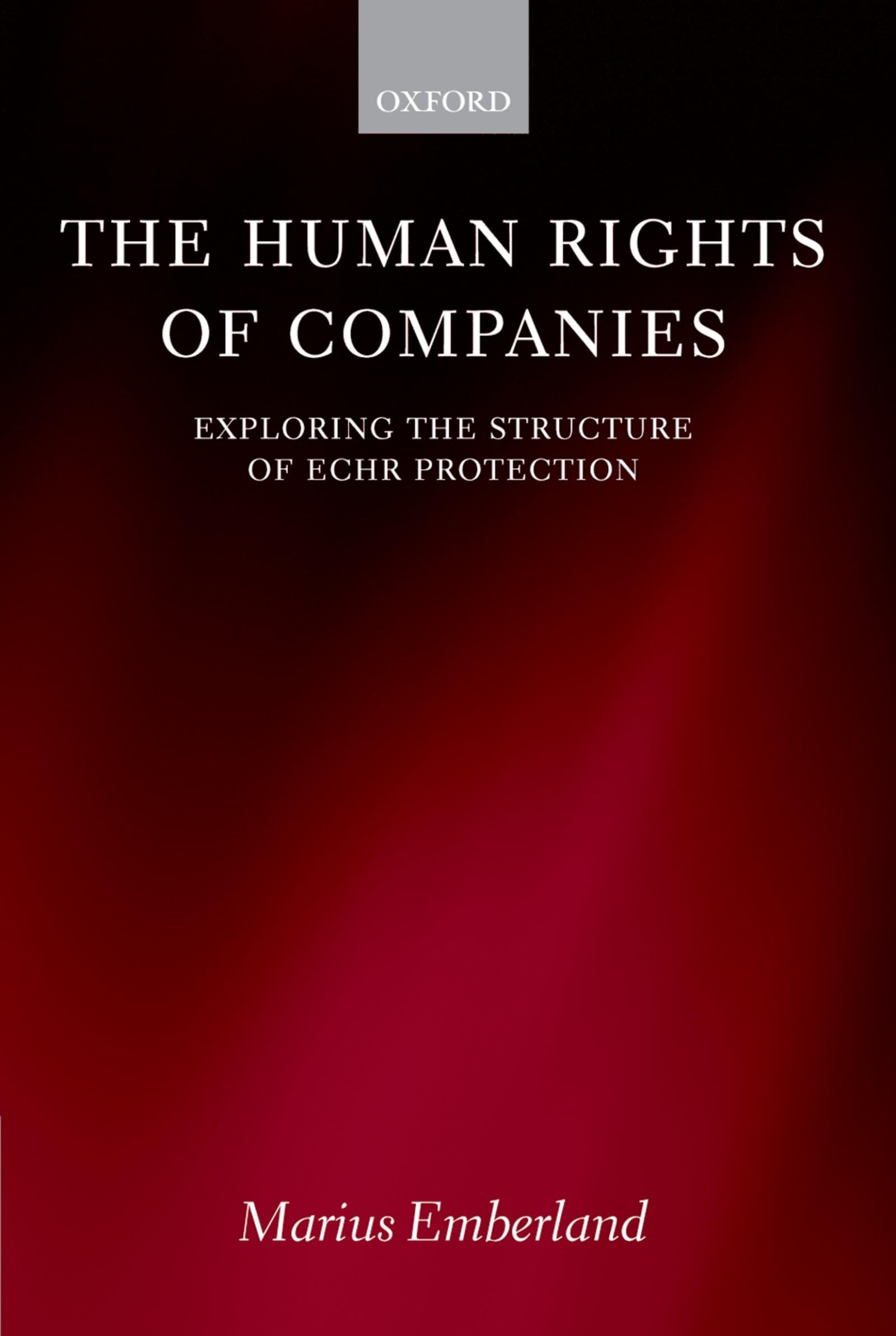
The Human Rights of Companies: Exploring the Structure of ECHR Protection by Marius Emberland – A Comprehensive Legal St
Inclusive of all applicable taxes. FREE shipping on all orders.
Available Offers
- 🚚Free Delivery — Free shipping on all orders
- 💵Cash on Delivery — Pay when your order arrives
- ↩️15-Day Easy Returns — Hassle-free return policy
- 🔒Cash on Delivery — Pay safely when your order arrives
Check Delivery
Product Description
Introduction
In an era where corporate entities increasingly navigate the complex terrain of international human rights law, Marius Emberland's The Human Rights of Companies: Exploring the Structure of Echr Protection offers a groundbreaking examination of how business interests find shelter under the European Convention on Human Rights (ECHR). This hardcover volume from OUP Oxford is an indispensable resource for Indian legal scholars, corporate lawyers, and students of international law who seek to understand the evolving relationship between commercial entities and fundamental rights protections. Emberland’s work challenges conventional assumptions by demonstrating that companies, much like individuals, can be bearers of human rights under certain legal frameworks, raising profound questions about the nature of rights, corporate personhood, and the balance between economic freedom and state regulation.
Book Overview
Published by OUP Oxford, this meticulously researched monograph provides the first in-depth analysis of the European Court of Human Rights' (ECtHR) response to complaints filed by companies and their shareholders. Emberland dissects the structural mechanisms through which the ECHR extends protection to business interests, exploring landmark cases and doctrinal developments that have shaped this area of law. The book systematically examines how the Convention’s provisions—particularly Article 1 of Protocol No. 1 (right to property), Article 6 (right to a fair trial), and Article 10 (freedom of expression)—are interpreted in the context of corporate claimants. By tracing the evolution of the Court’s jurisprudence, Emberland reveals the underlying value system that informs these decisions, offering a nuanced perspective on the intersection of corporate law and human rights.
Key Highlights
- First comprehensive study of corporate rights under the ECHR, bridging a critical gap in legal scholarship
- In-depth case law analysis covering pivotal ECtHR decisions involving companies and shareholders
- Structural exploration of how the Convention’s framework accommodates non-human claimants
- Comparative insights relevant to Indian corporate law and human rights discourse
- Rigorous theoretical foundation examining the concept of corporate personhood in international law
Inside the Book
The book is structured to guide readers through the doctrinal and philosophical dimensions of the subject. Emberland begins by setting the historical and theoretical context, explaining why companies have sought protection under the ECHR and how the Court has navigated the tension between individual rights and collective economic interests. Subsequent chapters delve into specific Convention articles, analysing their application to corporate entities through detailed case studies. The author also explores the role of shareholders as indirect claimants, examining how their rights intersect with those of the company. A particularly illuminating section addresses the limits of corporate protection, including instances where the Court has denied claims on grounds of abuse of rights or procedural barriers. The concluding chapters synthesise the findings, offering a coherent framework for understanding the ECHR’s value system as it pertains to business entities.
Key Topics
- Corporate personhood and the attribution of human rights to legal entities
- Property rights of companies under Article 1 of Protocol No. 1
- Fair trial guarantees for corporate litigants under Article 6
- Freedom of expression and commercial speech under Article 10
- Shareholder standing and the doctrine of indirect victim status
- Margin of appreciation and state discretion in regulating business activities
- Proportionality analysis in balancing corporate rights and public interest
- Comparative perspectives with Indian constitutional jurisprudence on corporate rights
Reader Benefits
This book equips readers with a sophisticated understanding of how international human rights law interacts with corporate interests—a knowledge area that is increasingly relevant in India’s dynamic legal landscape. Lawyers practising in commercial litigation, constitutional law, or human rights will gain valuable insights into the arguments that can be advanced on behalf of corporate clients before domestic and international forums. Academics and researchers will appreciate the depth of doctrinal analysis and the critical engagement with ECtHR jurisprudence. Students preparing for competitive examinations or pursuing advanced degrees in law will find the book’s structured approach helpful for grasping complex theoretical concepts. Moreover, the work encourages a reflective stance on the broader implications of extending human rights protections to non-human actors, fostering critical thinking about the purpose and limits of rights discourse.
Learning Outcomes
- Understand the structural framework of ECHR protection for companies and shareholders
- Analyse key ECtHR judgments that have defined corporate rights jurisprudence
- Evaluate the theoretical justifications for and against corporate human rights claims
- Apply comparative reasoning to assess the relevance of ECHR law in the Indian context
- Critically assess the value system underpinning the Court’s approach to business interests
- Develop advanced legal arguments concerning corporate rights and state regulation
Who Should Read
This book is essential reading for law students specialising in international law, human rights, or corporate law; practising lawyers handling commercial litigation or constitutional matters; legal academics researching the intersection of business and human rights; judges and judicial officers seeking comparative perspectives on corporate rights; corporate counsel advising on regulatory compliance and litigation strategy; policy makers involved in drafting legislation affecting business and human rights; and anyone interested in the philosophical question of whether companies can possess human rights. Indian readers will find the analysis particularly valuable given the growing importance of corporate constitutional rights in Indian Supreme Court jurisprudence, including cases on freedom of speech, property, and fair trial for companies.
About the Author
Marius Emberland is a distinguished legal scholar with expertise in international human rights law and European Convention law. His academic work has focused on the theoretical and doctrinal dimensions of rights protection, particularly as they apply to non-state actors. Emberland’s rigorous analytical style and deep engagement with ECtHR case law have earned him recognition among European and international legal circles. This book represents the culmination of years of research into the structural relationships between legal personality, rights-bearing, and the institutional framework of the ECHR.
About the Publisher
OUP Oxford, the academic publishing arm of Oxford University Press, is renowned worldwide for its authoritative legal texts and scholarly monographs. With a legacy of excellence spanning centuries, OUP Oxford publishes works that set the standard for legal research and education. This volume exemplifies the publisher’s commitment to advancing knowledge in specialised fields of law, offering readers a meticulously edited and produced hardcover edition that will endure as a reference work for years to come.
Conclusion
The Human Rights of Companies: Exploring the Structure of Echr Protection is a landmark contribution to legal scholarship that illuminates a previously underexplored area of international law. For Indian readers, the book offers not only a deep dive into European jurisprudence but also a framework for reflecting on analogous issues in India’s own constitutional order—where companies increasingly assert fundamental rights in litigation. Emberland’s work challenges us to reconsider the boundaries of human rights and the role of corporations in a rights-based legal system. Whether you are a student, practitioner, or academic, this book will enrich your understanding and provoke thoughtful debate about the future of corporate accountability and protection under the law.
Quick Summary
The Human Rights of Companies: Exploring the Structure of ECHR Protection by Marius Emberland is a pioneering academic work that investigates how the European Court of Human Rights adjudicates complaints brought by companies and their shareholders. This book provides the first comprehensive analysis of the protection of business interests under the European Convention on Human Rights, delving into the legal reasoning, value system, and doctrinal foundations that shape the Court's approach. Readers will learn about the legal personality of corporations, the scope of property rights, fair trial guarantees, and the standing of shareholders. The book is essential for law students, human rights practitioners, corporate lawyers, and academics seeking a deep understanding of the intersection between business and human rights in Europe. By purchasing from Bookshops.in, Indian readers gain access to an authentic hardcover edition from OUP Oxford, backed by trusted service and prompt delivery.
Book Highlights
Book Specifications
| ISBN-13 | 9780199289837 |
| ISBN-10 | 0199289832 |
| Publisher | Oxford Univ Pr on Demand |
| Language | English |
| Dimensions | 23.39 x 1.6 x 15.6 cm |
| Weight | 567 g |
| Category | Political Science › Civil Rights |
| Genre | Non-fiction |
| Reading Age | Adult |
| Original Language | English |
Frequently Asked Questions
What is the main focus of this book?
Who is the author Marius Emberland?
Is this book suitable for Indian readers?
Does the book cover shareholder rights?
What is the binding of this book?
Is this book used in law courses?
Does the book discuss corporate accountability?
What is the European Convention on Human Rights?
Can this book help in litigation?
What is the price of this book?
Is the book written in English?
Does the book compare ECHR with other systems?
Why buy from Bookshops.in?
Readers Also Search For
Customers Also Bought

Constitutional Law
Indigenous law and the state
Constitutional Law
Great Cases in Constitutional Law (English, Robert P. George)
Constitutional Law
Guilty Pleas in International Criminal Law (English, Nancy Amoury Combs)

Constitutional Law
The Growth of the Law by Benjamin N. Cardozo – Jurisprudence
Constitutional Law
Court of Injustice: Law Without Recognition in U.S. Immigration by J. C. Salyer

Constitutional Law
Youth: Learning Through Cases
Related Products
View All
Law
Mediasport | by Lawrence Wenner | Routledge | by Lawrence Wenner | Routledge | by Lawrence Wenner | Routledge | by Lawrence Wenner | Routledge | by Lawrence Wenner | Routledge | by Lawrence Wenner | Routledge | by Lawrence Wenner | Routledge | by Lawrence Wenner | Routledge | by Lawrence Wenner | Routledge | by Lawrence Wenner | Routledge | by Lawrence Wenner | Routledge | by Lawrence Wenner | Routledge | by Lawrence Wenner | Routledge | by Lawrence Wenner | Routledge | by Lawrence Wenner | Rout
Law
Human Rights Diplomacy | by Rein Mullerson | Routledge | by Rein Mullerson | Routledge | by Rein Mullerson | Routledge | by Rein Mullerson | Routledge | by Rein Mullerson | Routledge | by Rein Mullerson | Routledge | by Rein Mullerson | Routledge | by Rein Mullerson | Routledge | by Rein Mullerson | Routledge | by Rein Mullerson | Routledge | by Rein Mullerson | Routledge | by Rein Mullerson | Routledge | by Rein Mullerson | Routledge | by Rein Mullerson | Routledge | by Rein Mullerson | Routled
Law
Rome the Law-Giver | by Declareuil J. | Routledge | by Declareuil J. | Routledge | by Declareuil J. | Routledge | by Declareuil J. | Routledge | by Declareuil J. | Routledge | by Declareuil J. | Routledge | by Declareuil J. | Routledge | by Declareuil J. | Routledge | by Declareuil J. | Routledge | by Declareuil J. | Routledge | by Declareuil J. | Routledge | by Declareuil J. | Routledge | by Declareuil J. | Routledge | by Declareuil J. | Routledge | by Declareuil J. | Routledge | by Declareuil
Law
Human Rights and Gender Politics | by Anne-Marie Hilsdon | Martha MacIntyre | Vera MacKie | Routledge | by Anne-Marie Hilsdon | Martha MacIntyre | Vera MacKie | Routledge | by Anne-Marie Hilsdon | Martha MacIntyre | Vera MacKie | Routledge | by Anne-Marie Hilsdon | Martha MacIntyre | Vera MacKie | Routledge | by Anne-Marie Hilsdon | Martha MacIntyre | Vera MacKie | Routledge | by Anne-Marie Hilsdon | Martha MacIntyre | Vera MacKie | Routledge | by Anne-Marie Hilsdon | Martha MacIntyre | Vera Mac
Law
Politics of Human Rights in Southeast Asia | by Philip J. Eldridge | Routledge | by Philip J. Eldridge | Routledge | by Philip J. Eldridge | Routledge | by Philip J. Eldridge | Routledge | by Philip J. Eldridge | Routledge | by Philip J. Eldridge | Routledge | by Philip J. Eldridge | Routledge | by Philip J. Eldridge | Routledge | by Philip J. Eldridge | Routledge | by Philip J. Eldridge | Routledge | by Philip J. Eldridge | Routledge | by Philip J. Eldridge | Routledge | by Philip J. Eldridge |

Law