
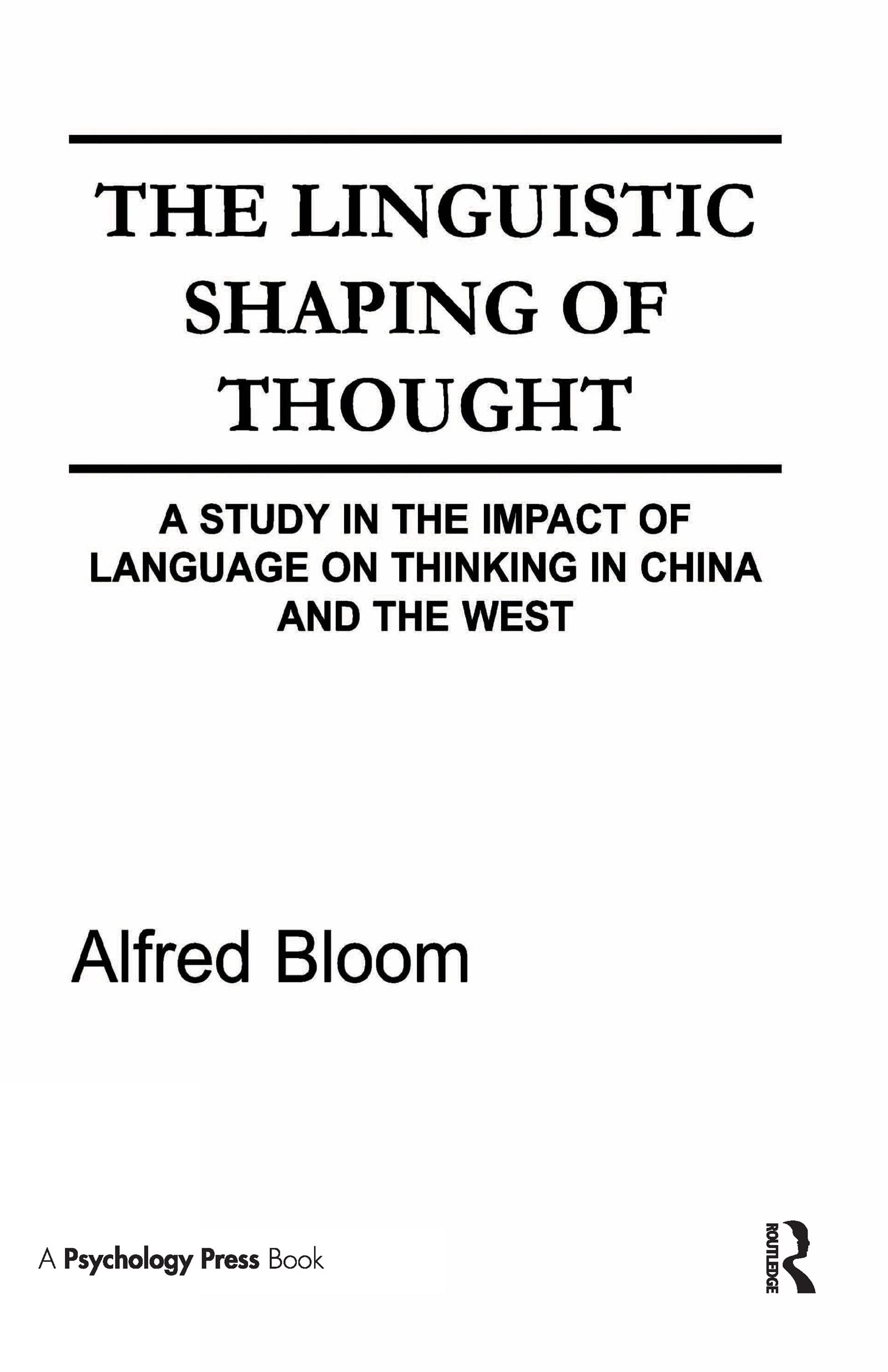
The Linguistic Shaping of Thought: A Study in the Impact of Language on Thinking in China and the West by A. H. Bloom
Inclusive of all applicable taxes. FREE shipping on all orders.
Available Offers
- 🚚Free Delivery — Free shipping on all orders
- 💵Cash on Delivery — Pay when your order arrives
- ↩️15-Day Easy Returns — Hassle-free return policy
- 🔒Cash on Delivery — Pay safely when your order arrives
Check Delivery
Product Description
Introduction
Does the language we speak shape the way we think? This question has intrigued philosophers, linguists, and psychologists for centuries. The Linguistic Shaping of Thought: A Study in the Impact of Language on Thinking in China and the West by A. H. Bloom offers a profound exploration into how linguistic structures influence cognitive processes. First published in 1981, this hardcover edition from Psychology Press remains a seminal work for anyone interested in the intersection of language, culture, and thought. Bloom draws on fourteen years of direct interaction with the Chinese language and its speakers, presenting a compelling case that languages are not mere tools for communication but active shapers of our mental worlds.
Book Overview
In this thought-provoking study, Bloom compares the cognitive habits of Chinese and English speakers, focusing on how linguistic differences lead to distinct ways of reasoning, categorizing, and understanding reality. The book challenges the dominant assumption in psychology that language plays a minimal role in cognitive life. Instead, Bloom argues that the structural features of a language—such as its treatment of counterfactuals, abstract concepts, and temporal relations—can deeply influence how speakers perceive causality, possibility, and even morality. Through detailed analysis and cross-cultural experiments, the book reveals the subtle yet powerful ways in which language molds thought.
Key Highlights
- Pioneering cross-cultural study comparing Chinese and English cognitive patterns.
- Rich empirical evidence from over a decade of linguistic and psychological research.
- Challenges the Sapir-Whorf hypothesis with nuanced, data-driven arguments.
- Reveals hidden biases in English-language thinking about counterfactuals and abstraction.
- Provides practical insights for translators, educators, and intercultural communicators.
- Hardcover edition from a respected academic publisher, ideal for long-term reference.
Inside the Book
The book is divided into carefully structured chapters that guide the reader from foundational concepts to complex analyses. Bloom begins with an overview of the theoretical landscape, then moves into specific linguistic features such as the Chinese lack of a clear counterfactual marker and its impact on hypothetical reasoning. He presents original experimental data showing how Chinese speakers and English speakers respond differently to questions about hypothetical scenarios, causality, and abstract categories. Later chapters explore the implications for philosophy, psychology, and education, making the book both a research monograph and a accessible treatise for serious readers.
Key Topics
- Linguistic relativity and the Sapir-Whorf hypothesis
- Counterfactual thinking in Chinese and English
- Abstract concepts and nominalization across languages
- Cultural cognition and the role of language in shaping worldview
- Methodological challenges in cross-linguistic psychology
- Implications for translation and intercultural understanding
Reader Benefits
This book offers Indian readers a unique lens to examine their own multilingual experiences. Whether you speak Hindi, Tamil, Bengali, or English, Bloom's analysis will help you recognize how your native language influences your reasoning and perception. For students of linguistics, psychology, and philosophy, it provides a rigorous framework for understanding the interplay between language and thought. Professionals in translation, education, and international relations will gain practical insights into avoiding cross-cultural misunderstandings. The book also enriches debates about language policy and education in India's diverse linguistic landscape.
Learning Outcomes
- Understand the key arguments for and against linguistic determinism.
- Identify specific ways in which Chinese and English differ in cognitive impact.
- Critically evaluate experimental methods used in cross-cultural psychology.
- Apply insights to improve communication in multilingual settings.
- Develop a deeper appreciation for how language shapes personal and collective thinking.
Who Should Read
This book is essential for undergraduate and postgraduate students in linguistics, cognitive science, psychology, and philosophy. It is also highly valuable for academic researchers exploring language and thought, as well as educators teaching cross-cultural communication. General readers with an interest in how language influences perception—especially those living in multilingual societies like India—will find Bloom's arguments both accessible and eye-opening. Translators, writers, and diplomats will benefit from the practical illustrations of linguistic bias.
About the Author
A. H. Bloom was a psychologist and linguist whose work focused on the cognitive implications of language. His fourteen years of immersion in Chinese language and culture gave him a unique vantage point for this study. Bloom's research was groundbreaking in its empirical rigor and its willingness to challenge prevailing theories in psychology. He published several influential papers and books on language and thought, and his work continues to be cited in contemporary debates about linguistic relativity. His nuanced approach—neither fully endorsing nor dismissing the strong version of the Sapir-Whorf hypothesis—makes his writing a balanced and enduring contribution to the field.
About the Publisher
Psychology Press is a distinguished academic imprint known for publishing high-quality works in psychology, linguistics, and cognitive science. With a reputation for rigorous editorial standards, the press has been a home for seminal texts that shape research and teaching worldwide. This hardcover edition reflects the publisher's commitment to durable, scholarly volumes that stand the test of time. For Indian readers, Psychology Press titles are a trusted resource for advanced study and reference.
Conclusion
The Linguistic Shaping of Thought remains a vital read for anyone curious about the deep connections between language and mind. A. H. Bloom's careful cross-cultural analysis not only illuminates the unique features of Chinese and English cognition but also invites readers to reflect on their own linguistic habits. In a world where communication across cultures is more important than ever, this book offers timeless wisdom. Add this hardcover edition to your library and embark on a journey that will change how you think about thinking itself.
Quick Summary
The Linguistic Shaping of Thought by A. H. Bloom is a seminal work in psycholinguistics that investigates how language influences cognitive processes. Drawing on fourteen years of direct interaction with Chinese speakers, Bloom compares the Chinese and English languages to reveal significant differences in modes of thinking. The book challenges the prevailing assumption within psychology that languages play a minimal role in shaping cognition, instead arguing that linguistic structures—such as grammar, vocabulary, and syntax—profoundly affect reasoning, perception, and worldview. Readers will learn about the biases inherent in the English language and gain sensitivity to what Chinese speakers mean. This book is ideal for psychology students, linguists, anthropologists, and anyone interested in cross-cultural cognition. By purchasing from Bookshops.in, Indian readers receive a high-quality hardcover edition from a trusted local bookstore, supporting the academic community with fast delivery and authentic products.
Book Highlights
Book Specifications
| ISBN-13 | 9780898590890 |
| ISBN-10 | 0898590892 |
| Publisher | Psychology Pr |
| Language | English |
| Dimensions | 15.84 x 1.17 x 23.46 cm |
| Weight | 363 g |
| Country | India |
| Category | Psychology › Cognitive Psychology |
| Genre | Non-fiction |
| Reading Age | Adult |
| Original Language | English |
Frequently Asked Questions
What is the main thesis of The Linguistic Shaping of Thought?
Who is the author A. H. Bloom?
Is this book suitable for undergraduate students?
Does the book support the Sapir-Whorf hypothesis?
What are some key differences between Chinese and English thinking discussed?
Is this book still relevant for modern research?
Can I use this book for a research paper on linguistic relativity?
Is the book focused only on Chinese and English?
What is the price of the book on Bookshops.in?
Does the book include any experimental data?
What is the binding of this edition?
Is this book part of a series?
How does this book challenge mainstream psychology?
Readers Also Search For
Customers Also Bought

Psychology
Koinonia: From Hate, Through Dialogue, to Culture in the Large Group by Patrick B. Demare

Psychology
Mindfulness-Based Interventions for Trauma and Its Consequences (Concise Guides on Trauma Care, 4)

Psychology
Handbook for Teaching Statistics and Research Methods by Mark E. Ware

Psychology
Psychoanalysis and the Nuclear Threat: Clinical and Theoretical Studies

Psychology
Humor and Psyche: Psychoanalytic Perspectives by James W. Barron

Relationships
The Experience and Expression of Uncertainty in Close Relationships by Jennifer A. Theiss
Related Products
View AllPsychology
Mindfulness-Based Interventions for Trauma and Its Consequences (Concise Guides on Trauma Care, 4)
Psychology
Handbook for Teaching Statistics and Research Methods by Mark E. Ware
Psychology
Psychoanalysis and the Nuclear Threat: Clinical and Theoretical Studies
Psychology
Humor and Psyche: Psychoanalytic Perspectives by James W. Barron

Psychology
Proceedings of the First International Conference on Genetic Algorithms and Their Applications
Psychology