
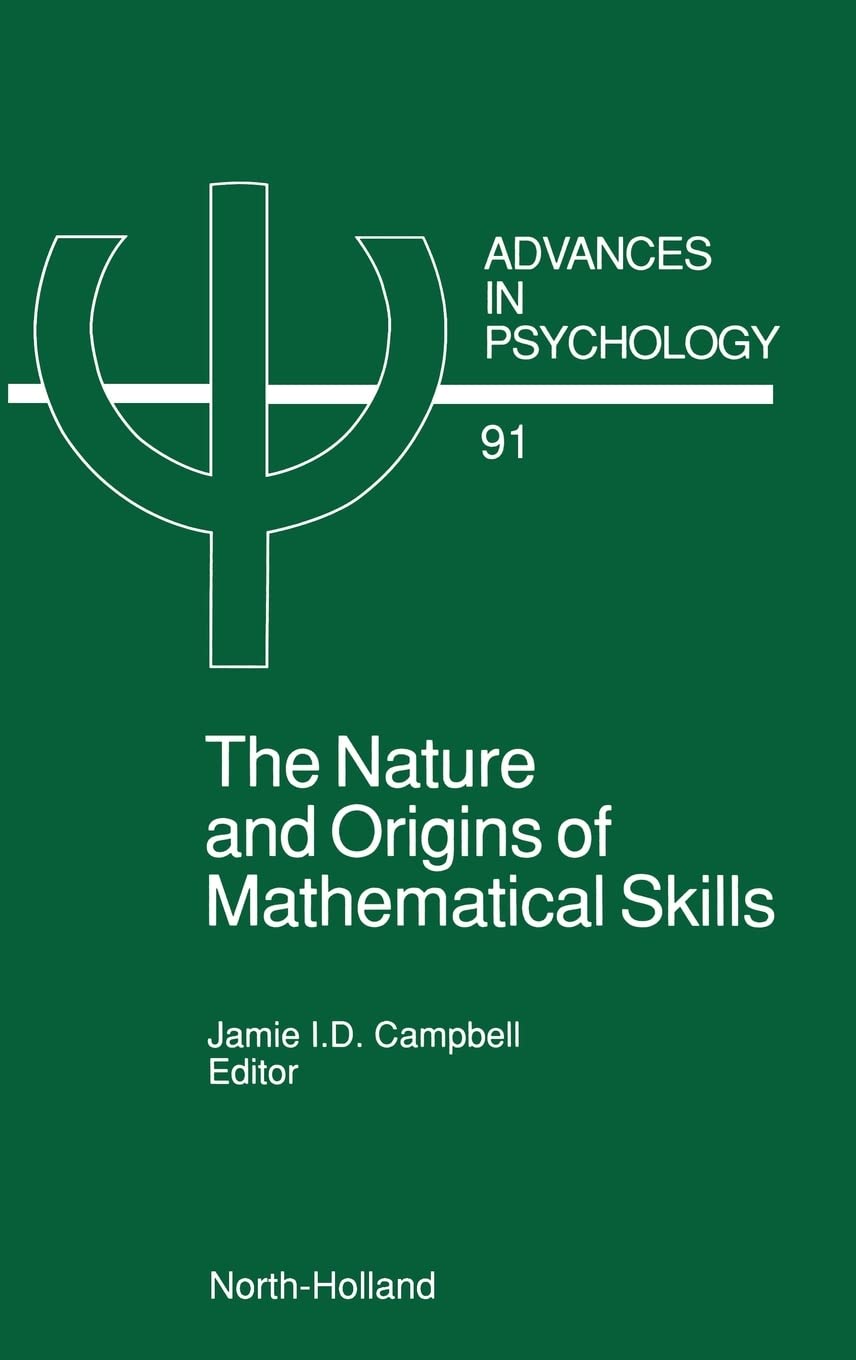
The Nature and Origin of Mathematical Skills by J. I. D. Campbell – A Research-Driven Exploration of Numerical Cognition
Inclusive of all applicable taxes. FREE shipping on all orders.
Available Offers
- 🚚Free Delivery — Free shipping on all orders
- 💵Cash on Delivery — Pay when your order arrives
- ↩️15-Day Easy Returns — Hassle-free return policy
- 🔒Cash on Delivery — Pay safely when your order arrives
Check Delivery
Product Description
Introduction
Understanding how the human mind acquires, processes, and refines mathematical skills is a fascinating puzzle that sits at the intersection of psychology, neuroscience, and education. The Nature and Origin of Mathematical Skills, edited by J. I. D. Campbell, offers a comprehensive exploration of this complex domain. This hardbound volume from North-Holland brings together cutting-edge research that delves into the cognitive foundations of numeracy, making it an indispensable resource for students, researchers, and educators in India and around the world. Whether you are studying cognitive psychology, teaching mathematics, or simply curious about how numbers shape our thinking, this book provides a rigorous yet accessible pathway into the science of mathematical cognition.
Book Overview
This scholarly work presents a broad spectrum of contemporary experimental research on numerical cognition and the acquisition of mathematical abilities. It is thoughtfully structured into two major parts: the first focuses on the development and acquisition of numerical skills from childhood through adulthood, while the second examines the information-processing mechanisms—such as perception, attention, and memory—that underpin these skills. The book captures the diversity of theoretical and methodological approaches that define current research, weaving together insights from educational psychology, cognitive psychology, and cognitive neuropsychology. Each chapter offers deep dives into specific phenomena, methodologies, and theories, ensuring that readers gain a nuanced understanding of how mathematical expertise emerges and evolves.
Key Highlights
- Multidisciplinary Perspective: Integrates findings from cognitive science, neuropsychology, and education to present a holistic view of mathematical skill acquisition.
- Dual Focus: Covers both the developmental trajectory of numerical skills and the underlying cognitive processes that support them.
- Research-Driven Content: Each chapter is grounded in rigorous experimental studies, offering empirical evidence and theoretical frameworks.
- Relevant for Indian Academia: Addresses universal cognitive principles that are directly applicable to mathematics education and research in Indian institutions.
- Authoritative Editorship: Edited by J. I. D. Campbell, a respected figure in numerical cognition, ensuring high-quality, peer-reviewed content.
Inside the Book
The volume opens with an exploration of how young children begin to understand numbers and counting, progressing to more complex arithmetic and problem-solving strategies. Later chapters investigate the role of working memory, attention, and automaticity in mathematical performance. The book also examines how brain-damaged patients reveal the neural architecture of number processing, offering unique insights into the cognitive systems that support mathematics. With contributions from leading international researchers, each section provides detailed analyses of specific issues—from the development of number sense to the cognitive mechanisms behind mental calculation and estimation.
Key Topics
- Acquisition of counting and number concepts in early childhood
- Development of arithmetic skills and problem-solving strategies
- Role of working memory and attention in mathematical cognition
- Information-processing models of numerical skills
- Perceptual and attentional mechanisms in number processing
- Cognitive neuropsychology of mathematical abilities
- Educational implications for teaching mathematics effectively
- Individual differences in mathematical proficiency
Reader Benefits
By engaging with this book, readers will gain a deep understanding of the cognitive architecture that enables mathematical thinking. It equips students and researchers with the theoretical tools to design experiments, interpret data, and apply findings to real-world educational contexts. Educators will find valuable insights into why some learners struggle with mathematics and how instruction can be tailored to support skill development. The multidisciplinary approach ensures that readers from various backgrounds—psychology, neuroscience, education, or mathematics—can extract meaningful knowledge that advances their own work or studies.
Learning Outcomes
- Understand the cognitive processes that underlie numerical cognition and mathematical skill acquisition
- Analyze the developmental stages of mathematical abilities from infancy to adulthood
- Evaluate different theoretical models of mathematical cognition
- Apply research findings to improve mathematics teaching and learning strategies
- Identify the neural and cognitive mechanisms involved in number processing
- Critically assess experimental methodologies used in numerical cognition research
Who Should Read
This book is ideal for postgraduate students and researchers in cognitive psychology, cognitive neuroscience, and educational psychology. It is also highly relevant for mathematics educators seeking a deeper understanding of how students learn numerical concepts. Professionals in special education, speech therapy, and clinical neuropsychology who work with individuals having mathematical difficulties will find the content particularly useful. Additionally, undergraduate students in advanced psychology or neuroscience courses will benefit from the comprehensive coverage of foundational and contemporary research.
About the Author
J. I. D. Campbell is a distinguished researcher in the field of numerical cognition, known for his extensive work on the cognitive processes underlying arithmetic and mathematical skills. With a career spanning decades, he has contributed numerous influential studies on topics such as mental arithmetic, number processing, and the development of mathematical expertise. His editorial leadership ensures that this volume represents the highest standards of scientific rigor and clarity.
About the Publisher
North-Holland, an imprint of Elsevier, is a prestigious academic publisher with a long-standing reputation for producing high-quality books in the sciences, including mathematics, psychology, and cognitive science. Their commitment to disseminating cutting-edge research makes them a trusted source for scholars and professionals worldwide.
Conclusion
The Nature and Origin of Mathematical Skills stands as a seminal work for anyone serious about understanding the cognitive roots of mathematical ability. Its blend of developmental, cognitive, and neuropsychological perspectives offers a rich, multidimensional view that is rare in a single volume. For Indian readers—whether in bustling university libraries in Delhi, research labs in Bangalore, or classrooms in Kolkata—this book provides a solid foundation for advancing both theoretical knowledge and practical application in mathematics education and cognitive science. Add this essential hardcover to your collection today at Bookshops.in and embark on a journey through the mind's mathematical landscape.
Quick Summary
The Nature and Origin of Mathematical Skills, edited by J. I. D. Campbell, is a seminal research volume that brings together a broad range of experimental studies on numerical cognition and the acquisition of mathematical abilities. The book is structured into two complementary parts: the first examines how numerical skills develop over time, while the second delves into the cognitive mechanisms—such as perception, attention, and memory—that underpin these skills. Each chapter offers rigorous analysis of specific issues, methodologies, and theoretical perspectives, capturing both the diversity and coherence of contemporary research in the field. This volume is essential for cognitive psychologists, educational psychologists, and researchers in mathematics education who seek a deeper understanding of how humans learn and perform mathematical tasks. Indian students and academics will find it a valuable reference for advanced studies and research projects. By purchasing from Bookshops.in, you gain access to a trusted source for premium academic books, ensuring timely delivery and genuine editions.
Book Highlights
Book Specifications
| ISBN-13 | 9780444890146 |
| ISBN-10 | 0444890149 |
| Publisher | North-Holland |
| Language | English |
| Dimensions | 15.6 x 3.18 x 23.39 cm |
| Weight | 1 kg 70 g |
| Category | Psychology › Cognitive Psychology |
| Genre | Non-fiction |
| Original Language | English |
Frequently Asked Questions
What is the main focus of this book?
Who is the author of this book?
Is this book suitable for Indian students?
What topics are covered in Part 1?
What topics are covered in Part 2?
Is this a textbook or a research volume?
What is the ISBN of this book?
Who is the publisher?
What language is the book in?
Does this book include practical teaching tips?
Is this book available in hardcover?
Can I use this book for my PhD research?
Why should I buy from Bookshops.in?
Readers Also Search For
Customers Also Bought

Psychology
Koinonia: From Hate, Through Dialogue, to Culture in the Large Group by Patrick B. Demare

Psychology
Mindfulness-Based Interventions for Trauma and Its Consequences (Concise Guides on Trauma Care, 4)

Psychology
Handbook for Teaching Statistics and Research Methods by Mark E. Ware

Psychology
Psychoanalysis and the Nuclear Threat: Clinical and Theoretical Studies

Psychology
Humor and Psyche: Psychoanalytic Perspectives by James W. Barron

Relationships
The Experience and Expression of Uncertainty in Close Relationships by Jennifer A. Theiss
Related Products
View AllPsychology
Mindfulness-Based Interventions for Trauma and Its Consequences (Concise Guides on Trauma Care, 4)
Psychology
Handbook for Teaching Statistics and Research Methods by Mark E. Ware
Psychology
Psychoanalysis and the Nuclear Threat: Clinical and Theoretical Studies
Psychology
Humor and Psyche: Psychoanalytic Perspectives by James W. Barron

Psychology
Proceedings of the First International Conference on Genetic Algorithms and Their Applications
Psychology