
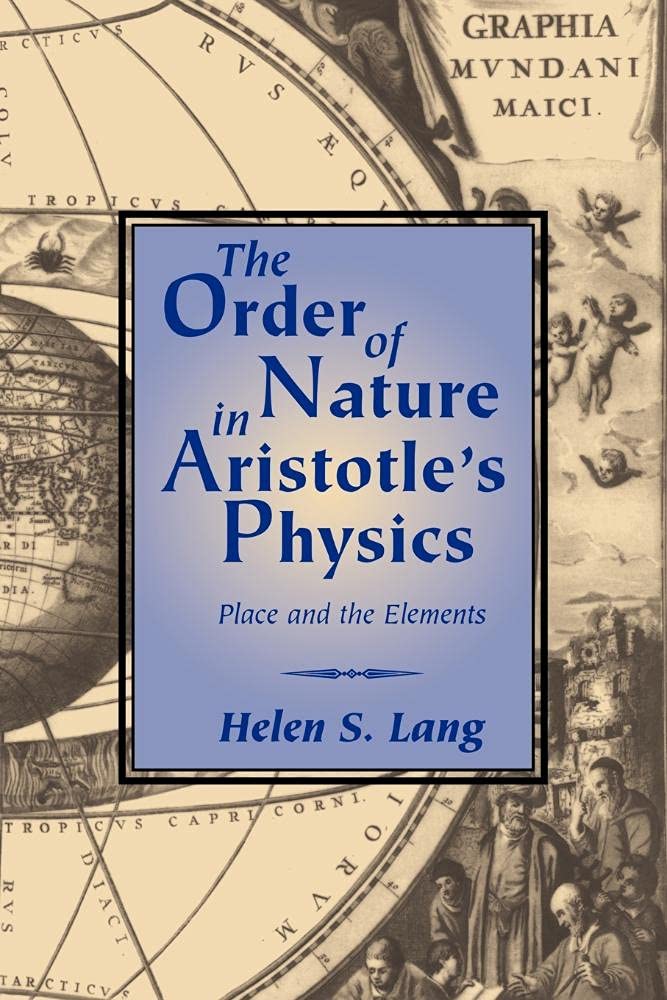
The Order of Nature in Aristotle's Physics: Place and the Elements by Helen S. Lang – A Deep Dive into Aristotelian Phys
Inclusive of all applicable taxes. FREE shipping on all orders.
Available Offers
- 🚚Free Delivery — Free shipping on all orders
- 💵Cash on Delivery — Pay when your order arrives
- ↩️15-Day Easy Returns — Hassle-free return policy
- 🔒Cash on Delivery — Pay safely when your order arrives
Check Delivery
Product Description
Introduction
For students and scholars of ancient philosophy and the history of science, Helen S. Lang's The Order of Nature in Aristotle's Physics: Place and the Elements offers a transformative reading of Aristotle's physical works. Published by Cambridge University Press in a durable hardcover edition, this book is essential for anyone seeking a deeper understanding of how Aristotle conceived the natural world. Lang challenges conventional interpretations by revealing a unified argument that runs from the Physics to De Caelo, making it a valuable resource for Indian readers pursuing advanced studies in philosophy, classics, or the foundations of scientific thought.
Book Overview
This meticulously researched work demonstrates a fresh method for reading Aristotle's texts. Rather than treating key arguments in isolation, Lang connects them into a coherent whole, showing how Aristotle's concepts of place, void, time, and the elements form a single, elegant system. The book culminates in a provocative question: why do these arguments remain compelling today, even though modern science has replaced them? Lang's analysis is both a rigorous scholarly exercise and an invitation to rethink our approach to Aristotelian science.
Key Highlights
- Unified Interpretation: Reveals a continuous line of argument linking the Physics and De Caelo, often treated as separate works.
- Original Methodology: Proposes a new way of reading Aristotle that prioritizes internal coherence over modern assumptions.
- Engaging Conclusion: Explores the enduring relevance of Aristotle's ideas despite their scientific obsolescence.
- Authoritative Source: Published by Cambridge University Press, a hallmark of academic excellence.
Inside the Book
The book is divided into carefully structured chapters that guide the reader through Aristotle's arguments. Lang begins by examining the concept of place (topos) as a fundamental principle, then moves to the nature of the void, the reality of time, and finally the theory of the four elements. Each chapter builds on the previous one, creating a logical progression that mirrors Aristotle's own method. The text is dense with philosophical analysis but remains accessible to dedicated readers, with clear explanations of key terms and concepts.
Key Topics
- Aristotle's definition of place and its role in natural motion
- The rejection of the void and its implications for cosmology
- Time as a measure of change, not an independent entity
- The elemental theory: earth, water, air, and fire
- The relationship between the sublunary and celestial realms
- The teleological ordering of nature
Reader Benefits
Readers will gain a nuanced understanding of Aristotle's physics that goes beyond textbook summaries. Lang's approach helps students see how ancient thinkers constructed systematic theories about the natural world, and why those theories mattered. For researchers, the book offers a model for interpreting difficult philosophical texts with intellectual honesty. Indian students, in particular, will appreciate how Lang bridges Eastern and Western philosophical traditions by emphasizing order, structure, and purpose in nature—themes that resonate with classical Indian thought.
Learning Outcomes
- Ability to trace Aristotle's arguments across multiple texts
- Critical skills for evaluating pre-modern scientific theories
- Insight into the philosophical foundations of physics
- Familiarity with key Aristotelian concepts like topos, kenon, and chronos
- Understanding of why Aristotle's science remains philosophically significant
Who Should Read
This book is ideal for advanced undergraduate and postgraduate students in philosophy, classics, and history of science. It is also suited for professors and researchers seeking a fresh perspective on Aristotle. Indian readers preparing for competitive exams like UGC-NET or pursuing a PhD in ancient philosophy will find it an invaluable reference. Anyone with a serious interest in the origins of scientific thinking will benefit from Lang's clear and compelling exposition.
About the Author
Helen S. Lang is a distinguished scholar of ancient philosophy, known for her work on Aristotle and the history of science. She has taught at leading universities and published extensively on Greek natural philosophy. Her methodical approach and deep engagement with primary texts have earned her respect among peers. In this book, she brings decades of expertise to bear on one of the most challenging aspects of Aristotle's corpus.
About the Publisher
Cambridge University Press is one of the oldest and most prestigious academic publishers in the world. Founded in 1534, it has a long tradition of publishing groundbreaking scholarship in the humanities and sciences. This hardcover edition reflects the Press's commitment to quality, with durable binding and clear typography suitable for years of study.
Conclusion
The Order of Nature in Aristotle's Physics: Place and the Elements is more than a scholarly monograph—it is a thoughtful meditation on how we read and understand ancient texts. Lang's work challenges us to engage with Aristotle on his own terms, appreciating the elegance of a system that, though scientifically outdated, remains philosophically rich. For Indian readers who value intellectual rigor and historical depth, this book is a worthy addition to any library. Order your copy from Bookshops.in today and explore the foundations of Western natural philosophy.
Quick Summary
The Order of Nature in Aristotle's Physics: Place and the Elements by Helen S. Lang is a scholarly work that uncovers a continuous line of argument running from Aristotle's Physics to his De Caelo. Lang demonstrates how concepts of place and the elements form a coherent system of natural order, challenging fragmented readings of Aristotle's physical science. This book is primarily intended for advanced students, researchers, and academics in philosophy, classics, and the history of science. Readers will gain a deeper appreciation of Aristotelian methodology and the elegance of ancient Greek natural philosophy. By purchasing from Bookshops.in, Indian readers receive a genuine hardcover edition with reliable delivery, supporting their academic pursuits with a premium physical book that inspires critical thinking about the foundations of science.
Book Highlights
Book Specifications
| ISBN-13 | 9780521042291 |
| ISBN-10 | 0521042291 |
| Publisher | Cambridge University Press |
| Language | English |
| Dimensions | 15.24 x 2.16 x 22.86 cm |
| Weight | 512 g |
| Country | India |
| Category | Philosophy › History & Surveys |
| Genre | Non-fiction |
| Original Language | English |
Frequently Asked Questions
What is the main thesis of The Order of Nature in Aristotle's Physics?
Who is Helen S. Lang?
Is this book suitable for beginners in philosophy?
Does the book cover Aristotle's concept of place?
What is the connection between Physics and De Caelo?
Is this book available in hardcover?
Why should I buy this book from Bookshops.in?
Does the book include modern scientific perspectives?
Is the book written in English?
What is the ISBN of this book?
Can this book be used for a course on ancient philosophy?
Does the book discuss Aristotle's element theory?
Is there any discussion of teleology in this book?
Readers Also Search For
Customers Also Bought
Islam
Spiritual Economies (English, Daromir Rudnyckyj)

Islam
Who Is Allah? (English, Bruce B. Lawrence)

Islam
Islam and Liberal Citizenship: The Search for an Overlapping Consensus by Andrew F. March
Islam
Fiqh Us-Sunnah: Funerals and Diggers by Al-Sayyid Sabiq – Islamic Funeral Guide

Christianity
Genetics (English, Thomas a. Shannon | Mark P. Aulisio | Françoise Baylis)

Hinduism
Karma and Creativity by Christopher Key Chapple – Indian Philosophy
Related Products
View All
Philosophy
The Metaphysics of Extrinsic Properties: 11 (Metaphysical Research, 11)
Philosophy
Dialogues on Metaphysics and on Religion by Nicolas Malebranche – Philosophy
Philosophy
Metaphysics and Oppression: Heidegger's Challenge to Western Philosophy by John McCumber
Philosophy
Merleau-Ponty's Philosophy by Lawrence Hass – Phenomenology & Continental Philosophy

Philosophy
Feminism, Capitalism, and Ecology
Philosophy