
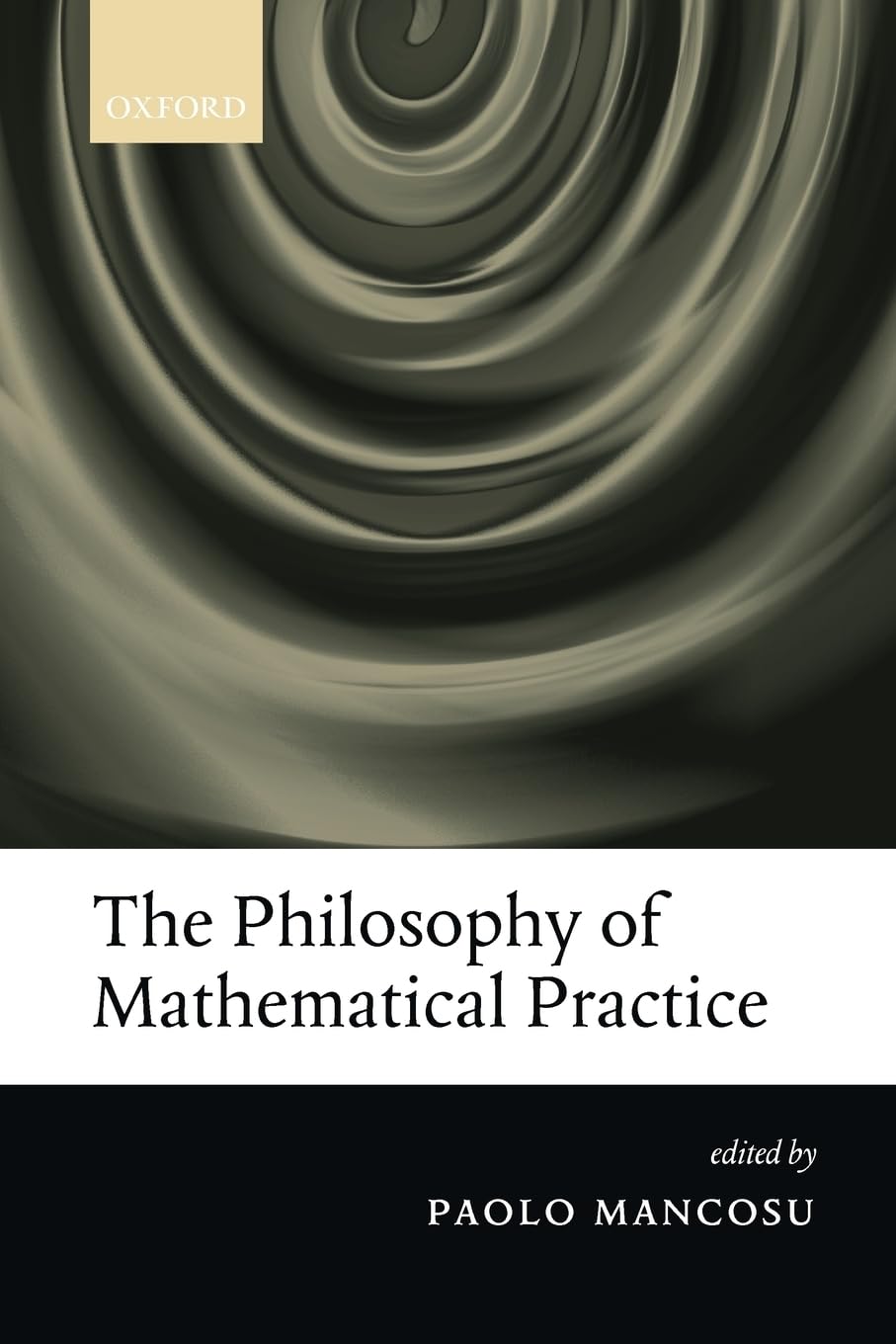
The Philosophy of Mathematical Practice: A Groundbreaking Work on Contemporary Mathematics and Philosophy by Paolo Manco
Inclusive of all applicable taxes. FREE shipping on all orders.
Available Offers
- 🚚Free Delivery — Free shipping on all orders
- 💵Cash on Delivery — Pay when your order arrives
- ↩️15-Day Easy Returns — Hassle-free return policy
- 🔒Cash on Delivery — Pay safely when your order arrives
Check Delivery
Product Description
Introduction
In the ever-evolving landscape of Indian academia, the study of mathematics has long been revered for its precision and logical rigour. Yet, for students and researchers alike, the deeper question of how mathematics is actually practised often remains unexplored. The Philosophy of Mathematical Practice by Paolo Mancosu bridges this gap, offering a refreshing departure from abstract foundational debates. This hardbound volume from OUP Oxford invites Indian readers—whether in Delhi’s research institutes, Mumbai’s universities, or Bengaluru’s science hubs—to engage with mathematics not as a static system of axioms, but as a living, dynamic human activity. It is an essential addition to any serious library of science and mathematics.
Book Overview
This groundbreaking work is the first coherent and unified presentation of a new wave in philosophy of mathematics—one that places mathematical practice at its core. Rather than focusing solely on logical foundations or ontological puzzles, Mancosu explores the actual methods, heuristics, and reasoning strategies used by mathematicians in their daily work. The book argues that contemporary mathematics offers novel characteristics—from diagrammatic reasoning to computer-assisted proofs—that demand fresh philosophical attention. It is a rigorous yet accessible text that reshapes how we think about mathematical knowledge.
Key Highlights
- First of its kind: A unified presentation of practice-oriented philosophy of mathematics.
- Contemporary focus: Moves beyond classical foundational debates to address modern mathematical innovations.
- Interdisciplinary appeal: Connects philosophy with history, cognitive science, and mathematical pedagogy.
- Authoritative author: Paolo Mancosu is a leading scholar in the philosophy of mathematics and logic.
- Premium hardcover: Durable binding suitable for years of academic reference.
Inside the Book
The book is structured around key themes that emerge from mathematical practice. It examines the role of visual thinking and diagrammatic reasoning in geometry and analysis, the significance of non-deductive reasoning such as analogies and thought experiments, and the philosophical implications of computer-assisted proofs. Each chapter is grounded in real mathematical examples, from number theory to topology, making abstract ideas tangible. Mancosu also delves into the history of mathematical concepts, showing how philosophical questions arise naturally from evolving practices. The text is richly footnoted, with references to both classical and contemporary literature.
Key Topics
- Diagrammatic reasoning and visualisation in mathematics
- Heuristics and problem-solving strategies
- The role of analogies and inductive reasoning
- Computer-assisted proofs and their epistemological impact
- Mathematical explanation and understanding
- Historical case studies in mathematical practice
- Non-deductive logic in mathematical discovery
- The social dimension of mathematical knowledge
Reader Benefits
Indian students and researchers will find this book invaluable for developing a deeper appreciation of mathematical creativity. It enhances critical thinking by revealing the reasoning processes behind famous theorems. For those preparing for competitive examinations or teaching mathematics, the book provides insights into how mathematicians think, which can be applied to problem-solving and pedagogy. It also serves as a bridge between philosophy and mathematics, offering a fresh perspective that enriches both disciplines. The hardcover format ensures longevity, making it a lasting reference for academic libraries.
Learning Outcomes
- Understand the philosophical significance of mathematical practice beyond formal logic.
- Analyse the role of visual and non-verbal reasoning in mathematical discovery.
- Critically evaluate the impact of computers on mathematical proof and knowledge.
- Apply historical case studies to contemporary philosophical questions.
- Develop a nuanced view of mathematical explanation and understanding.
- Recognise the social and cognitive dimensions of mathematical work.
Who Should Read
This book is ideal for advanced undergraduate and postgraduate students in philosophy, mathematics, and cognitive science. It is equally suited for researchers in philosophy of science, mathematics educators seeking deeper insights into mathematical thinking, and professional mathematicians curious about the philosophical underpinnings of their craft. Indian readers preparing for NET, GATE, or PhD entrance exams in philosophy or mathematics will find it a valuable resource. It also appeals to self-learners and enthusiasts with a strong background in mathematics and a taste for philosophical inquiry.
About the Author
Paolo Mancosu is a distinguished professor of philosophy at the University of California, Berkeley. He is widely recognised for his work in the history and philosophy of mathematics and logic, with numerous publications on topics ranging from the foundations of geometry to the philosophy of mathematical practice. His scholarship combines rigorous historical analysis with contemporary philosophical insight, making him a leading voice in the field. Mancosu’s ability to communicate complex ideas with clarity has earned him a global readership among academics and students alike.
About the Publisher
OUP Oxford (Oxford University Press) is one of the world’s oldest and most respected academic publishers, with a legacy spanning over five centuries. Known for its commitment to scholarly excellence, OUP publishes works that shape intellectual discourse across disciplines. This hardcover edition reflects OUP’s high production standards, with clear typography and durable binding—ideal for the Indian academic environment where books are treasured for years. OUP’s catalogue in philosophy and mathematics is especially esteemed, and this volume upholds that tradition.
Conclusion
The Philosophy of Mathematical Practice is not merely a book; it is a gateway to a new way of thinking about mathematics. By focusing on the lived experience of mathematicians, Paolo Mancosu challenges us to reconsider what it means to know, prove, and discover. For Indian students and scholars who value both rigour and creativity, this hardbound edition is an investment in intellectual growth. Add it to your collection today and explore the vibrant intersection of philosophy and mathematics.
Quick Summary
The Philosophy of Mathematical Practice by Paolo Mancosu is a landmark work that reorients philosophy of mathematics towards the actual activities of mathematicians. Instead of focusing solely on foundational programs, this book examines how contemporary mathematics—with its diverse methods, concepts, and structures—demands new philosophical frameworks. Readers will explore epistemological and ontological questions through the lens of mathematical practice, including the nature of proof, the role of diagrams, and the impact of computer-assisted reasoning. The book is designed for advanced students and researchers in philosophy, mathematics, and cognitive science. It bridges historical insights with cutting-edge analysis, making it invaluable for Indian scholars preparing for competitive exams or academic research. By choosing Bookshops.in, you get authentic, high-quality hardcover editions delivered across India. This book is a must-have for any serious academic library.
Book Highlights
Book Specifications
| ISBN-13 | 9780199640102 |
| ISBN-10 | 0199640106 |
| Publisher | Oxford Univ Pr on Demand |
| Language | English |
| Dimensions | 15.6 x 2.64 x 23.39 cm |
| Weight | 658 g |
| Category | Philosophy › Logic |
| Genre | Non-fiction |
| Original Language | English |
Frequently Asked Questions
What is The Philosophy of Mathematical Practice about?
Who is the author of this book?
Is this book suitable for Indian students?
What makes this book different from other philosophy of mathematics books?
Does the book cover historical perspectives?
What topics are covered in the book?
Is this book a hardcover?
Who is the publisher?
What is the ISBN?
Is this book recommended for research?
Does the book include case studies?
Can I use this book for self-study?
Where can I buy this book in India?
Readers Also Search For
Customers Also Bought
Islam
Spiritual Economies (English, Daromir Rudnyckyj)

Islam
Who Is Allah? (English, Bruce B. Lawrence)
Islam
Islam and Liberal Citizenship: The Search for an Overlapping Consensus by Andrew F. March

Islam
Fiqh Us-Sunnah: Funerals and Diggers by Al-Sayyid Sabiq – Islamic Funeral Guide

Christianity
Genetics (English, Thomas a. Shannon | Mark P. Aulisio | Françoise Baylis)

Hinduism
Karma and Creativity by Christopher Key Chapple – Indian Philosophy
Related Products
View All
Philosophy
Latin American Philosophy: Currents, Issues, Debates by Eduardo Mendieta

Philosophy
Al-Farabi's Short Commentary on Aristotle's Prior Analytics by Nicholas Rescher – Philosophy

Philosophy
Poetics of Imagining: Modern to Post-modern by Richard Kearney

Philosophy
The Metaphysics of Extrinsic Properties: 11 (Metaphysical Research, 11)

Philosophy
Dialogues on Metaphysics and on Religion by Nicolas Malebranche – Philosophy
Philosophy