
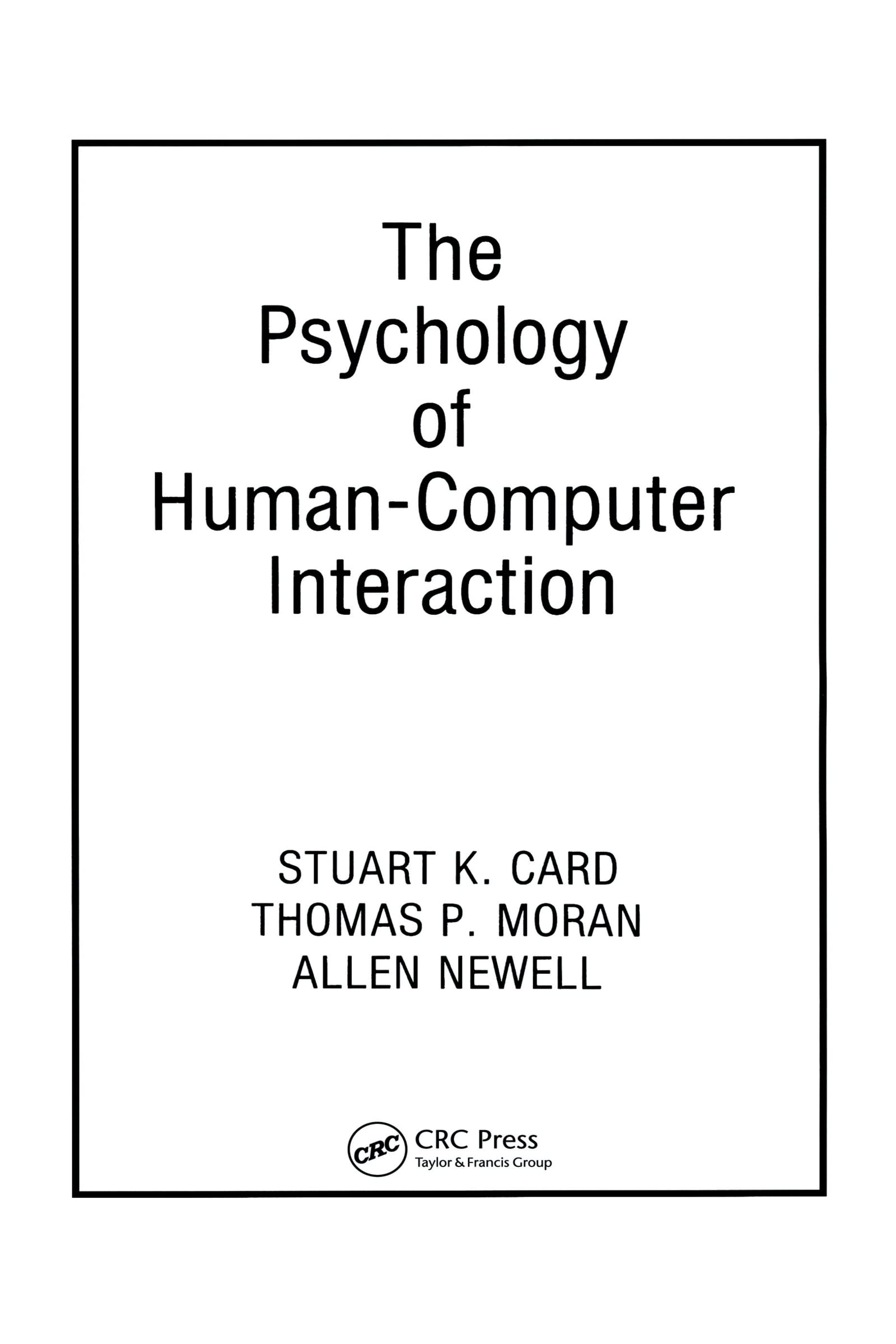
The Psychology of Human-Computer Interaction by Stuart K. Card – A Landmark Textbook on Cognitive Science and Interface
Inclusive of all applicable taxes. FREE shipping on all orders.
Available Offers
- 🚚Free Delivery — Free shipping on all orders
- 💵Cash on Delivery — Pay when your order arrives
- ↩️15-Day Easy Returns — Hassle-free return policy
- 🔒Cash on Delivery — Pay safely when your order arrives
Check Delivery
Product Description
Introduction
In an age where every click, keystroke, and screen interaction shapes our digital experience, understanding the human mind behind the machine has never been more critical. The Psychology of Human-Computer Interaction by Stuart K. Card is a landmark work that bridges the gap between cognitive psychology and computer science. For Indian students, researchers, and IT professionals navigating a rapidly digitizing world, this book offers a foundational framework to design interfaces that truly resonate with how people think, learn, and work.
Book Overview
Published by CRC Press, this hardcover volume is a definitive guide to the applied psychology of interactive systems. It distills years of research from the Applied Information-Processing Psychology Project group, presenting a scientific approach to understanding user behaviour. Rather than offering mere anecdotes, the book builds a rigorous model of human cognition—memory, attention, problem-solving—and shows how these elements interact with computer interfaces. It is not a quick-fix design manual but a deep exploration of the principles that make technology usable, efficient, and satisfying.
Key Highlights
- Pioneering Research: Based on the groundbreaking work of the Applied Information-Processing Psychology Project, this book laid the groundwork for modern human-computer interaction (HCI) as a scientific discipline.
- Cognitive Modelling: Introduces the GOMS (Goals, Operators, Methods, Selection rules) model, a powerful tool for predicting user performance and optimizing interface design.
- Empirical Foundation: Rich with experimental data and case studies, the book grounds every concept in real-world observation rather than speculation.
- Timeless Relevance: Despite its original publication, the core psychological principles remain as relevant today as ever, applicable to everything from mobile apps to enterprise software.
Inside the Book
Readers will journey through a structured exploration of human cognition as it relates to computing. The book begins by establishing a psychological perspective on interactive systems, then delves into detailed analyses of user tasks—from simple text editing to complex problem-solving. You will encounter chapters on the human information-processing system, the nature of errors, and the role of learning and memory in interface use. Each concept is illustrated with clear diagrams and practical examples, making abstract theories tangible.
Key Topics
- The human information-processing system: perception, cognition, and motor action
- GOMS model and its application in predicting user performance
- Task analysis and decomposition for interface design
- Error analysis and designing for error tolerance
- Learning curves and skill acquisition in computer use
- Attention and memory constraints in interactive tasks
- Quantitative methods for evaluating interface efficiency
Reader Benefits
By studying this book, you will gain a scientific lens through which to view every user interface. You will learn to anticipate user behaviour, reduce cognitive load, and design systems that feel intuitive. For students, it provides a rigorous academic foundation in HCI. For professionals, it offers actionable insights to improve product usability and user satisfaction. The knowledge here empowers you to move beyond guesswork and make data-driven design decisions.
Learning Outcomes
- Understand the fundamental cognitive processes underlying human-computer interaction
- Apply the GOMS model to analyze and predict user performance on tasks
- Identify common sources of user error and design interfaces that minimize them
- Evaluate interface designs using quantitative metrics from cognitive psychology
- Design more efficient and user-friendly systems by aligning with human capabilities
- Critically assess existing interfaces through a psychological framework
Who Should Read
This book is essential for undergraduate and postgraduate students in computer science, psychology, cognitive science, and human-computer interaction. It is equally valuable for UX designers, product managers, software engineers, and usability researchers who wish to deepen their theoretical understanding. Indian tech professionals working in startups, IT services, or product development will find the principles directly applicable to creating user-centric digital solutions for diverse Indian audiences.
About the Author
Stuart K. Card is a pioneering figure in the field of human-computer interaction. A Senior Research Fellow at Xerox PARC, he co-founded the discipline with his seminal work on the psychology of user interfaces. His research on information processing and interaction models has influenced generations of designers and engineers. Card's rigorous, scientific approach continues to shape how we think about the human side of technology.
About the Publisher
CRC Press is a globally respected academic publisher known for its high-quality textbooks and reference works in science, technology, and mathematics. With a legacy of publishing authoritative content, CRC Press ensures that this volume meets the highest standards of scholarship and clarity. For Indian readers, CRC Press books are a trusted resource for advanced learning in engineering and computer science.
Conclusion
The Psychology of Human-Computer Interaction is more than a book; it is a cornerstone of modern interface science. In a country like India, where digital adoption is soaring, understanding the user's mind is the key to building technology that serves everyone—from the first-time smartphone user to the seasoned programmer. Add this essential hardcover to your library and gain the psychological insight to create interfaces that are not just functional, but truly human-centred.
Quick Summary
The Psychology of Human-Computer Interaction by Stuart K. Card is a seminal work that established a scientific foundation for understanding how people interact with computers. Drawing from cognitive psychology and information-processing theory, the book introduces models like GOMS to analyze user tasks and predict performance. It is written for students, researchers, and professionals in HCI, UX design, and computer science. Readers will learn how to apply psychological principles to design more intuitive and efficient interactive systems. The book covers memory, attention, problem-solving, and error handling, offering both theoretical insights and practical methods. Originally published in 1983, its content remains highly relevant for modern interface design. By purchasing from Bookshops.in, Indian readers receive a genuine hardcover edition with fast delivery. This is an essential addition to any HCI library, providing timeless knowledge that bridges the gap between human cognition and technology.
Book Highlights
Book Specifications
| ISBN-13 | 9780898598599 |
| ISBN-10 | 0898598591 |
| Publisher | CRC Pr I Llc |
| Language | English |
| Dimensions | 15.6 x 2.79 x 23.39 cm |
| Weight | 839 g |
| Category | Psychology › Cognitive Psychology |
| Genre | Non-fiction |
| Original Language | English |
Frequently Asked Questions
What is the book 'The Psychology of Human-Computer Interaction' about?
Who is the author of this book?
Is this book suitable for beginners in HCI?
What is the GOMS model mentioned in the book?
Does this book include practical design guidelines?
Is the book relevant for modern UX design?
Does the book cover human error in computing?
Can Indian students use this book for academic courses?
What is the price of this book at Bookshops.in?
Is this book available in paperback or digital format?
Who should read this book besides students?
Does the book include case studies?
What is the language of the book?
Readers Also Search For
Customers Also Bought

Psychology
Koinonia: From Hate, Through Dialogue, to Culture in the Large Group by Patrick B. Demare

Psychology
Mindfulness-Based Interventions for Trauma and Its Consequences (Concise Guides on Trauma Care, 4)

Psychology
Handbook for Teaching Statistics and Research Methods by Mark E. Ware

Psychology
Psychoanalysis and the Nuclear Threat: Clinical and Theoretical Studies
Psychology
Humor and Psyche: Psychoanalytic Perspectives by James W. Barron

Relationships
The Experience and Expression of Uncertainty in Close Relationships by Jennifer A. Theiss
Related Products
View AllPsychology
Mindfulness-Based Interventions for Trauma and Its Consequences (Concise Guides on Trauma Care, 4)
Psychology
Handbook for Teaching Statistics and Research Methods by Mark E. Ware
Psychology
Psychoanalysis and the Nuclear Threat: Clinical and Theoretical Studies
Psychology
Humor and Psyche: Psychoanalytic Perspectives by James W. Barron

Psychology
Proceedings of the First International Conference on Genetic Algorithms and Their Applications
Psychology