
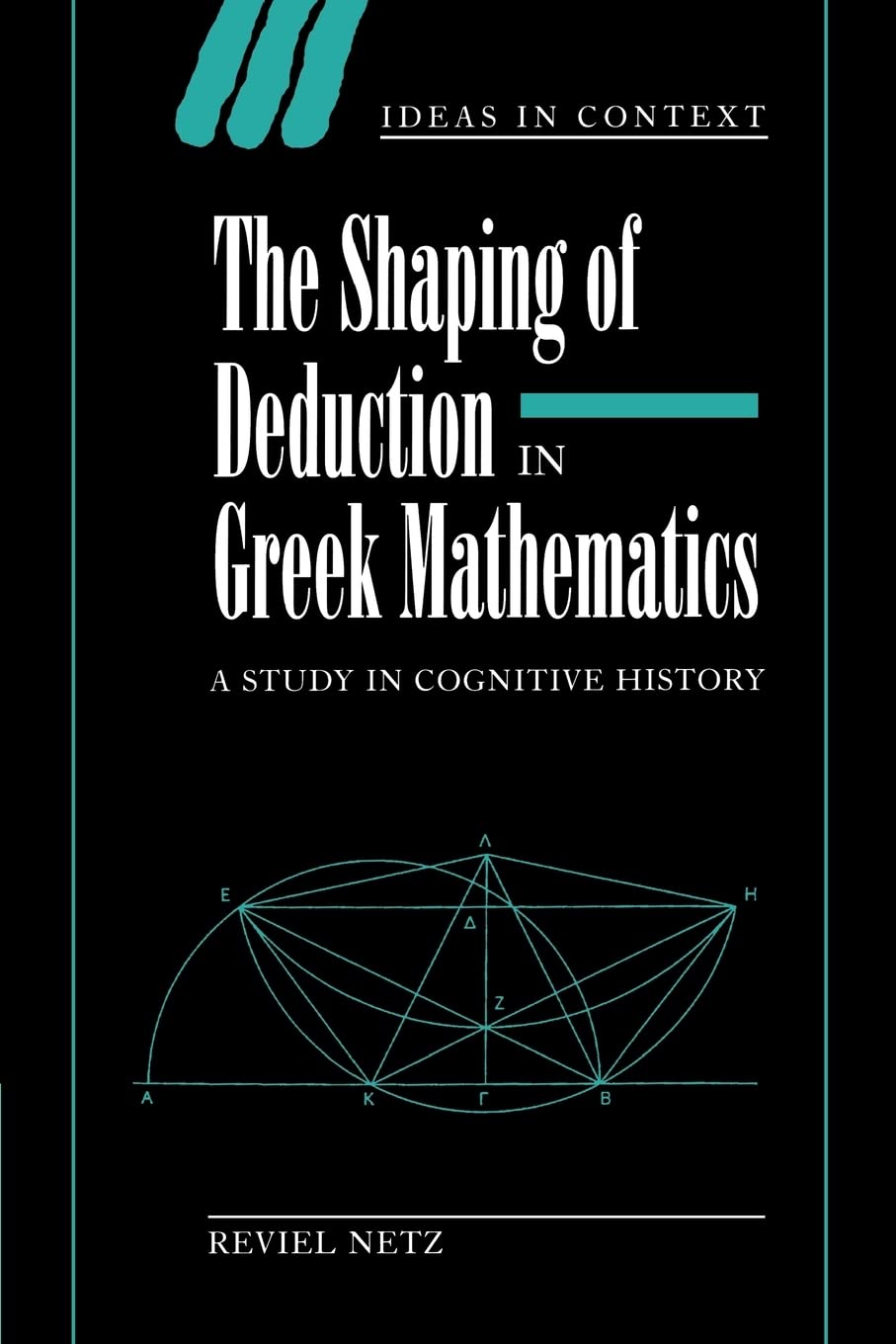
The Shaping of Deduction in Greek Mathematics: A Study in Cognitive History by Reviel Netz – Understanding the Origins o
Inclusive of all applicable taxes. FREE shipping on all orders.
Available Offers
- 🚚Free Delivery — Free shipping on all orders
- 💵Cash on Delivery — Pay when your order arrives
- ↩️15-Day Easy Returns — Hassle-free return policy
- 🔒Cash on Delivery — Pay safely when your order arrives
Check Delivery
Product Description
Introduction
Why did Greek mathematics develop into the rigorous, deductive system we admire today? In The Shaping of Deduction in Greek Mathematics: A Study in Cognitive History, Reviel Netz offers a groundbreaking exploration of the cognitive and cultural forces that shaped ancient Greek mathematical thought. This book is not merely a history of theorems and proofs; it is an inquiry into how the very act of deduction emerged as a dominant mode of reasoning. For Indian students and scholars of mathematics, philosophy, and history of science, this work provides a unique lens to understand the intellectual roots of modern mathematics.
Book Overview
Published by Cambridge University Press, this hardcover volume delves into the practices of Greek mathematicians, focusing on the interplay between text and diagram. Netz argues that the lettered diagram—a visual tool central to Greek geometry—was not just an illustration but a cognitive instrument that shaped the structure of proofs. By analyzing the repetitive formulae, logical structures, and the social context of mathematical practice, the book reveals why Greek mathematics achieved such remarkable clarity and satisfaction. It is a masterful blend of cognitive science, history, and philology.
Key Highlights
- Original Cognitive Approach: Examines how the human mind interacts with diagrams and language to produce deductive reasoning.
- Focus on the Lettered Diagram: A detailed study of how Greek mathematicians used labeled diagrams to anchor their proofs.
- Linguistic Analysis: Explores the repetitive, formulaic language that made Greek mathematics both precise and teachable.
- Structural Insights: Breaks down the anatomy of Greek proofs, showing why they feel so logically satisfying.
- Historical Context: Situates Greek mathematical practice within the broader cultural and intellectual world of antiquity.
Inside the Book
The book is organized into several thematic chapters. It begins with the foundational role of the lettered diagram, showing how geometric figures were constructed and lettered to support deductive steps. Subsequent chapters examine the linguistic habits of mathematicians—their use of repeated phrases and standardized expressions—which facilitated the transmission of complex ideas. Two pivotal chapters dissect the structure of proofs, revealing a consistent pattern of assumptions, constructions, and deductions. The final chapter steps back to consider the social and institutional settings where this mathematical culture flourished, including the role of schools and patrons.
Key Topics
- The cognitive origins of deductive proof
- The lettered diagram as a cognitive tool
- Formulaic language in Greek mathematics
- Logical structure of Euclidean-style proofs
- Interaction between text and diagram
- Historical context of Greek mathematical practice
- Comparison with other ancient mathematical traditions
Reader Benefits
- Deepen Your Understanding: Gain a nuanced perspective on why Greek mathematics became the foundation of Western science.
- Enhance Your Teaching: Educators will find fresh insights to explain the origins of deductive reasoning to students.
- Bridge Disciplines: Connects mathematics with cognitive science, history, and philosophy—ideal for interdisciplinary study.
- Critical Thinking: Learn to see mathematical proofs not just as abstract truths but as products of human cognition and culture.
Learning Outcomes
By reading this book, you will be able to: trace the cognitive steps that lead from a diagram to a theorem; identify the recurring linguistic patterns in Greek mathematical texts; explain why the deductive method took the form it did; appreciate the role of visual and textual elements in reasoning; and critically evaluate the historical conditions that made Greek mathematics unique. This knowledge enriches your grasp of both ancient and modern mathematical thought.
Who Should Read
- Students of mathematics history and philosophy
- Researchers in cognitive science and history of science
- Classicists interested in ancient intellectual practices
- Indian educators seeking to deepen their understanding of mathematical foundations
- Anyone curious about how human beings invented the idea of proof
About the Author
Reviel Netz is a professor of classics at Stanford University and a leading scholar of ancient Greek mathematics. His work combines philological precision with cognitive and historical analysis. He has authored several influential books on Greek science, including The Transformation of Mathematics in the Early Mediterranean World. Netz is known for making complex ideas accessible while maintaining scholarly rigor.
About the Publisher
Cambridge University Press is one of the oldest and most respected academic publishers in the world. Founded in 1534, it has a long tradition of publishing groundbreaking works in science, mathematics, and the humanities. This book reflects their commitment to high-quality scholarship that pushes the boundaries of knowledge.
Conclusion
The Shaping of Deduction in Greek Mathematics is an essential read for anyone who wants to understand not just what ancient mathematicians discovered, but how they thought. Reviel Netz's cognitive history approach offers a fresh and illuminating perspective on the birth of deductive reasoning. Whether you are a student, teacher, researcher, or lifelong learner, this book will transform the way you see mathematics and its history. Order your copy from Bookshops.in today and add this intellectual treasure to your library.
Quick Summary
The Shaping of Deduction in Greek Mathematics: A Study in Cognitive History by Reviel Netz is a groundbreaking work that investigates the cognitive and historical roots of deductive reasoning in ancient Greek mathematics. Rather than a mere chronicle of theorems, the book examines how Greek mathematicians used lettered diagrams, formulaic language, and structured proofs to create a system of rigorous deduction. Netz argues that the very shape of Greek mathematical thinking emerged from specific cultural and cognitive practices, including the interaction between text and diagram. The book is designed for three levels of reading: as a description of mathematical practices, as a theory of the emergence of deduction, and as a case study in the history of science. Readers will gain a profound understanding of how geometry and logic intertwined in antiquity. This volume is ideal for Indian students and scholars in history, philosophy, cognitive science, and mathematics. By purchasing from Bookshops.in, you receive a genuine hardcover edition from Cambridge University Press, ensuring authenticity and quality for your academic library.
Book Highlights
Book Specifications
| ISBN-13 | 9780521541206 |
| ISBN-10 | 0521541204 |
| Publisher | Cambridge University Press |
| Language | English |
| Dimensions | 15.24 x 2.24 x 22.86 cm |
| Weight | 540 g |
| Country | India |
| Category | Philosophy › History & Surveys |
| Genre | Non-fiction |
| Original Language | English |
Frequently Asked Questions
What is 'The Shaping of Deduction in Greek Mathematics' about?
Who is the author of this book?
Is this book suitable for undergraduate students?
Does the book cover only Greek geometry?
What makes this book different from other histories of mathematics?
Can I use this book for my research in cognitive science?
Is the book available in hardcover?
Does the book include illustrations or diagrams?
What is the price of this book in India?
Is this book part of a series?
What language is the book written in?
Who should read this book?
Does the book cover Indian mathematics?
Where can I buy this book in India?
Readers Also Search For
Customers Also Bought

Islam
Spiritual Economies (English, Daromir Rudnyckyj)

Islam
Who Is Allah? (English, Bruce B. Lawrence)

Islam
Islam and Liberal Citizenship: The Search for an Overlapping Consensus by Andrew F. March

Islam
Fiqh Us-Sunnah: Funerals and Diggers by Al-Sayyid Sabiq – Islamic Funeral Guide

Christianity
Genetics (English, Thomas a. Shannon | Mark P. Aulisio | Françoise Baylis)

Hinduism
Karma and Creativity by Christopher Key Chapple – Indian Philosophy
Related Products
View All
Philosophy
Latin American Philosophy: Currents, Issues, Debates by Eduardo Mendieta

Philosophy
Al-Farabi's Short Commentary on Aristotle's Prior Analytics by Nicholas Rescher – Philosophy

Philosophy
Poetics of Imagining: Modern to Post-modern by Richard Kearney

Philosophy
The Metaphysics of Extrinsic Properties: 11 (Metaphysical Research, 11)

Philosophy
Dialogues on Metaphysics and on Religion by Nicolas Malebranche – Philosophy

Philosophy