
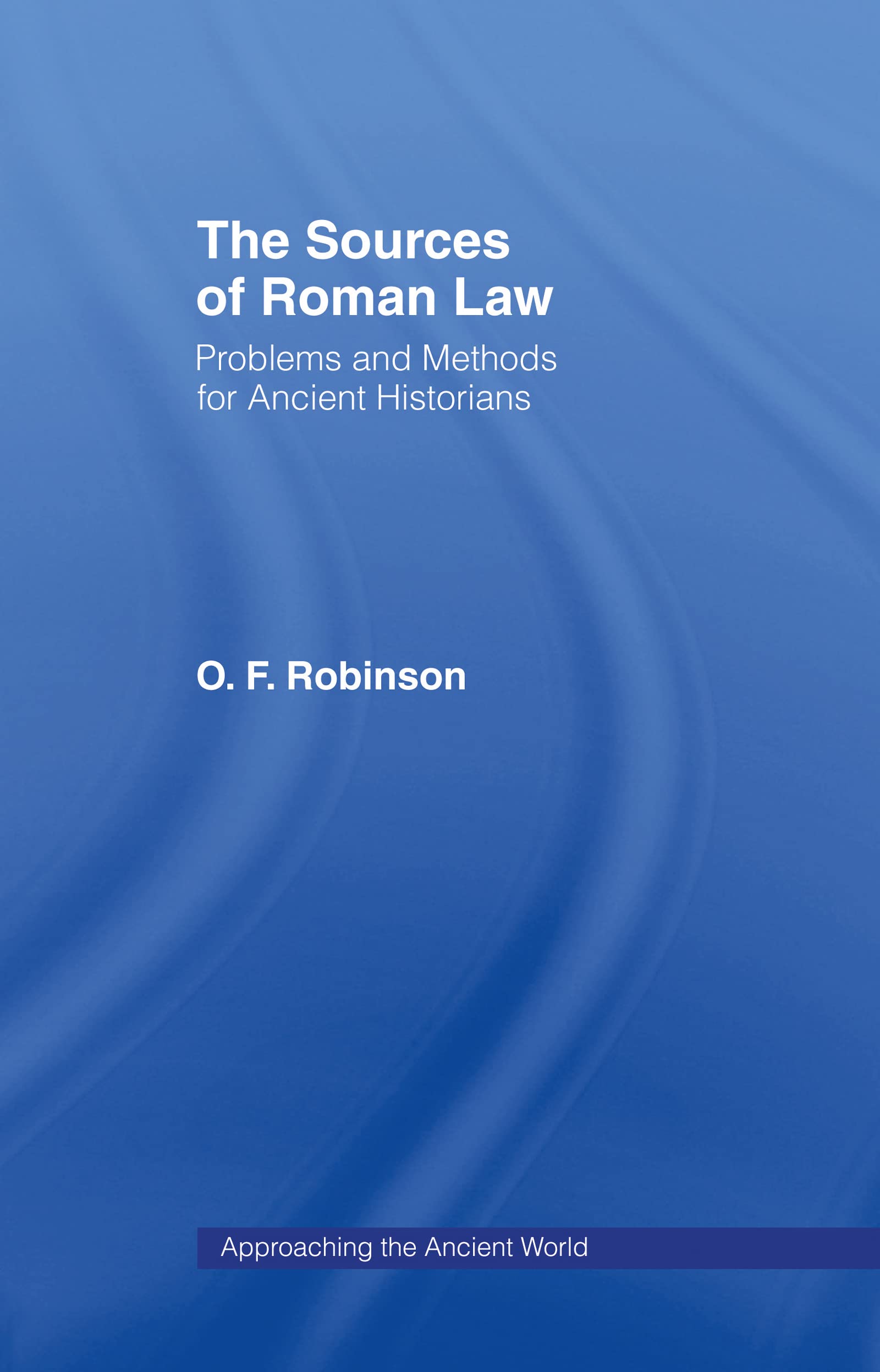
The Sources of Roman Law: Problems and Methods for Ancient Historians by O. F. Robinson – A Scholarly Exploration of Rom
Inclusive of all applicable taxes. FREE shipping on all orders.
Available Offers
- 🚚Free Delivery — Free shipping on all orders
- 💵Cash on Delivery — Pay when your order arrives
- ↩️15-Day Easy Returns — Hassle-free return policy
- 🔒Cash on Delivery — Pay safely when your order arrives
Check Delivery
Product Description
Introduction
Roman law stands as one of the most enduring legacies of the ancient world, shaping legal systems across Europe and beyond. Yet for students of history, the question of how we know what we know about Roman law can be as fascinating as the law itself. The Sources of Roman Law: Problems and Methods for Ancient Historians by O. F. Robinson offers a clear, scholarly guide to the origins, transmission, and interpretation of Roman legal sources. This book is essential reading for anyone seeking to understand not just what the law was, but how it was made, recorded, and enforced in the Roman world.
Book Overview
In this compact but richly detailed volume, Robinson addresses four fundamental questions that any historian of Roman law must confront: Who had the authority to make law? Where did a Roman citizen go to find out what the law said? How have these legal sources survived across two millennia? And what procedures existed to put the law into practice? By exploring these questions, the book bridges the gap between legal theory and historical practice, showing how law was woven into the fabric of everyday Roman life. The author draws on a wide range of material—from the Twelve Tables to the Digest of Justinian—to illustrate how legal sources evolved alongside Roman society.
Key Highlights
- Clear framework for understanding the different types of legal sources in ancient Rome
- Critical analysis of how legal texts were created, preserved, and transmitted through history
- Practical guidance for historians on using legal sources as evidence for broader social and political history
- Chronological coverage from the early Republic through the late Empire
- Accessible style that makes complex legal concepts understandable for non-specialists
Inside the Book
The book is structured around the four central questions mentioned above, with each chapter delving into a specific aspect of Roman legal sources. Robinson begins by examining the lawmakers—from magistrates and emperors to the popular assemblies and jurists—and the relative weight of their contributions. She then turns to the practical question of legal knowledge: how did Romans learn about the law, and what role did written texts, oral tradition, and professional jurists play? The survival of legal sources is treated with special attention to the challenges of textual transmission, including the work of later compilers and the impact of historical events such as the fall of the Western Empire. Finally, the book explores the procedures for enforcing law, from the praetor's edict to the courts and appeals process.
Key Topics
- The Twelve Tables and early Roman legislation
- Edicts of magistrates and the role of the praetor
- Senatus consulta and imperial constitutions
- Jurisprudence and the writings of classical jurists
- The Digest, Codex, and Institutes of Justinian
- Textual criticism and the reconstruction of lost sources
- Legal procedure and the system of actions
- The influence of Greek philosophy on Roman legal thought
Reader Benefits
Students of Roman history will find here a reliable companion that demystifies the technical aspects of legal sources. Law students, meanwhile, will gain a deeper appreciation for the historical context that shaped the substantive rules they study. The book equips readers with the tools to critically evaluate legal evidence, whether they are analyzing a primary text or a modern scholarly argument. Robinson's methodical approach helps readers avoid common pitfalls, such as assuming that later compilations accurately reflect earlier law or that legal sources can be read as straightforward descriptions of social reality.
Learning Outcomes
- Identify and distinguish the various types of legal sources in ancient Rome
- Understand how Roman law was created, recorded, and transmitted over time
- Evaluate the reliability and limitations of different legal sources
- Apply critical methods to the study of Roman legal texts
- Connect legal developments to broader historical changes in Roman society
- Gain confidence in using legal sources as evidence for historical research
Who Should Read
This book is ideal for undergraduate and postgraduate students of ancient history, classical studies, and Roman law. It is also highly recommended for law students who wish to understand the historical foundations of legal systems, as well as for scholars and enthusiasts who want a concise yet rigorous introduction to the subject. Teachers and lecturers will find it a useful textbook for courses on Roman history or legal history.
About the Author
O. F. Robinson is a distinguished legal historian who has taught at the University of Glasgow and other institutions. Her research focuses on Roman law and its influence on later legal traditions. She is known for her clear, accessible writing style and her ability to make complex legal concepts understandable for historians and students. Her works have been widely praised for combining scholarly rigour with practical guidance.
About the Publisher
Routledge is a leading academic publisher with a strong reputation in the humanities and social sciences. Their list includes many essential works on ancient history, classical studies, and legal history. This hardcover edition is well-bound and printed on quality paper, making it a durable addition to any personal or institutional library.
Conclusion
The Sources of Roman Law: Problems and Methods for Ancient Historians is a masterful guide to one of the most important and challenging areas of ancient history. Whether you are a student just beginning your exploration of Roman law or a seasoned researcher looking for a reliable reference, this book offers clarity, depth, and practical insight. It reminds us that law was not a remote abstraction in ancient Rome but a living force that shaped the lives of its citizens—and that the sources through which we know this law are themselves a rich and rewarding subject of study.
Quick Summary
The Sources of Roman Law: Problems and Methods for Ancient Historians by O. F. Robinson is a scholarly yet accessible exploration of the foundations of Roman legal system. The book addresses four fundamental questions: who made the law in ancient Rome, where citizens and officials could discover what the law was, how these legal sources have survived to the present day, and what procedures existed for enforcing the law. Robinson situates each source—whether legislation, edicts, juristic writings, or imperial decrees—within the evolving historical context of the Roman Republic and Empire. This approach helps readers understand not just the content of Roman law but also the social, political, and cultural forces that shaped it. The book is ideal for law students seeking a historical perspective on jurisprudence, as well as ancient historians who need to work with legal documents as primary sources. Robinson's methodology emphasizes critical analysis of surviving texts and inscriptions, making this a practical guide for research. By purchasing from Bookshops.in, Indian readers receive a genuine hardcover edition at a fair price, with the convenience of a trusted local bookstore. This book enriches one's appreciation of how deeply law permeated Roman life—a legacy that continues to influence legal systems worldwide.
Book Highlights
Book Specifications
| ISBN-13 | 9780415089944 |
| ISBN-10 | 0415089948 |
| Publisher | Routledge |
| Language | English |
| Dimensions | 14.57 x 1.45 x 22.19 cm |
| Weight | 340 g |
| Country | India |
| Category | Political Science › Government |
| Genre | Non-fiction |
| Original Language | English |
Frequently Asked Questions
What is the main focus of this book?
Who is the author of The Sources of Roman Law?
Is this book suitable for beginners in Roman law?
What kind of legal sources are discussed?
Does the book cover the entire Roman period?
How does this book help with understanding modern law?
Is the book only for law students?
Does the book include original Latin texts?
Is this book available in hardcover?
What is the ISBN of this book?
Can I use this book for my university course?
Does the book discuss the Twelve Tables?
Why buy from Bookshops.in?
Readers Also Search For
Customers Also Bought

Constitutional Law
Indigenous law and the state
Constitutional Law
Great Cases in Constitutional Law (English, Robert P. George)

Constitutional Law
Guilty Pleas in International Criminal Law (English, Nancy Amoury Combs)

Constitutional Law
The Growth of the Law by Benjamin N. Cardozo – Jurisprudence
Constitutional Law
Court of Injustice: Law Without Recognition in U.S. Immigration by J. C. Salyer
Constitutional Law
Youth: Learning Through Cases
Related Products
View All
Law
Mediasport | by Lawrence Wenner | Routledge | by Lawrence Wenner | Routledge | by Lawrence Wenner | Routledge | by Lawrence Wenner | Routledge | by Lawrence Wenner | Routledge | by Lawrence Wenner | Routledge | by Lawrence Wenner | Routledge | by Lawrence Wenner | Routledge | by Lawrence Wenner | Routledge | by Lawrence Wenner | Routledge | by Lawrence Wenner | Routledge | by Lawrence Wenner | Routledge | by Lawrence Wenner | Routledge | by Lawrence Wenner | Routledge | by Lawrence Wenner | Rout
Law
Human Rights Diplomacy | by Rein Mullerson | Routledge | by Rein Mullerson | Routledge | by Rein Mullerson | Routledge | by Rein Mullerson | Routledge | by Rein Mullerson | Routledge | by Rein Mullerson | Routledge | by Rein Mullerson | Routledge | by Rein Mullerson | Routledge | by Rein Mullerson | Routledge | by Rein Mullerson | Routledge | by Rein Mullerson | Routledge | by Rein Mullerson | Routledge | by Rein Mullerson | Routledge | by Rein Mullerson | Routledge | by Rein Mullerson | Routled
Law
Rome the Law-Giver | by Declareuil J. | Routledge | by Declareuil J. | Routledge | by Declareuil J. | Routledge | by Declareuil J. | Routledge | by Declareuil J. | Routledge | by Declareuil J. | Routledge | by Declareuil J. | Routledge | by Declareuil J. | Routledge | by Declareuil J. | Routledge | by Declareuil J. | Routledge | by Declareuil J. | Routledge | by Declareuil J. | Routledge | by Declareuil J. | Routledge | by Declareuil J. | Routledge | by Declareuil J. | Routledge | by Declareuil

Law
Human Rights and Gender Politics | by Anne-Marie Hilsdon | Martha MacIntyre | Vera MacKie | Routledge | by Anne-Marie Hilsdon | Martha MacIntyre | Vera MacKie | Routledge | by Anne-Marie Hilsdon | Martha MacIntyre | Vera MacKie | Routledge | by Anne-Marie Hilsdon | Martha MacIntyre | Vera MacKie | Routledge | by Anne-Marie Hilsdon | Martha MacIntyre | Vera MacKie | Routledge | by Anne-Marie Hilsdon | Martha MacIntyre | Vera MacKie | Routledge | by Anne-Marie Hilsdon | Martha MacIntyre | Vera Mac
Law
Politics of Human Rights in Southeast Asia | by Philip J. Eldridge | Routledge | by Philip J. Eldridge | Routledge | by Philip J. Eldridge | Routledge | by Philip J. Eldridge | Routledge | by Philip J. Eldridge | Routledge | by Philip J. Eldridge | Routledge | by Philip J. Eldridge | Routledge | by Philip J. Eldridge | Routledge | by Philip J. Eldridge | Routledge | by Philip J. Eldridge | Routledge | by Philip J. Eldridge | Routledge | by Philip J. Eldridge | Routledge | by Philip J. Eldridge |
Law