
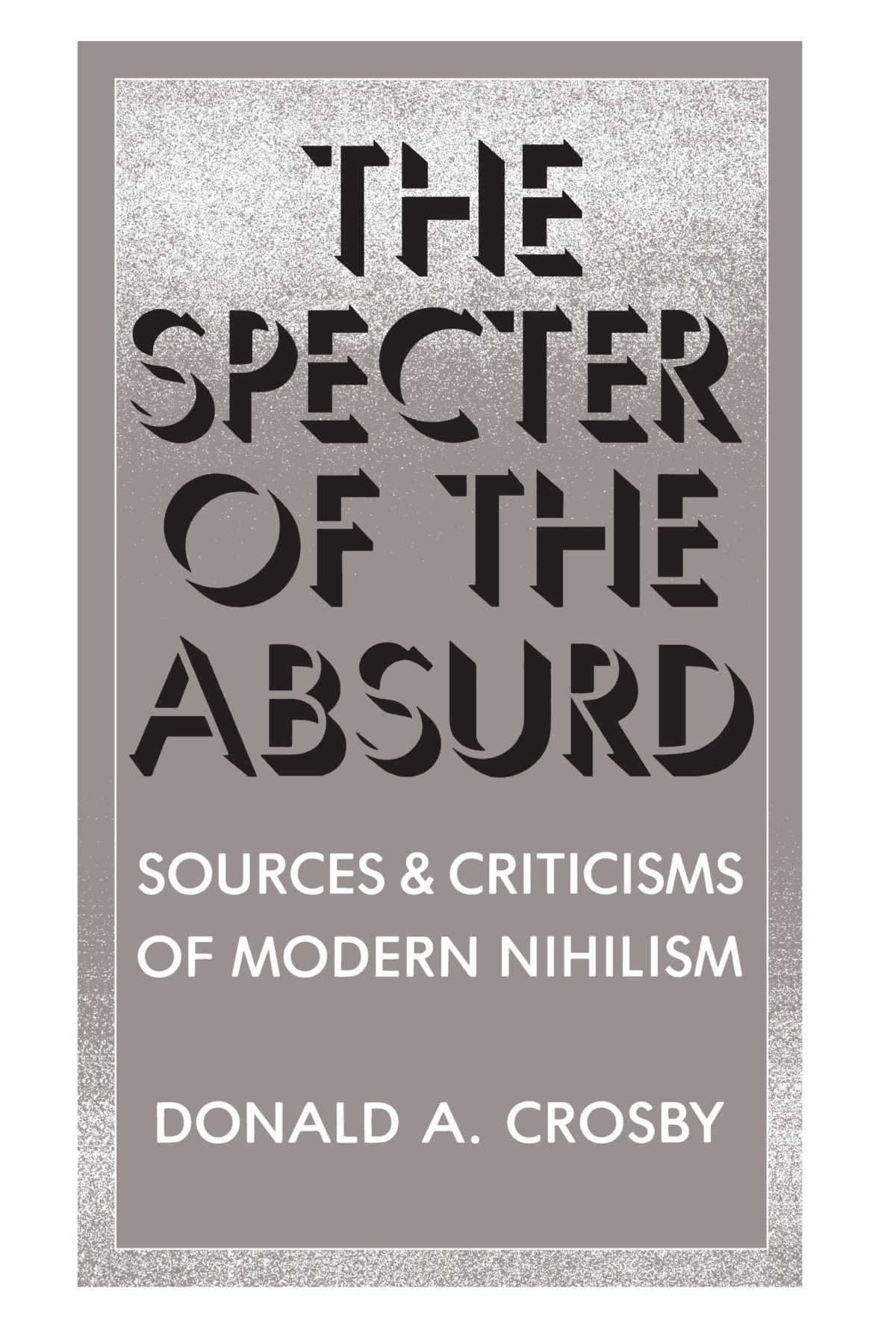
The Specter of the Absurd: Sources and Criticisms of Modern Nihilism by Donald A. Crosby – A Deep Philosophical Analysis
Inclusive of all applicable taxes. FREE shipping on all orders.
Available Offers
- 🚚Free Delivery — Free shipping on all orders
- 💵Cash on Delivery — Pay when your order arrives
- ↩️15-Day Easy Returns — Hassle-free return policy
- 🔒Cash on Delivery — Pay safely when your order arrives
Check Delivery
Product Description
Introduction
In an age where meaning often feels fragile and certainty elusive, Donald A. Crosby’s The Specter of the Absurd: Sources and Criticisms of Modern Nihilism offers a profound and sobering exploration of one of the most pressing philosophical challenges of our time. This hardbound volume from the State University of New York Press is not merely an academic treatise—it is a vital intellectual companion for anyone seeking to understand the roots of modern despair and the pathways toward a more grounded sense of purpose. Crosby’s work stands as a comprehensive and wise treatment of nihilism, examining its many guises with a clarity that resonates deeply with students, scholars, and thoughtful readers across India and beyond.
Book Overview
The Specter of the Absurd is a rigorous yet accessible study that dissects the phenomenon of nihilism—the belief that life has no intrinsic meaning, value, or purpose. Crosby argues that contemporary culture is genuinely haunted by nihilism, which manifests not only in the debilitating alienation from all orientation but also in the fideism of fundamentalism. He traces how a one-sided development of Western culture has led to this crisis, illuminating the collusion of multiple sources: the death of God, the objectification of nature, the meaninglessness of suffering in a mechanical universe, the ephemerality of time where value does not accumulate, the arbitrariness of historicized reason, the reduction of value to will, and the alienation of the Cartesian ego. The book is structured in four parts, with the first two laying bare the origins of nihilism and the latter two offering critical responses and possible ways forward.
Key Highlights
- Comprehensive Analysis: Crosby provides one of the most thorough examinations of nihilism available, comparing favourably with works by Rosen, Cavell, and Spengler.
- Multi-Source Framework: Unlike many writers, Crosby acknowledges that nihilism arises from a convergence of intellectual, cultural, and existential forces, not a single cause.
- Balanced Critique: The book does not merely diagnose the problem; it also offers constructive criticisms and potential remedies, making it a hopeful as well as a sobering read.
- Accessible Scholarship: Despite its depth, the prose remains clear and engaging, suitable for both academic and general readers.
- Timely Relevance: In an era of rapid change and uncertainty, this book speaks directly to the anxieties and questions that many Indians—especially students and young professionals—face today.
Inside the Book
The journey begins with an exploration of the historical and philosophical sources of nihilism. Crosby examines the impact of Nietzsche’s proclamation of the death of God, the rise of mechanistic science that stripped nature of intrinsic purpose, and the secularization of suffering that left pain without redemptive meaning. He then delves into the problem of time and transience, showing how a world where value does not accumulate can erode our sense of continuity and commitment. The second part extends this analysis to the realms of reason and morality, arguing that historicized reason and the reduction of value to will have further undermined our foundations. In the third and fourth parts, Crosby turns to criticisms of nihilism, drawing on existentialist, pragmatic, and religious perspectives to suggest how we might resist the spectre and rebuild a sense of meaning. Throughout, he engages with thinkers from Kierkegaard and Dostoevsky to Heidegger and Sartre, making this a rich intertextual dialogue.
Key Topics
- The death of God and its cultural consequences
- Objectification of nature and the loss of intrinsic value
- Meaninglessness of suffering in a mechanical universe
- Ephemerality of time and the problem of transience
- Arbitrariness of historicized reason
- Reduction of value to will and power
- Alienation of the Cartesian ego
- Fideism and fundamentalism as responses to nihilism
- Existentialist and pragmatic critiques of nihilism
- Possibilities for meaning in a post-traditional world
Reader Benefits
- Deepen Your Understanding: Gain a nuanced grasp of one of the most influential and unsettling ideas in modern philosophy.
- Navigate Modern Anxiety: Discover why feelings of meaninglessness are so pervasive and how they have been shaped by history and culture.
- Engage with Great Thinkers: Crosby’s synthesis of key philosophers provides a solid foundation for further study.
- Develop Critical Thinking: The book encourages readers to question assumptions about value, reason, and existence.
- Find Intellectual Solace: By confronting nihilism head-on, Crosby offers not despair but a clearer path toward authentic living.
Learning Outcomes
- Understand the major sources of modern nihilism and how they interrelate.
- Analyze the role of religion, science, and philosophy in shaping contemporary attitudes toward meaning.
- Critically evaluate different responses to nihilism, from fundamentalism to existentialism.
- Develop a personal framework for addressing questions of purpose and value in a pluralistic world.
- Recognize the enduring relevance of philosophical inquiry for everyday life.
Who Should Read
- Students of philosophy, theology, and cultural studies at Indian universities and colleges.
- Professors and researchers looking for a definitive text on nihilism.
- General readers interested in existential questions and the human condition.
- Young professionals and thinkers navigating a world of rapid change and uncertainty.
- Members of book clubs or study groups focused on modern thought and spirituality.
About the Author
Donald A. Crosby is a distinguished professor of philosophy whose work has long centred on metaphysics, philosophy of religion, and existential thought. With a career spanning several decades, Crosby has authored numerous books and articles that probe the deepest questions of human existence. His writing is marked by a rare combination of scholarly rigour and humane wisdom, making complex ideas accessible without sacrificing depth. In The Specter of the Absurd, he draws on a lifetime of reflection to offer what many consider his magnum opus—a work that speaks with equal force to the academy and to the seeking soul.
About the Publisher
The State University of New York Press (SUNY Press) is a leading academic publisher known for its commitment to advancing scholarship in the humanities and social sciences. With a reputation for publishing works of enduring intellectual value, SUNY Press brings Crosby’s masterful study to a global audience, ensuring that its insights reach students, scholars, and general readers who are grappling with the spectre of nihilism in their own lives and communities.
Conclusion
The Specter of the Absurd is more than a book—it is an intellectual and existential compass for our times. Donald A. Crosby’s comprehensive treatment of nihilism, from its sources to its criticisms, offers readers a rare opportunity to confront the darkest questions of modern life with courage and clarity. Whether you are a student of philosophy, a seeker of meaning, or simply a thoughtful reader, this hardcover volume deserves a place on your shelf. Order your copy from Bookshops.in today and take the first step toward understanding—and perhaps overcoming—the spectre that haunts our age.
Quick Summary
Donald A. Crosby's 'The Specter of the Absurd: Sources and Criticisms of Modern Nihilism' is a landmark philosophical work that dissects the roots of nihilism in Western culture. Crosby argues that nihilism is not a single phenomenon but a complex interplay of ideas including the 'death of God,' the objectification of nature, the meaninglessness of suffering in a mechanical universe, the ephemerality of time, the arbitrariness of historicized reason, and the reduction of value to will. The book critically examines responses such as fideism and fundamentalism, showing how they often deepen alienation. Written for advanced students and scholars of philosophy, theology, and cultural studies, this hardcover edition from State University of New York Press provides a wise and comprehensive treatment that remains relevant today. Readers will gain a nuanced understanding of modern despair and the intellectual tools to critique it. Purchasing from Bookshops.in ensures you receive a genuine, well-preserved copy for your academic or personal library.
Book Highlights
Book Specifications
| ISBN-13 | 9780887067204 |
| ISBN-10 | 0887067204 |
| Publisher | State Univ of New York Pr |
| Language | English |
| Dimensions | 15.24 x 2.69 x 22.86 cm |
| Weight | 590 g |
| Category | Philosophy › History & Surveys |
| Genre | Philosophy |
| Original Language | English |
Frequently Asked Questions
What is 'The Specter of the Absurd' about?
Who is Donald A. Crosby?
Is this book suitable for beginners in philosophy?
What topics does the book cover?
How does this book compare to other works on nihilism?
Is this book relevant for Indian readers?
What is the ISBN for this edition?
Is this a hardcover book?
What is the price of this book on Bookshops.in?
Does this book include a discussion of existentialism?
Can I use this book for a university course?
What is the reader rating for this book?
Why should I buy from Bookshops.in?
Readers Also Search For
Customers Also Bought
Islam
Spiritual Economies (English, Daromir Rudnyckyj)

Islam
Who Is Allah? (English, Bruce B. Lawrence)

Islam
Islam and Liberal Citizenship: The Search for an Overlapping Consensus by Andrew F. March

Islam
Fiqh Us-Sunnah: Funerals and Diggers by Al-Sayyid Sabiq – Islamic Funeral Guide

Christianity
Genetics (English, Thomas a. Shannon | Mark P. Aulisio | Françoise Baylis)

Hinduism
Karma and Creativity by Christopher Key Chapple – Indian Philosophy
Related Products
View All
Philosophy
Latin American Philosophy: Currents, Issues, Debates by Eduardo Mendieta

Philosophy
Al-Farabi's Short Commentary on Aristotle's Prior Analytics by Nicholas Rescher – Philosophy
Philosophy
Poetics of Imagining: Modern to Post-modern by Richard Kearney
Philosophy
The Metaphysics of Extrinsic Properties: 11 (Metaphysical Research, 11)
Philosophy
Dialogues on Metaphysics and on Religion by Nicolas Malebranche – Philosophy
Philosophy