
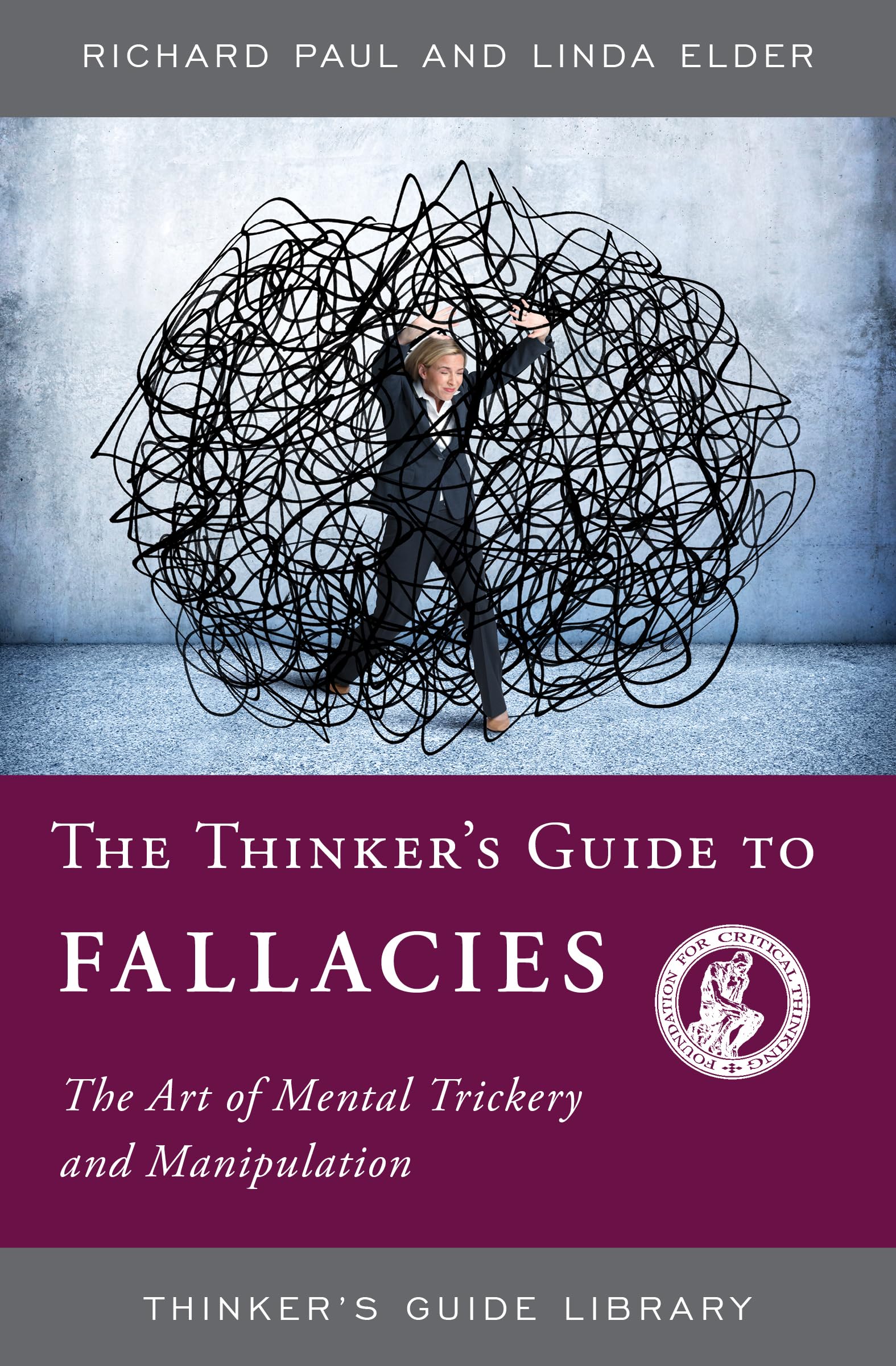
The Thinker's Guide to Fallacies: The Art of Mental Trickery and Manipulation by Richard Paul – A Comprehensive Guide to
Inclusive of all applicable taxes. FREE shipping on all orders.
Available Offers
- 🚚Free Delivery — Free shipping on all orders
- 💵Cash on Delivery — Pay when your order arrives
- ↩️15-Day Easy Returns — Hassle-free return policy
- 🔒Cash on Delivery — Pay safely when your order arrives
Check Delivery
Product Description
Introduction
In an age of information overload and digital debates, the ability to think clearly and critically has never been more essential. The Thinker's Guide to Fallacies: The Art of Mental Trickery and Manipulation by Richard Paul is a powerful resource for anyone who wants to sharpen their reasoning skills and avoid being misled by deceptive arguments. Published by the respected Foundation for Critical Thinking, this hardcover edition is a must-have for Indian students, educators, and professionals who wish to navigate the complexities of modern discourse with clarity and fairness.
Book Overview
This guide systematically introduces readers to the concept of mental trickery—how our own minds can deceive us and how others can manipulate our thinking. It focuses on forty-four distinct types of fallacies, each explained with practical examples and clear reasoning. The book goes beyond mere definitions, delving into the psychology behind self-deception and manipulation. As part of the acclaimed Thinker's Guide Library, it promotes fair-minded, logical thought in discussions, debates, and everyday decision-making. Whether you are preparing for competitive exams, engaging in academic writing, or simply seeking to become a more discerning individual, this book offers invaluable tools for intellectual growth.
Key Highlights
- Comprehensive coverage: Explores 44 different fallacies, from common ones like ad hominem and straw man to more subtle forms of manipulation.
- Focus on self-deception: Understand how our own biases and emotions lead us into faulty reasoning.
- Practical examples: Each fallacy is illustrated with real-world scenarios that Indian readers can easily relate to, from classroom debates to social media arguments.
- Fair-minded approach: Encourages critical thinking that is ethical, empathetic, and grounded in intellectual virtues.
- Part of a trusted series: Published by the Foundation for Critical Thinking, a global leader in critical thinking education.
Inside the Book
The book is structured as a concise yet thorough guide. It begins with an introduction to the nature of fallacies and the role of mental trickery in human thought. Each chapter then dissects a specific fallacy, explaining its structure, common variations, and why it is deceptive. The author provides tips for identifying fallacies in real time and offers strategies for responding to them effectively. The final sections tie everything together, showing how fair-minded critical thinking can transform personal and professional interactions. The hardcover binding ensures durability, making it a lasting reference for your bookshelf.
Key Topics
- What are fallacies and why do they matter?
- The psychology of self-deception and manipulation
- 44 types of fallacies: definitions, examples, and analysis
- How to spot fallacies in conversations, media, and written arguments
- Strategies for building logical, fair-minded arguments
- The role of intellectual virtues in critical thinking
- Applying fallacy awareness to academic, professional, and personal life
Reader Benefits
- Enhanced reasoning skills: Learn to construct stronger arguments and identify weaknesses in others' reasoning.
- Improved decision-making: Avoid common mental traps that lead to poor choices in studies, work, and relationships.
- Better communication: Engage in more productive and respectful debates, whether in a classroom, office, or online forum.
- Protection from manipulation: Become less susceptible to propaganda, fake news, and deceptive advertising.
- Academic advantage: Essential for students preparing for competitive exams like UPSC, CAT, or law entrance tests, where logical reasoning is key.
Learning Outcomes
By the end of this book, readers will be able to: recognize and name over forty common fallacies; understand the psychological roots of faulty reasoning; evaluate arguments with greater objectivity; construct fair-minded and logically sound arguments; and apply critical thinking principles to real-world situations. These skills are foundational for success in higher education, professional careers, and informed citizenship.
Who Should Read
This book is ideal for Indian students of all disciplines—especially those in humanities, law, journalism, and competitive exam preparation. It is also highly valuable for teachers, professors, and trainers who want to incorporate critical thinking into their curriculum. Professionals in management, marketing, media, and public relations will find it useful for navigating complex arguments and ethical dilemmas. General readers who enjoy philosophy, psychology, or self-improvement will also benefit immensely from this guide.
About the Author
Richard Paul was a leading authority on critical thinking and co-founder of the Foundation for Critical Thinking. He authored numerous books and articles on the subject, and his work has influenced educational practices worldwide. His deep understanding of human cognition and his commitment to fair-minded reasoning shine through every page of this guide.
About the Publisher
Foundation for Critical Thinking is a non-profit organization dedicated to transforming education and society through the cultivation of intellectual virtues. Their Thinker's Guide Library is widely used in schools, colleges, and universities across the globe. This hardcover edition, published in English, upholds the foundation's mission to promote clear, logical, and ethical thinking in every field of study.
Conclusion
The Thinker's Guide to Fallacies: The Art of Mental Trickery and Manipulation is more than just a book—it is a mental toolkit for life. In a world filled with misinformation and polarizing debates, this guide empowers you to think for yourself, spot deception, and engage with others fairly. Whether you are a student, educator, or lifelong learner, adding this hardcover to your collection is a step toward becoming a more discerning and thoughtful individual. Order your copy from Bookshops.in today and begin your journey toward intellectual mastery.
Quick Summary
The Thinker's Guide to Fallacies by Richard Paul is an essential resource for anyone seeking to master logical reasoning and detect mental trickery. This compact hardcover, published by the Foundation for Critical Thinking, systematically introduces 44 fallacies—from ad hominem to straw man—and reveals how self-deception and manipulation distort rational thought. Designed for Indian students, educators, and professionals, the book builds critical thinking skills that are vital for academic success, competitive exams, debates, and everyday decision-making. Readers will learn to identify flawed arguments, avoid common reasoning traps, and engage in fair-minded discussions. Unlike typical lists of fallacies, this guide delves into the psychological roots of error, making it a powerful tool for personal and intellectual growth. By cultivating intellectual virtues like humility and open-mindedness, the book empowers readers to think more clearly and resist manipulation in media, advertising, and interpersonal communication. Ordering from Bookshops.in ensures you receive an authentic, high-quality print edition delivered to your doorstep across India.
Book Highlights
Book Specifications
| ISBN-13 | 9780944583272 |
| ISBN-10 | 094458327X |
| Publisher | Foundation for Critical Thinking |
| Language | English |
| Dimensions | 13.34 x 0.31 x 20.32 cm |
| Weight | 82 g |
| Category | Philosophy › Logic |
| Series | Thinker's Guide Library |
| Genre | Nonfiction |
| Original Language | English |
Frequently Asked Questions
What is The Thinker's Guide to Fallacies about?
Who is the author of this book?
Is this book suitable for Indian students?
How many fallacies are covered in the book?
What format is this book available in?
Can this book help with debate preparation?
Is this part of a series?
What is the ISBN-13?
Who should read this book?
Does the book include exercises?
What is the price in India?
Is this book used in universities?
How does this book differ from other fallacy books?
Readers Also Search For
Customers Also Bought
Islam
Spiritual Economies (English, Daromir Rudnyckyj)

Islam
Who Is Allah? (English, Bruce B. Lawrence)
Islam
Islam and Liberal Citizenship: The Search for an Overlapping Consensus by Andrew F. March

Islam
Fiqh Us-Sunnah: Funerals and Diggers by Al-Sayyid Sabiq – Islamic Funeral Guide

Christianity
Genetics (English, Thomas a. Shannon | Mark P. Aulisio | Françoise Baylis)

Hinduism
Karma and Creativity by Christopher Key Chapple – Indian Philosophy
Related Products
View All
Philosophy
Latin American Philosophy: Currents, Issues, Debates by Eduardo Mendieta

Philosophy
Al-Farabi's Short Commentary on Aristotle's Prior Analytics by Nicholas Rescher – Philosophy

Philosophy
Poetics of Imagining: Modern to Post-modern by Richard Kearney

Philosophy
The Metaphysics of Extrinsic Properties: 11 (Metaphysical Research, 11)

Philosophy
Dialogues on Metaphysics and on Religion by Nicolas Malebranche – Philosophy

Philosophy