
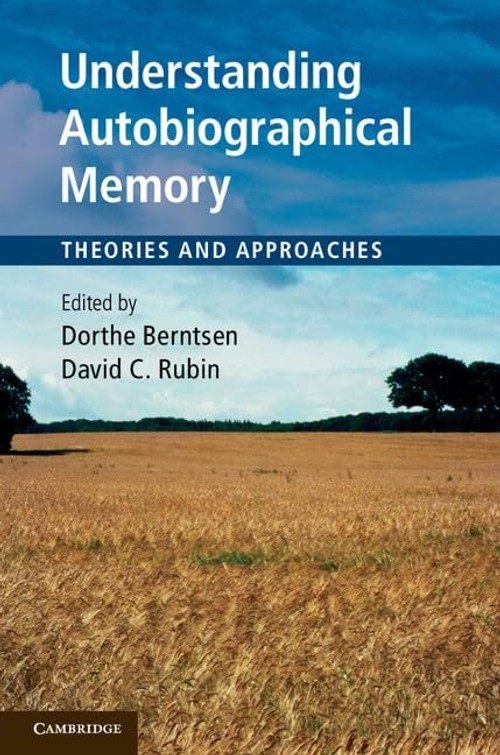
Understanding Autobiographical Memory: Theories and Approaches by Dorthe Berntsen – A Comprehensive Guide to Cognitive a
Inclusive of all applicable taxes. FREE shipping on all orders.
Available Offers
- 🚚Free Delivery — Free shipping on all orders
- 💵Cash on Delivery — Pay when your order arrives
- ↩️15-Day Easy Returns — Hassle-free return policy
- 🔒Cash on Delivery — Pay safely when your order arrives
Check Delivery
Product Description
Introduction
Memory is not merely a repository of facts—it is the living narrative of who we are. Understanding Autobiographical Memory: Theories and Approaches offers a comprehensive and scholarly exploration of how we remember our personal past, why certain memories linger, and how they shape our identity. Edited by the renowned Dorthe Berntsen, this hardcover volume from Cambridge University Press is an indispensable resource for psychology students, researchers, and anyone fascinated by the intricate workings of human memory.
Book Overview
Since the first dedicated collection of papers on autobiographical memory was published in 1986, the field has expanded enormously. This book captures the state of the art, synthesising decades of research into a coherent framework. It brings together leading international scholars who examine autobiographical memory from multiple angles—neural, cognitive, developmental, social, and clinical. The result is a richly layered account that not only reviews existing knowledge but also sets the agenda for future inquiry.
Key Highlights
- Comprehensive coverage: Integrates neural, cognitive, developmental, social, and clinical perspectives in one volume.
- Expert contributors: Features chapters from pioneering researchers who have shaped the field.
- Practical relevance: Explains how autobiographical memory relates to clinical disorders, false memories, and legal contexts.
- Brain-based insights: Links memory processes to brain structures, enriching our understanding of the neural basis of self.
Inside the Book
The book is structured to guide readers from foundational concepts to advanced applications. Early chapters address the basic neural systems underlying autobiographical memory, including the role of the hippocampus and prefrontal cortex. Subsequent sections delve into cognitive structures and retrieval processes, examining how we organise and access personal memories. The developmental trajectory is traced from infancy through childhood, and the decline of memory in ageing is analysed with clarity. Social and cultural dimensions are explored, showing how memory is shaped by family narratives, societal expectations, and cultural frameworks. Finally, the book links autobiographical memory to personality, the self, and clinical disorders such as PTSD and depression.
Key Topics
- Neural correlates of autobiographical memory
- Encoding, storage, and retrieval of personal events
- Development of memory in infancy and childhood
- Memory changes in normal and pathological ageing
- Social and cultural influences on remembering
- Autobiographical memory and the construction of self
- False memories and their implications for legal systems
- Clinical applications in trauma, depression, and amnesia
Reader Benefits
This book empowers readers to understand the science behind everyday remembering. Students will gain a solid grounding in key theories and methodologies. Researchers will find a treasure trove of references and conceptual frameworks. Clinicians will appreciate the practical insights into disorders of memory. For anyone curious about why we remember certain events vividly while others fade, this volume offers clear, evidence-based answers.
Learning Outcomes
- Identify the major theoretical approaches to autobiographical memory.
- Explain the neural mechanisms that support personal memory.
- Describe how autobiographical memory develops across the lifespan.
- Analyse the social and cultural factors that shape memory.
- Evaluate the role of memory in clinical conditions and legal contexts.
- Apply key concepts to real-world scenarios, from therapy to eyewitness testimony.
Who Should Read
Understanding Autobiographical Memory is ideal for advanced undergraduate and postgraduate students in psychology, cognitive science, and neuroscience. It is equally valuable for academic researchers, clinical psychologists, and mental health professionals. Educators teaching courses on memory, cognition, or the self will find it an excellent textbook or supplementary reading. Legal professionals interested in eyewitness memory and false memories will also benefit.
About the Author
Dorthe Berntsen is a professor of psychology at Aarhus University, Denmark, and a leading authority on autobiographical memory. Her research has significantly advanced our understanding of involuntary memories, the reminiscence bump, and the role of memory in mental health. She has published extensively in top-tier journals and edited several influential volumes.
About the Publisher
Cambridge University Press is one of the world's oldest and most prestigious academic publishers. With a history spanning nearly five centuries, it is renowned for its rigorous peer review and commitment to scholarly excellence. This book upholds that tradition, offering a meticulously edited collection that meets the highest standards of academic publishing.
Conclusion
Understanding Autobiographical Memory: Theories and Approaches is an essential addition to any serious library of psychology. It bridges the gap between neural mechanisms and lived experience, providing a deep, nuanced account of how we remember our lives. Whether you are a student embarking on your first study of memory or a seasoned researcher seeking a comprehensive reference, this book will enlighten and inspire. Order your copy from Bookshops.in today and explore the fascinating landscape of personal memory.
Quick Summary
Understanding Autobiographical Memory: Theories and Approaches, edited by Dorthe Berntsen and published by Cambridge University Press, is a definitive academic volume that synthesizes over two decades of research in the field of autobiographical memory. The book brings together eminent scholars to appraise the neural systems underlying memory, cognitive structures and retrieval processes, development from infancy through childhood, changes in aging, and the influence of social and cultural contexts. It also explores the intricate relationship between memory, personality, and the self. This comprehensive work is ideal for postgraduate psychology students, cognitive scientists, neuroscientists, and clinical practitioners seeking a thorough understanding of how personal memories are formed, stored, and recalled. Readers will gain insights into empirical generalizations that have shaped the field and learn about practical applications for clinical settings. By purchasing from Bookshops.in, Indian readers receive an authentic hardcover edition with reliable service, making it a valuable addition to any academic library.
Book Highlights
Book Specifications
| ISBN-13 | 9781107007307 |
| ISBN-10 | 1107007305 |
| Publisher | Cambridge University Press |
| Language | English |
| Dimensions | 16.51 x 2.54 x 24.13 cm |
| Weight | 720 g |
| Country | India |
| Category | Psychology › Cognitive Psychology |
| Genre | Non-fiction |
| Original Language | English |
Frequently Asked Questions
What is autobiographical memory?
Who edited this book?
Is this book suitable for undergraduate students?
What topics are covered in the book?
Does the book include clinical applications?
Is this book a collection of research papers?
Who is the publisher?
What is the language of the book?
Is the book available in paperback?
What is the ISBN?
Can I use this book for my research?
Does the book cover memory in aging?
Why should I buy from Bookshops.in?
Readers Also Search For
Customers Also Bought
Psychology
Koinonia: From Hate, Through Dialogue, to Culture in the Large Group by Patrick B. Demare
Psychology
Mindfulness-Based Interventions for Trauma and Its Consequences (Concise Guides on Trauma Care, 4)

Psychology
Handbook for Teaching Statistics and Research Methods by Mark E. Ware

Psychology
Psychoanalysis and the Nuclear Threat: Clinical and Theoretical Studies
Psychology
Humor and Psyche: Psychoanalytic Perspectives by James W. Barron

Relationships
The Experience and Expression of Uncertainty in Close Relationships by Jennifer A. Theiss
Related Products
View AllPsychology
Mindfulness-Based Interventions for Trauma and Its Consequences (Concise Guides on Trauma Care, 4)
Psychology
Handbook for Teaching Statistics and Research Methods by Mark E. Ware
Psychology
Psychoanalysis and the Nuclear Threat: Clinical and Theoretical Studies
Psychology
Humor and Psyche: Psychoanalytic Perspectives by James W. Barron

Psychology
Proceedings of the First International Conference on Genetic Algorithms and Their Applications
Psychology