
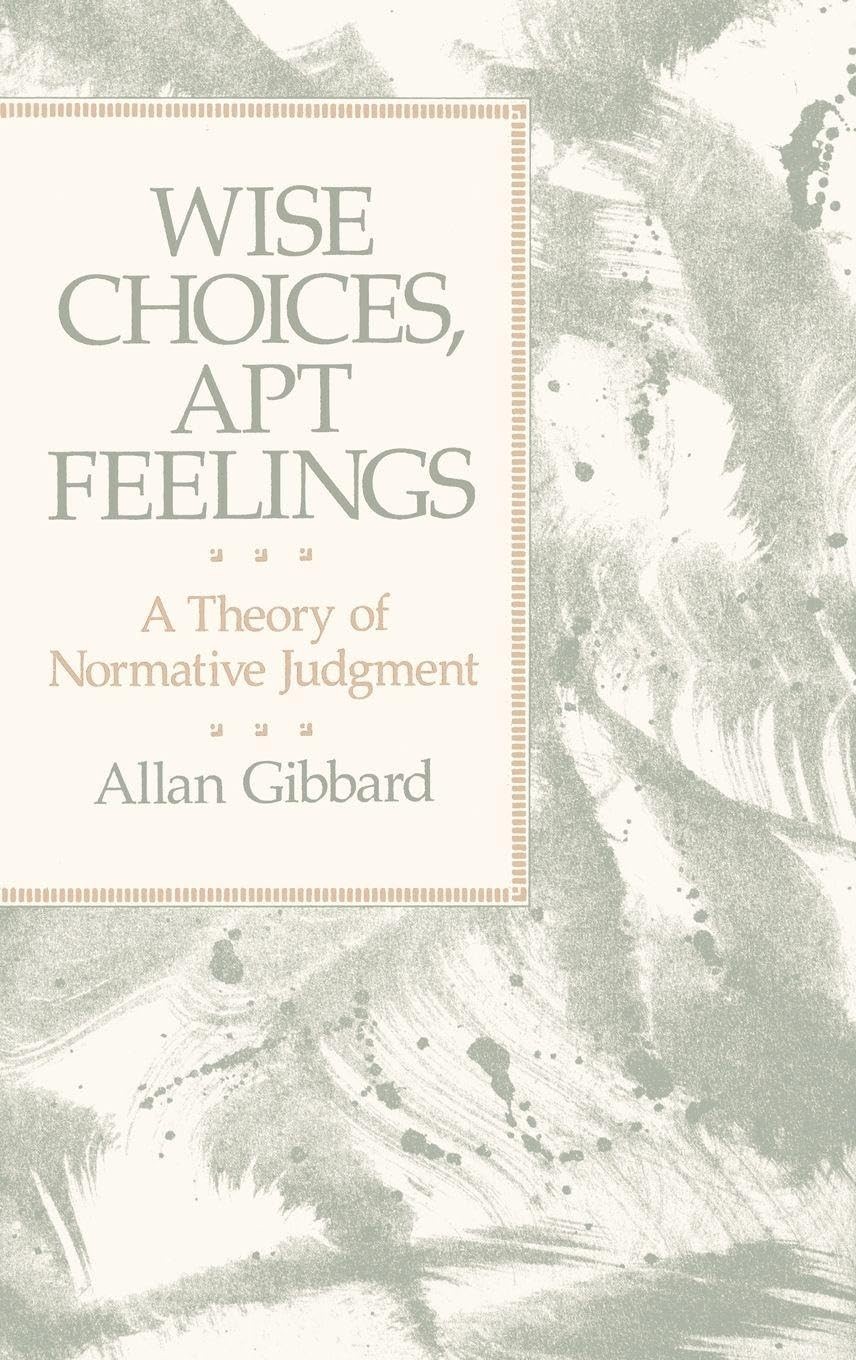
Wise Choices, Apt Feelings: A Theory of Normative Judgment by Allan Gibbard – A Landmark Work in Metaethics and Moral Ph
Inclusive of all applicable taxes. FREE shipping on all orders.
Available Offers
- 🚚Free Delivery — Free shipping on all orders
- 💵Cash on Delivery — Pay when your order arrives
- ↩️15-Day Easy Returns — Hassle-free return policy
- 🔒Cash on Delivery — Pay safely when your order arrives
Check Delivery
Product Description
Introduction
In the vast landscape of moral philosophy and rational decision-making, few works have managed to bridge the gap between abstract theory and everyday human experience as effectively as Wise Choices, Apt Feelings: A Theory of Normative Judgment. Authored by the distinguished philosopher Allan Gibbard, this hardbound volume from OUP Oxford offers a profound exploration of what it means to make wise choices and to experience feelings that are truly apt. For Indian readers and students of philosophy, psychology, and the social sciences, this book is an indispensable guide to understanding the normative judgments that shape our lives—whether in personal dilemmas, professional ethics, or societal debates.
Book Overview
At its core, Wise Choices, Apt Feelings is a systematic and original theory of normative judgment. Gibbard argues that normative judgments—about what is rational, moral, or appropriate—are fundamentally expressions of our attitudes and plans. The book delves into the nature of rationality and morality, proposing that our feelings and choices are not merely subjective but can be evaluated as apt or misguided. This work stands as a landmark in metaethics and the philosophy of mind, offering a fresh perspective that resonates with both Western analytical traditions and Indian philosophical inquiries into the nature of right action and emotional appropriateness.
Key Highlights
- Pioneering Theory: Presents a non-cognitivist, expressivist account of normative language and thought, challenging traditional realist interpretations.
- Interdisciplinary Approach: Integrates insights from philosophy, psychology, and evolutionary biology to explain how normative judgments function in human life.
- Clear and Rigorous: Despite its depth, Gibbard's writing is accessible to advanced undergraduates and graduate students, making complex ideas comprehensible.
- Relevance to Indian Context: The discussion on collective decision-making and moral consensus is particularly valuable for students of Indian ethics, law, and public policy.
- Enduring Influence: Since its publication, this work has shaped debates on moral psychology, rational choice theory, and the philosophy of emotions.
Inside the Book
The book is structured into several parts, each building on the last. Gibbard begins by introducing the concept of normative judgment as a distinct human phenomenon. He then explores the role of planning and decision-making in our lives, arguing that to judge something as rational is to endorse a plan of action. The middle chapters focus on the emotions—particularly guilt, anger, and shame—and how they relate to moral judgments. The final sections address the implications of his theory for understanding moral disagreement, objectivity, and the possibility of a universal ethics. Throughout, Gibbard uses vivid examples and thought experiments to illustrate his points, making the theoretical discussion grounded and engaging.
Key Topics
- Nature of normative judgments and their role in human life
- Expressivism versus realism in metaethics
- The logic of planning and rational decision-making
- Emotions as apt or inapt responses to situations
- Moral responsibility and the concept of guilt
- Evolutionary origins of normative thinking
- Objectivity and disagreement in moral and rational matters
- Connection between individual choices and social norms
Reader Benefits
This book offers Indian readers a chance to deepen their understanding of how we justify our actions and emotions. It equips philosophy students with a robust framework for analyzing moral arguments. For psychology and sociology students, it provides a philosophical foundation for studying human behavior and social norms. Professionals in law, ethics, and public policy will find Gibbard's insights invaluable for grappling with complex normative questions in a pluralistic society. Moreover, the book encourages critical thinking about one's own choices and feelings, promoting a more reflective and thoughtful approach to life.
Learning Outcomes
- Understand the core debates in metaethics and normative theory
- Analyze the structure of normative arguments and judgments
- Evaluate different theories of rationality and morality
- Apply expressivist ideas to real-world ethical dilemmas
- Critically assess the relationship between emotions and moral reasoning
- Develop a nuanced perspective on moral disagreement and cultural diversity
Who Should Read
This book is ideal for undergraduate and postgraduate students of philosophy, especially those specializing in ethics, metaethics, or the philosophy of mind. It is also highly recommended for students of psychology, sociology, and political science who are interested in the foundations of human judgment. Researchers and academics in the social sciences will find it a stimulating resource. Additionally, any thoughtful reader—whether a lawyer, journalist, or engaged citizen—who seeks to understand the rational and emotional bases of their own choices will benefit from this work.
About the Author
Allan Gibbard is a Professor of Philosophy at the University of Michigan, Ann Arbor, and one of the most influential figures in contemporary metaethics. His work spans moral philosophy, philosophy of language, and decision theory. He is known for developing the expressivist theory of normative language, which has reshaped how philosophers think about moral judgments. Gibbard's other major works include Thinking How to Live and Meaning and Normativity, both of which continue his exploration of normative concepts. His writing is characterized by clarity, rigor, and a deep engagement with both historical and contemporary thinkers.
About the Publisher
OUP Oxford (Oxford University Press) is a globally respected academic publisher with a rich history of producing authoritative works in philosophy, science, and the humanities. Known for its commitment to scholarly excellence, OUP brings readers the highest quality research and writing. This hardcover edition is a testament to OUP's dedication to producing durable, elegantly designed books that are built to last—perfect for students and scholars who value a physical library.
Conclusion
Wise Choices, Apt Feelings: A Theory of Normative Judgment is more than a book—it is a journey into the very heart of what it means to be a rational and moral being. For Indian readers seeking a deeper understanding of ethics, decision-making, and the emotions that accompany our choices, this volume offers both intellectual stimulation and practical wisdom. Whether you are a student preparing for exams, a researcher building a theoretical framework, or a curious mind exploring the foundations of human conduct, Allan Gibbard's masterpiece will enrich your perspective and sharpen your judgment. Order your copy today from Bookshops.in and embark on a transformative intellectual adventure.
Quick Summary
Allan Gibbard's 'Wise Choices, Apt Feelings: A Theory of Normative Judgment' is a seminal work in metaethics that systematically develops an expressivist account of normative language and judgment. The book argues that to call a choice wise or a feeling apt is to express one's acceptance of norms that permit or require such responses. Gibbard integrates insights from decision theory, moral psychology, and philosophy of language to build a comprehensive framework for understanding rationality and morality. This hardcover edition, published by OUP Oxford, is an essential resource for philosophy students, researchers, and academics in India who wish to engage deeply with contemporary ethical theory. Readers will gain a nuanced understanding of how norms govern both action and emotion, and how normative discourse shapes our social and personal lives. By purchasing from Bookshops.in, customers receive a genuine, high-quality copy with prompt service across India, making it a trusted choice for scholarly reading.
Book Highlights
Book Specifications
| ISBN-13 | 9780198249856 |
| ISBN-10 | 0198249853 |
| Publisher | Clarendon Press |
| Language | English |
| Dimensions | 15.6 x 2.06 x 23.39 cm |
| Weight | 670 g |
| Country | India |
| Category | Philosophy › Ethics |
| Genre | Philosophy |
| Reading Age | Adult |
| Original Language | English |
Frequently Asked Questions
What is 'Wise Choices, Apt Feelings' about?
Who is the author of this book?
Is this book suitable for beginners in philosophy?
What is the main argument of the book?
How does this book relate to Indian philosophy?
What format is this book available in?
Is the book used in Indian universities?
Does the book cover moral psychology?
Can I use this book for research?
What is the ISBN?
Is the language English?
What is the price in INR?
Why buy from Bookshops.in?
Readers Also Search For
Customers Also Bought

Islam
Spiritual Economies (English, Daromir Rudnyckyj)

Islam
Who Is Allah? (English, Bruce B. Lawrence)
Islam
Islam and Liberal Citizenship: The Search for an Overlapping Consensus by Andrew F. March

Islam
Fiqh Us-Sunnah: Funerals and Diggers by Al-Sayyid Sabiq – Islamic Funeral Guide

Christianity
Genetics (English, Thomas a. Shannon | Mark P. Aulisio | Françoise Baylis)

Hinduism
Karma and Creativity by Christopher Key Chapple – Indian Philosophy
Related Products
View All
Philosophy
Latin American Philosophy: Currents, Issues, Debates by Eduardo Mendieta

Philosophy
Al-Farabi's Short Commentary on Aristotle's Prior Analytics by Nicholas Rescher – Philosophy

Philosophy
Poetics of Imagining: Modern to Post-modern by Richard Kearney

Philosophy
The Metaphysics of Extrinsic Properties: 11 (Metaphysical Research, 11)
Philosophy
Dialogues on Metaphysics and on Religion by Nicolas Malebranche – Philosophy
Philosophy