
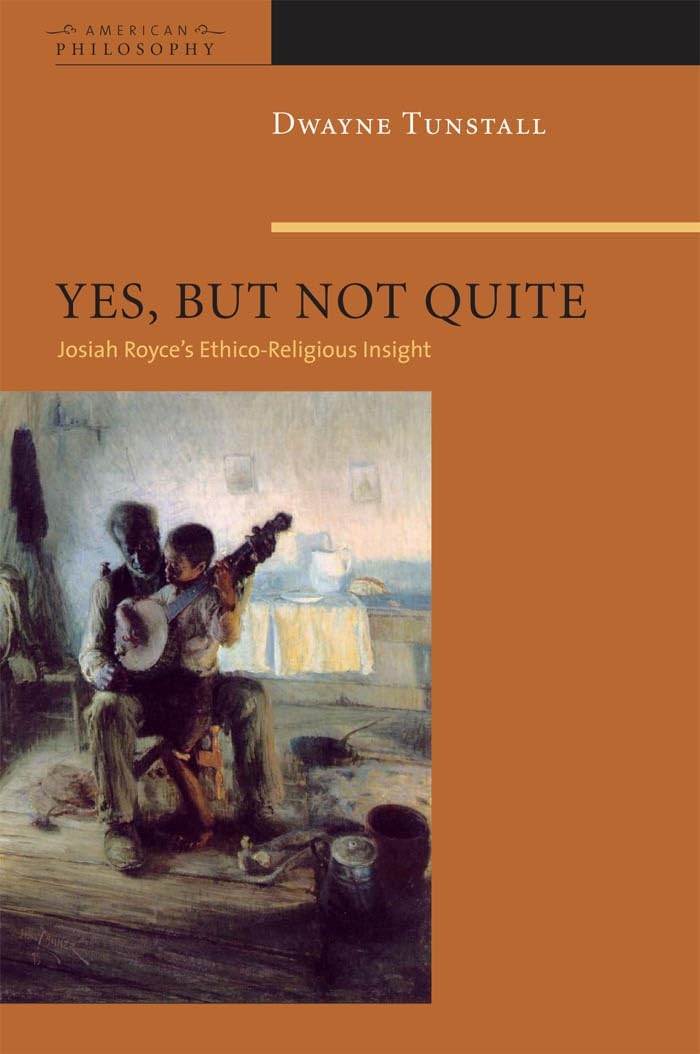
Yes, But Not Quite: Encountering Josiah Royce's Ethico-Religious Insight by Dwayne A. Tunstall – A Scholarly Journey int
Inclusive of all applicable taxes. FREE shipping on all orders.
Available Offers
- 🚚Free Delivery — Free shipping on all orders
- 💵Cash on Delivery — Pay when your order arrives
- ↩️15-Day Easy Returns — Hassle-free return policy
- 🔒Cash on Delivery — Pay safely when your order arrives
Check Delivery
Product Description
Introduction
In the vast landscape of American philosophy, few thinkers have been as misunderstood or as prescient as Josiah Royce. Dwayne A. Tunstall's Yes, But Not Quite: Encountering Josiah Royce's Ethico-Religious Insight offers a compelling re-examination of Royce's idealistic personalism, arguing that his ethico-religious vision remains urgently relevant for our impersonal, technology-driven age. Published by Fordham University Press, this hardcover volume is a must-read for students of philosophy, theology, and ethics across India.
Book Overview
This scholarly work contends that Royce bequeathed to philosophy a novel form of idealism rooted in an ethico-religious insight. Tunstall traces how Royce developed his idealistic personalism in dialogue with critics like George Holmes Howison, ultimately constructing a metaphysics of community that places personal being at the centre of reality. The book argues that Royce's panentheistic personalism—akin to Charles Hartshorne's process philosophy—offers a powerful response to the depersonalising forces of modern intellectual life.
Key Highlights
- Original Interpretation: Presents Royce's philosophy as an ethical, panentheistic personalism that prioritises community and relationality.
- Critical Dialogue: Engages with George Holmes Howison's criticisms to show how Royce refined his metaphysical vision.
- Interdisciplinary Reach: Bridges classical American philosophy with process thought, liberation theology, and continental ethics.
- Contemporary Relevance: Demonstrates how Royce's insights can address modern challenges of alienation and moral fragmentation.
Inside the Book
The volume is divided into two major parts. The first part meticulously reconstructs Royce's response to Howison's personalist objections, showing how Royce developed an ethical theism that affirms both divine immanence and transcendence. The second part delves into Royce's ethico-religious insight itself, exploring how it can be strengthened by incorporating the philosophical theology of Dr. Martin Luther King Jr. and Emmanuel Levinas's ethics of the face. Tunstall argues that King's beloved community and Levinas's infinite responsibility enrich Royce's vision, making it more responsive to social suffering.
Key Topics
- Josiah Royce's idealistic personalism and its metaphysical foundations
- The ethico-religious insight as the core of Royce's philosophy
- Panentheism and process philosophy in dialogue with Royce
- Martin Luther King Jr.'s theology of the beloved community
- Emmanuel Levinas's ethics of alterity and infinite responsibility
- The metaphysics of community for personal beings in an impersonal age
Reader Benefits
By engaging with this book, readers will gain a nuanced understanding of a neglected American philosopher whose ideas anticipate many contemporary concerns. The text offers tools for thinking about ethics, religion, and community in a world increasingly dominated by technology and instrumental reason. Indian readers, in particular, will find resonances with Vedantic and bhakti traditions that emphasise relationality and the primacy of the personal.
Learning Outcomes
- Understand the core arguments of Royce's idealistic personalism and its ethical dimensions
- Analyse the relationship between metaphysics, ethics, and religious experience in Royce's thought
- Critically evaluate how King and Levinas can supplement Royce's ethico-religious insight
- Apply Roycean concepts to contemporary issues of community, justice, and personal identity
- Develop a comparative perspective linking American philosophy with Indian philosophical traditions
Who Should Read
This book is ideal for advanced undergraduate and postgraduate students of philosophy, religious studies, and theology. It will also appeal to scholars working in American philosophy, process thought, personalism, and social ethics. Anyone interested in the intersection of metaphysics, ethics, and community—especially those grappling with the challenges of living meaningfully in a technological age—will find this work deeply rewarding.
About the Author
Dwayne A. Tunstall is a philosopher specialising in American philosophy, personalism, and the philosophy of religion. His scholarship focuses on retrieving and reinterpreting classical American thinkers for contemporary ethical and metaphysical debates. Tunstall's work is known for its clarity, rigour, and commitment to showing how philosophical ideas can illuminate real human concerns.
About the Publisher
Fordham University Press is a prestigious academic publisher based in New York, known for its distinguished list in philosophy, theology, and the humanities. Its publications are recognised worldwide for scholarly excellence and intellectual depth, making it a trusted source for rigorous academic works.
Conclusion
Yes, But Not Quite is not merely an exegesis of a forgotten philosopher; it is a constructive proposal for how we might think about ethics, religion, and community today. Tunstall's careful scholarship and creative synthesis make this book an indispensable resource for anyone seeking a more personal, relational, and ethically engaged philosophy. For Indian readers, it offers a unique bridge between Western idealistic traditions and the perennial questions of self, other, and the divine that have animated Indian thought for millennia.
Quick Summary
Yes, But Not Quite: Encountering Josiah Royce's Ethico-Religious Insight by Dwayne A. Tunstall is a scholarly work that reinterprets Josiah Royce's philosophy as a unique form of idealistic personalism grounded in an ethico-religious insight. The book is divided into two parts: the first traces how Royce developed his personalism in response to criticisms from George Holmes Howison, positioning it as an ethical and panentheistic system akin to Charles Hartshorne's process philosophy. The second part delves into Royce's idealistic metaphysics, focusing on his ethico-religious insight and its implications for a metaphysics of community. Tunstall argues that for Royce, the Real is personal, and community is the most appropriate metaphysical category for personal beings, especially in an impersonal technological age. This book is ideal for graduate students, researchers, and scholars of American philosophy, metaphysics, philosophy of religion, and process thought. Readers will gain a deep understanding of Royce's thought, its critical dialogues, and its relevance to contemporary ethical and metaphysical questions. By purchasing from Bookshops.in, Indian readers receive a premium hardcover edition with fast delivery and authentic stock.
Book Highlights
Book Specifications
| ISBN-13 | 9780823230549 |
| ISBN-10 | 0823230546 |
| Publisher | Fordham Univ Pr |
| Language | English |
| Dimensions | 15.88 x 2.54 x 22.86 cm |
| Weight | 431 g |
| Country | India |
| Category | Religious Studies › Theology & Philosophy of Religion |
| Genre | Non-fiction |
| Reading Age | Adult |
| Original Language | English |
Frequently Asked Questions
What is the main argument of Yes, But Not Quite?
Who is Dwayne A. Tunstall?
Is this book suitable for beginners in philosophy?
How does this book relate to Charles Hartshorne?
What is panentheism?
Does the book cover Royce's entire philosophy?
Why is the book titled Yes, But Not Quite?
What is idealistic personalism?
Is this book relevant to Indian readers?
Does the book discuss Royce's concept of loyalty?
Is the book part of a series?
Can I use this book for a research paper?
Where can I buy this book in India?
Readers Also Search For
Customers Also Bought
Islam
Spiritual Economies (English, Daromir Rudnyckyj)

Islam
Who Is Allah? (English, Bruce B. Lawrence)
Islam
Islam and Liberal Citizenship: The Search for an Overlapping Consensus by Andrew F. March
Islam
Fiqh Us-Sunnah: Funerals and Diggers by Al-Sayyid Sabiq – Islamic Funeral Guide

Christianity
Genetics (English, Thomas a. Shannon | Mark P. Aulisio | Françoise Baylis)

Hinduism
Karma and Creativity by Christopher Key Chapple – Indian Philosophy
Related Products
View All
Religion & Spirituality
Spiritual Competency in Psychotherapy | by Philip Brownell | Springer Publishing Company | by Philip Brownell | Springer Publishing Company | by Philip Brownell | Springer Publishing Company | by Philip Brownell | Springer Publishing Company | by Philip Brownell | Springer Publishing Company | by Philip Brownell | Springer Publishing Company | by Philip Brownell | Springer Publishing Company | by Philip Brownell | Springer Publishing Company | by Philip Brownell | Springer Publishing Company | b
Religion & Spirituality
Religion as a Conversation Starter | by Ina Merdjanova | Continuum | by Ina Merdjanova | Continuum | by Ina Merdjanova | Continuum | by Ina Merdjanova | Continuum | by Ina Merdjanova | Continuum | by Ina Merdjanova | Continuum | by Ina Merdjanova | Continuum | by Ina Merdjanova | Continuum | by Ina Merdjanova | Continuum | by Ina Merdjanova | Continuum | by Ina Merdjanova | Continuum | by Ina Merdjanova | Continuum | by Ina Merdjanova | Continuum | by Ina Merdjanova | Continuum | by Ina Merdjano
Religion & Spirituality
The Other Jewish Question: Identifying the Jew and Making Sense of Modernity
Religion & Spirituality
The Oxford Guide to People & Places of the Bible | by Bruce M. Metzger | Michael D. Coogan | Oxford University Press | by Bruce M. Metzger | Michael D. Coogan | Oxford University Press | by Bruce M. Metzger | Michael D. Coogan | Oxford University Press | by Bruce M. Metzger | Michael D. Coogan | Oxford University Press | by Bruce M. Metzger | Michael D. Coogan | Oxford University Press | by Bruce M. Metzger | Michael D. Coogan | Oxford University Press | by Bruce M. Metzger | Michael D. Coogan |

Religion & Spirituality
Anti-Judaism in Early Christianity | by Stephen G. Wilson | Wilfrid Laurier University Press | by Stephen G. Wilson | Wilfrid Laurier University Press | by Stephen G. Wilson | Wilfrid Laurier University Press | by Stephen G. Wilson | Wilfrid Laurier University Press | by Stephen G. Wilson | Wilfrid Laurier University Press | by Stephen G. Wilson | Wilfrid Laurier University Press | by Stephen G. Wilson | Wilfrid Laurier University Press | by Stephen G. Wilson | Wilfrid Laurier University Press |
Religion & Spirituality