
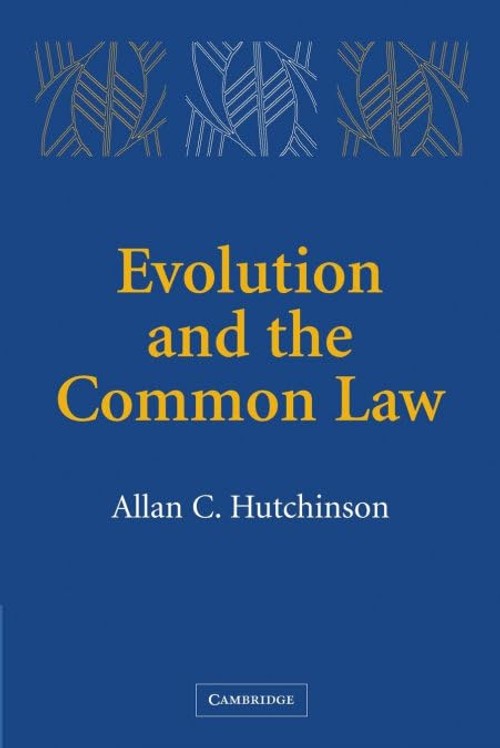
Evolution and the Common Law: A Jurisprudential Analysis of Legal Change by Allan C. Hutchinson
Inclusive of all applicable taxes. FREE shipping on all orders.
Available Offers
- 🚚Free Delivery — Free shipping on all orders
- 💵Cash on Delivery — Pay when your order arrives
- ↩️15-Day Easy Returns — Hassle-free return policy
- 🔒Cash on Delivery — Pay safely when your order arrives
Check Delivery
Product Description
Introduction
In the ever-evolving landscape of legal theory, few works manage to bridge the gap between biological science and jurisprudence with such clarity and depth as Allan C. Hutchinson's Evolution and the Common Law. Published by the prestigious Cambridge University Press, this hardbound volume offers a refreshingly original perspective on how the common law system adapts, grows, and transforms—much like the natural world itself. For Indian law students, legal practitioners, and scholars interested in the philosophical underpinnings of legal change, this book is an indispensable addition to any serious library.
Book Overview
Evolution and the Common Law is not merely a comparative study; it is a bold reimagining of legal development through the lens of evolutionary theory. Allan C. Hutchinson argues that the common law is not a static set of rules but a dynamic, organic system that evolves through a process akin to natural selection. Drawing on concepts from biology, philosophy, and legal history, the author demonstrates how legal principles survive, mutate, and adapt in response to social, economic, and cultural pressures. The book challenges traditional notions of precedent and stability, offering a model of law that is both historically grounded and forward-looking.
Key Highlights
- Original Synthesis: A rare and insightful fusion of Darwinian evolutionary theory with common law jurisprudence.
- Critical Analysis: A deep critique of formalist and positivist approaches to law, advocating for a more fluid and adaptive understanding.
- Global Relevance: While rooted in Anglo-American legal traditions, the arguments are directly applicable to the Indian legal system, especially in areas of constitutional interpretation and judicial precedent.
- Accessible Scholarship: Written in a clear, engaging style that makes complex theoretical ideas understandable for advanced undergraduates and postgraduate students alike.
Inside the Book
The book is structured around a central metaphor: the common law as a living organism. Hutchinson begins by outlining the basic principles of biological evolution—variation, inheritance, and selection—and then maps these onto the development of legal doctrines. He examines landmark cases and historical shifts to illustrate how legal rules compete for survival, how they are inherited through precedent, and how they are selected or discarded by judges and society. The later chapters delve into the implications of this evolutionary model for legal reasoning, judicial discretion, and the very nature of justice. Readers will find detailed discussions on the role of chance, the importance of context, and the limits of predictability in law.
Key Topics
- Darwinian evolution and legal change
- Common law as a complex adaptive system
- The role of precedent and legal mutation
- Judicial creativity versus legal stability
- Law, society, and natural selection
- Critique of legal formalism and originalism
- Evolutionary epistemology in jurisprudence
Reader Benefits
By engaging with this book, readers will develop a deeper appreciation for the dynamic nature of law. It equips law students with a robust theoretical framework to understand why legal doctrines change over time and how judges exercise discretion. For legal professionals, the evolutionary perspective offers practical insights into predicting legal trends and crafting persuasive arguments. Academics will find a rich source of interdisciplinary ideas that challenge conventional boundaries. Moreover, the book encourages critical thinking about the relationship between law and society—a skill essential for any thoughtful citizen or scholar in India's rapidly transforming legal landscape.
Learning Outcomes
- Understand the parallels between biological evolution and common law development.
- Critically evaluate traditional theories of legal precedent and stability.
- Analyze historical and contemporary cases through an evolutionary lens.
- Develop a nuanced perspective on judicial activism and restraint.
- Apply evolutionary concepts to legal reasoning and argumentation.
- Recognize the impact of social and cultural forces on legal change.
Who Should Read
This book is ideally suited for law students (LL.B., LL.M., and PhD candidates) specializing in jurisprudence, legal theory, or constitutional law. It is also highly recommended for practicing lawyers and judges who wish to deepen their understanding of the philosophical foundations of common law. Academics in fields such as political science, sociology, and philosophy of law will find the interdisciplinary approach particularly valuable. Additionally, anyone with a keen interest in how systems evolve—whether legal, biological, or social—will find this book intellectually stimulating.
About the Author
Allan C. Hutchinson is a distinguished legal scholar and professor of law at Osgoode Hall Law School, York University, Canada. He is widely recognized for his pioneering work in critical legal studies, legal theory, and constitutional law. Hutchinson has authored numerous influential books and articles that challenge orthodox legal thinking, and his scholarship often bridges law with philosophy, politics, and science. His ability to make complex ideas accessible has earned him a reputation as one of the most original voices in contemporary jurisprudence.
About the Publisher
Cambridge University Press is one of the world's oldest and most respected academic publishers, with a history dating back to 1534. Known for its rigorous editorial standards and commitment to scholarly excellence, Cambridge publishes works that shape intellectual discourse across disciplines. This book is part of their distinguished law and legal theory catalogue, ensuring that readers receive a work of the highest academic quality and reliability.
Conclusion
Evolution and the Common Law is a thought-provoking and transformative work that redefines how we understand legal change. Allan C. Hutchinson masterfully demonstrates that the common law is not a museum of fixed rules but a vibrant, evolving ecosystem. For Indian readers, this perspective is especially timely as our own legal system navigates the challenges of modernization, globalization, and social transformation. Whether you are a student, a practitioner, or a curious intellectual, this book will change the way you think about law—and perhaps about evolution itself. Add it to your collection today and embark on a journey into the living heart of the common law.
Quick Summary
Evolution and the Common Law by Allan C. Hutchinson is a groundbreaking work that applies evolutionary theory to the development of common law systems. The book argues that law, like living organisms, undergoes a process of variation, selection, and retention. Hutchinson draws on Darwinian concepts to explain how judicial decisions adapt to changing social conditions, how precedent functions as a form of legal inheritance, and how legal systems survive by evolving. This interdisciplinary approach challenges static views of law and offers a dynamic model for understanding legal change. The book is ideal for Indian law students, scholars, and practitioners who want to deepen their understanding of jurisprudence and the common law tradition. It is particularly relevant for those studying comparative legal systems, legal philosophy, or constitutional law. By purchasing from Bookshops.in, readers get a genuine Cambridge University Press hardcover edition delivered to their doorstep across India. The book encourages critical thinking and provides a unique lens through which to view the Indian legal system's evolution.
Book Highlights
Book Specifications
| ISBN-13 | 9780521614917 |
| ISBN-10 | 0521614910 |
| Publisher | Cambridge University Press |
| Language | English |
| Dimensions | 15.24 x 1.75 x 22.86 cm |
| Weight | 215 g |
| Category | Law › Business Law |
| Genre | Non-fiction |
| Original Language | English |
Frequently Asked Questions
What is Evolution and the Common Law about?
Who is the author of this book?
Is this book suitable for Indian law students?
What makes this book different from other legal theory books?
Does this book cover Indian common law?
Is this a hardcover or paperback edition?
Can I use this book for my LLM studies?
Does the book include case studies?
What is the price of this book?
Is this book available in English?
Who should read this book besides law students?
Does this book relate to Indian constitutional law?
Why should I buy this book from Bookshops.in?
Readers Also Search For
Customers Also Bought

Constitutional Law
Indigenous law and the state
Constitutional Law
Great Cases in Constitutional Law (English, Robert P. George)

Constitutional Law
Guilty Pleas in International Criminal Law (English, Nancy Amoury Combs)

Constitutional Law
The Growth of the Law by Benjamin N. Cardozo – Jurisprudence

Constitutional Law
Court of Injustice: Law Without Recognition in U.S. Immigration by J. C. Salyer

Constitutional Law
Youth: Learning Through Cases
Related Products
View All
Business Law
Codification of European Copyright Law: Challenges and Perspectives: 29 (Information Law Series, 29)

Business Law
Multimodal Transport Law: The Law Applicable to the Multimodal Contract for the Carriage of Goods (Aviation Law and Policy Series)

Business Law
Regulating Law by John Braithwaite – Legal Theory Book

Business Law
An Introduction to the Law of Trusts by Simon Gardner – Trusts Law Textbook

Business Law
Civil Procedure and EU Law: A Policy Area Uncovered by Eva Storskrubb

Business Law